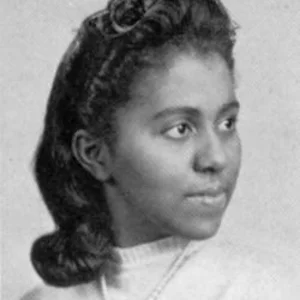

Marie Maynard Daly (1921-2003) was an American biochemist, the first African American woman to earn a doctorate in chemistry in the United States. Her work focused on cholesterol, proteins, and the structure of the cell nucleus.
Marie Maynard Daly(1921 — 2003)
Marie Maynard Daly
États-Unis
6 min read
Frequently asked questions
Key Facts
- Born on April 16, 1921, in Corona, Queens (New York)
- Earned a doctorate in chemistry from Columbia University in 1947, becoming the first African American woman to hold a doctorate in chemistry in the United States
- Conducted research on the link between cholesterol and high blood pressure
- Taught at the Albert Einstein College of Medicine in New York
- Died on October 28, 2003, in New York
Works & Achievements
First African American woman to earn a doctorate in chemistry in the United States; her thesis examined the action of pancreatic amylase on starch.
Work with Alfred Mirsky at the Rockefeller Institute on the protein composition of the nucleus, contributing to the understanding of how DNA is organized.
With Quentin Deming, she linked cholesterol, high blood pressure, and the clogging of arteries, shedding light on the causes of heart disease.
She studied the impact of cigarettes on the respiratory system, at a time when these dangers were only beginning to be documented.
She trained generations of students in biochemistry and medicine, while campaigning for greater access to the sciences for minorities.
A fund created in memory of her father to support African American students in chemistry and physics.
Anecdotes
Marie's father, Ivan Daly, had begun studying chemistry at **Cornell University**, but had to give it up for lack of money. His daughter took up the torch and fulfilled her father's dream: becoming a chemist. In **1988**, she created a scholarship at **Queens College** in his memory, intended for African American students in the sciences.
In **1947**, **Marie Maynard Daly** became the first African American woman to earn a doctorate in chemistry in the United States, awarded by **Columbia University**. At the time, very few women, and even fewer Black women, gained access to American university laboratories.
In the early 1950s, Marie worked with the biochemist **Alfred Mirsky** at the **Rockefeller Institute** on histones, the proteins around which DNA coils inside the nucleus of our cells. Her research helped to better understand how genetic information is organized and read.
With the physician **Quentin Deming**, Marie studied the link between cholesterol, high blood pressure, and the clogging of arteries. Their work was among the first to shed light on the causes of heart disease, a field of research still young at the time.
Marie Maynard Daly also worked to open the doors of science and medical schools to students from minority backgrounds. From her own father's story, she knew how deeply a lack of resources could shatter a scientific calling.
Primary Sources
Marie M. Daly's doctoral thesis on the products formed by the action of pancreatic amylase on corn starch, supervised by the chemist Mary Letitia Caldwell.
A scientific paper analyzing the amino acid composition and properties of histones, the proteins associated with DNA in the cell nucleus.
Experimental research on protein synthesis in the pancreas and the role of nucleoproteins, carried out at the Rockefeller Institute.
Clinical and biochemical studies on the relationships between diet, cholesterol, blood pressure, and arterial blockage.
Key Places
New York neighborhood where Marie Maynard Daly was born in 1921 and grew up in a family that valued education.
University where Marie earned her chemistry degree in 1942; she later established a scholarship there in memory of her father.
University where she earned her chemistry doctorate in 1947, becoming the first African American woman to do so in the United States.
Research center where she worked with Alfred Mirsky on histones and the structure of the cell nucleus.
Medical school where she taught and continued her research on cholesterol and hypertension starting in 1960.
Institution where Marie earned her master's degree in chemistry in 1943, before her doctorate.
Typical Objects

A device that spins at very high speed to separate the components of cells, such as proteins and nuclei. Marie Daly used it to isolate histones and other molecules.

An instrument that measures how much light a solution absorbs, used to quantify proteins and chemical compounds. An essential tool in 20th-century biochemistry labs.

A device used to separate the components of a mixture, in particular the amino acids in proteins. Marie Daly used it to analyze the composition of histones.

A small glass instrument used to draw up and precisely measure liquids. An everyday gesture for any biochemist in the lab.

A magnifying optical instrument used to observe cells and their nuclei. Indispensable to research on cell structure.

A notebook in which the researcher recorded her protocols, measurements, and results day after day. The written memory and proof of scientific experimentation.
School Curriculum
Vocabulary & Tags
Key Vocabulary
Tags
Daily Life
Morning
Marie often started her day early, heading to the laboratory to prepare her experiments. She checked her cultures and reagents and launched the first separations in the ultracentrifuge.
Afternoon
The afternoon was devoted to analyses: spectrophotometer assays, chromatography, and meticulous measurements recorded in her lab notebook. She also discussed results with her fellow researchers.
Evening
In the evening, she read scientific papers, wrote her own publications, and prepared her lectures. She also dedicated time to mentoring young students, particularly those from minority backgrounds.
Food
Like many Americans in twentieth-century cities, her diet combined fresh produce and canned goods. In an irony of her own research, she studied precisely the effects of cholesterol and fats on health.
Clothing
In the laboratory, she wore the white coat of chemists over plain, professional attire, in keeping with the understated elegance expected of academics of the time.
Housing
She lived in New York, first in Queens where she had grown up, then near her workplaces in Manhattan and the Bronx, in urban apartments typical of the city.
Historical Timeline
Period Vocabulary
Liens externes & ressources
Références
Œuvres
Doctorat de chimie à l'université Columbia
1947
Recherches sur les histones et le noyau cellulaire
1950-1955
Études sur le cholestérol et l'athérosclérose
années 1960
Recherches sur les effets du tabac sur les poumons
années 1960-1970
Enseignement à l'Albert Einstein College of Medicine
1960-1986
Bourse Ivan C. Daly à Queens College
1988