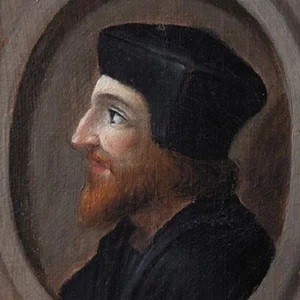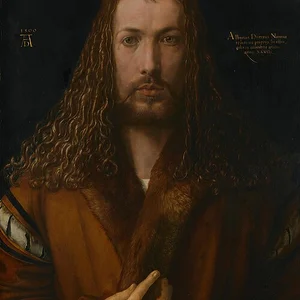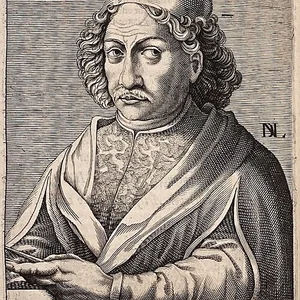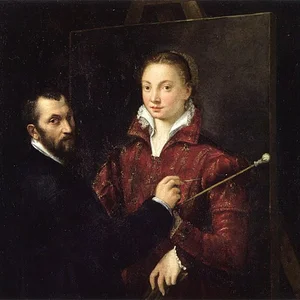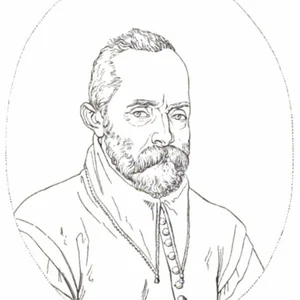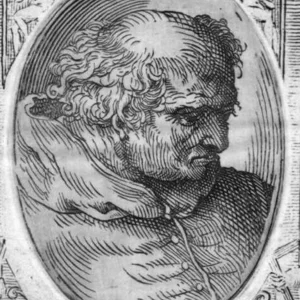

Painter or artist of the Italian Renaissance whose biographical details remain poorly documented. His name suggests an artist active in Italian artistic circles of the 15th–16th centuries.
Mario Augusta
Mario Augusta
7 min read
Frequently asked questions
Key Facts
- Active during the Italian Renaissance period (15th–16th century)
- Belongs to the artistic movement of the Renaissance, characterized by perspective and humanism
Works & Achievements
A painter active in Italian artistic circles of the 15th–16th centuries would very likely have produced votive panels intended for private chapels or religious confraternities, a genre highly prevalent in Renaissance Italy.
Ecclesiastical commissions were the primary source of income for Italian painters of this period; a Renaissance artist would have participated in the decoration of one or more local churches, producing altarpieces or narrative frescoes.
Individual portraiture experienced unprecedented growth in the Italian Renaissance under Flemish influence and the rediscovery of ancient medallions; a painter of this era would necessarily have produced such works for his patrons.
Anecdotes
Like most painters of the Italian Renaissance, Mario Augusta most likely began his career as an apprentice in a *bottega*, a workshop run by a recognized master. Young painters spent years grinding pigments and preparing plaster before being allowed to put brush to a real work. This transmission of craft from master to pupil was the living heart of Italian artistic creation.
In Mario Augusta's time, Italian painters were engaged in a genuine visual revolution: they sought to represent space in three dimensions through linear perspective, codified by Brunelleschi and Alberti. Mastering this mathematical technique had become an essential requirement for securing major commissions. A painter who could not construct perspectival space risked losing clients to more modern competitors.
Artists of the Italian Renaissance depended closely on their patrons — the Church, great noble families, or merchant guilds. A painter of this era would have negotiated precise contracts, the *commissioni*, stipulating which colors to use (gold and lapis lazuli, imported from Afghanistan, were more valuable than gold), deadlines, and the subjects to be depicted. These documents allow us today to reconstruct the life of workshops.
Like many minor artists of the Renaissance, Mario Augusta's trace in the archives is faint: a mention in a guild register, an ecclesiastical commission, perhaps a votive panel preserved in a local church. These discreet fragments make up the biography of hundreds of forgotten artists from this prolific period, whose works still adorn provincial chapels that art historians are gradually rediscovering.
Primary Sources
The painter must above all master geometry. Lines and angles are the foundations by which the hand can reproduce what the eye perceives in nature, and without this knowledge, no one can claim the dignity of the craft.
In those times so fertile in genius, Tuscany and Rome saw so many artists come forth that their names cannot all be recorded, for their number far exceeded the fame any single one of them managed to win.
If you wish to attain perfection in art, enter the workshop of a skilled master as early as you can and remain there as long as possible, for it is there that the true craft of painting is learned.
The divine proportion, which the ancients called the golden section, is the hidden principle that governs the beauty of forms, and every artist worthy of the name must know it and apply it in his compositions.
Key Places
Cradle of the Italian Renaissance and artistic capital of Europe in the 15th century. Under the patronage of the Medici, the city attracted the greatest artists and humanist thinkers of the peninsula.
Under popes Julius II and Leo X, Rome became in the early 16th century the most ambitious artistic construction site in Europe, drawing Michelangelo, Raphael, and many Italian artists in search of glory and commissions.
Florence's great artistic rival, Venice developed a distinctive school of painting characterized by richness of color and the early adoption of canvas as a pictorial support.
Artistic capital of northern Italy, Milan welcomed Leonardo da Vinci at the Sforza court and served as an important center for aristocratic and ecclesiastical commissions.
Typical Objects

A wooden board held in hand on which the painter arranges and mixes pigments. During the Renaissance, it held colors ground from minerals, plants, or exotic insects.

Colored powders extracted from minerals or plants, bound with egg or oil to form paint. Lapis lazuli, imported from Afghanistan, was more precious than gold and reserved for the wealthiest patrons.

A large drawing on thick paper used to finalize the composition before transferring it to a panel or fresco by pricking or tracing. Michelangelo and Leonardo created cartoons of exceptional artistic quality.

The traditional support for Italian painting before canvas became widespread. The wood was coated with several layers of gesso (plaster and glue) to create a smooth, white surface.

Geometric instruments essential for drawing the vanishing lines of linear perspective, codified in the 15th century. Any serious Renaissance painter had to master geometry to be taken seriously.

A notebook of paper or parchment in which the painter recorded studies from nature, anatomical observations, and composition ideas. Leonardo da Vinci's notebooks are the most celebrated examples of this fundamental tool.
School Curriculum
Vocabulary & Tags
Key Vocabulary
Daily Life
Morning
The Renaissance painter rises early, making the most of the natural light essential to his work. The day begins with the preparation of colors — grinding pigments, mixing binders — a task typically assigned to apprentices under the master's supervision. The first hours are devoted to the most delicate work, when the eye is fresh and the light at its best.
Afternoon
The afternoon is given over to painting proper: applying ground layers, working on flesh tones, laying in architectural backgrounds. In a busy *bottega*, several paintings progress at the same time. The master steps in for the difficult passages — faces, hands — while the apprentices handle the backgrounds and large expanses of drapery.
Evening
Evenings may be spent drawing from life or studying antique sculpture, if the painter has access to a collection. More learned artists read Alberti or Vitruvius by candlelight. Gatherings at academies or friends' homes provide the chance to exchange views on art theory and new techniques arriving from Flanders or Rome.
Food
The diet of an urban Italian Renaissance artist centers on bread, vegetables, legumes, and wine diluted with water. Meat is a luxury reserved for feast days or meals at a patron's table. Olive oil, cheese, and aromatic herbs are ever-present in Tuscan and Paduan cooking.
Clothing
In the workshop the painter wears simple, practical clothes — a linen shirt, hose, a wool doublet — often stained with colored pigments. When visiting patrons or attending public events, he puts on a more presentable outfit, a mark of social respectability in a city where appearance signals status.
Housing
The *bottega* serves at once as workshop, living quarters, and training ground. The master and his apprentices often share a roof in a building near the city center. The rooms are simply furnished: a large worktable, shelves for pigments and tools, canvases in progress. Natural light is precious, and the windows — north-facing for a steady light — are wide.
Historical Timeline
Period Vocabulary
Liens externes & ressources
Références
Œuvres
Panneau votif (attribution hypothétique)
v. 1490-1520
Portrait de commanditaire (attribution hypothétique)
v. 1500-1525