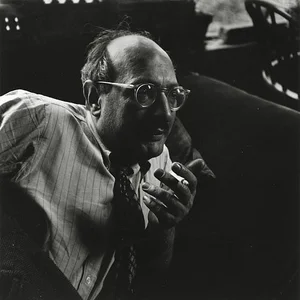

Mark Rothko was an American painter of Latvian origin and a major figure of Abstract Expressionism. He is famous for his vast canvases composed of floating rectangles of color, intended to evoke an emotional and spiritual experience in the viewer.
Mark Rothko(1903 — 1970)
Mark Rothko
États-Unis
5 min read
Frequently asked questions
Key Facts
- Born in 1903 in Dvinsk (Russian Empire, present-day Latvia), he emigrated to the United States with his family in 1913
- During the 1940s and 1950s, he developed his mature style of the “multiforms” and then of rectangular color fields
- In the 1960s he carried out the commission for the Rothko Chapel in Houston, inaugurated in 1971
- In 1958–1959 he refused to deliver the murals commissioned for the Four Seasons restaurant in New York
- He took his own life in 1970 in New York
Works & Achievements
Transitional canvases where floating masses of color foreshadow his mature style. A key step toward abandoning all figuration.
An iconic color-field work, with its stacked rectangles and vibrating edges. Held at the MOCA in Los Angeles.
A canvas of warm colors sold at auction in 2012 for a record price for the artist. An example of his most luminous period.
A set of dark murals commissioned for the Four Seasons restaurant, ultimately rejected and donated to the Tate Gallery.
Fourteen canvases in black and purple tones designed for a place of meditation in Houston. Regarded as his spiritual testament.
Canvases in deep, architectural tones evoking doors or walled-up windows. They mark a turn toward graver works.
Anecdotes
Born Markus Rothkowitz in Daugavpils, Latvia, he emigrated to the United States at the age of ten without speaking a word of English. A brilliant student, he earned a scholarship to Yale, but left the university without a degree, disillusioned by its elitist and antisemitic atmosphere.
Rothko refused to have his paintings called “abstract” or reduced to mere rectangles of color. He insisted that he painted fundamental human emotions — tragedy, ecstasy, doom — and was delighted when visitors wept in front of his canvases.
In 1958, he accepted a prestigious commission for murals for the luxurious Four Seasons restaurant in New York. After dining at the establishment, sickened by its opulence, he returned the money and kept the canvases, which he would later donate to the Tate Gallery in London.
To exhibit his works, Rothko demanded dim lighting and that the canvases be hung very low, almost at floor level, so that the viewer would feel enveloped by the color. He wanted people to look at his paintings from very close up, about 45 centimeters away.
After his death in 1970, his executors sold off hundreds of his works to the Marlborough gallery at absurdly low prices. The sensational lawsuit that followed, won by his daughter Kate, became a landmark case in art law.
Primary Sources
I think of my pictures as dramas; the shapes in the pictures are the performers.
We assert that the subject is crucial and only that subject matter is valid which is tragic and timeless.
Art is an adventure into an unknown world, which can be explored only by those willing to take the risks.
A picture lives by companionship, expanding and quickening in the eyes of the sensitive observer. It dies by the same token.
Key Places
Rothko's birthplace, then part of the Russian Empire, where he spent his childhood in a Jewish family before emigrating.
The city where the Rothkowitz family settled upon arriving in the United States and where young Mark attended school.
The center of Rothko's artistic life, where he developed abstract expressionism and set up his studio.
An ecumenical place of meditation housing fourteen dark canvases designed by the artist, inaugurated in 1971.
The university where Rothko studied briefly on a scholarship before dropping out.
Typical Objects

Rothko applied his layers of diluted color with large brushes to create soft, vibrant edges. The brushstroke remained deliberately visible and atmospheric.

He mixed his own pigments with binders (egg, glue, resin) to obtain translucent, layered coats. This technique gives the impression that the color emanates from within the canvas.

Rothko painted on monumental formats, sometimes over two meters, to envelop the viewer. The size was an integral part of the intended emotional experience.

For his giant formats, Rothko used large wooden stretcher frames and ladders to reach the top of his canvases. His studio was organized to accommodate these oversized works.

A heavy smoker, Rothko painted with a cigarette in hand and his studio was steeped in smoke. His fragile health, worsened by tobacco and alcohol, marked his final years.
School Curriculum
Vocabulary & Tags
Key Vocabulary
Tags
Daily Life
Morning
Rothko often started his day late, reading, listening to the classical music or opera he adored. He would then head to his New York studio, his true home.
Afternoon
A large part of the afternoon was spent observing his canvases in silence, sitting for long hours before laying down a single stroke. Painting, for him, was a slow and deeply considered act.
Evening
In the evening, Rothko frequented the cafés and bars of New York with other painters such as Barnett Newman or Clyfford Still, putting the art world to rights. These heated discussions fed his thinking.
Food
His declining health forced him toward the end to follow a diet, but he drank heavily and smoked relentlessly. Alcohol and tobacco weighed heavily on his final years.
Clothing
Rothko dressed simply, like a New York intellectual of the 1950s and 1960s: shirt, jacket, and thick-framed glasses. He cultivated the look of a thinker rather than a dandy.
Housing
He lived in apartments and studios in Manhattan, transforming his workplaces into dark, controlled spaces to better master the light falling on his works.
Historical Timeline
Period Vocabulary
Liens externes & ressources
Références
Œuvres
Multiforms (série)
vers 1948-1949
No. 61 (Rust and Blue)
1953
Orange, Red, Yellow
1961
Fresques de la Rothko Chapel
1964-1967
Black on Maroon / Red on Maroon (série Seagram)
1958-1959