 flip
flipFish Laulau with Taro Leaves
Fish Laulau with Taro Leaves
Why this dish? During the large gatherings where the genealogies she studied were chanted, Beckwith saw the imu, the earth oven, opened, from which steaming bundles emerged. This festive dish embodies the moment when the ethnographer stops observing and sits down among the guests.
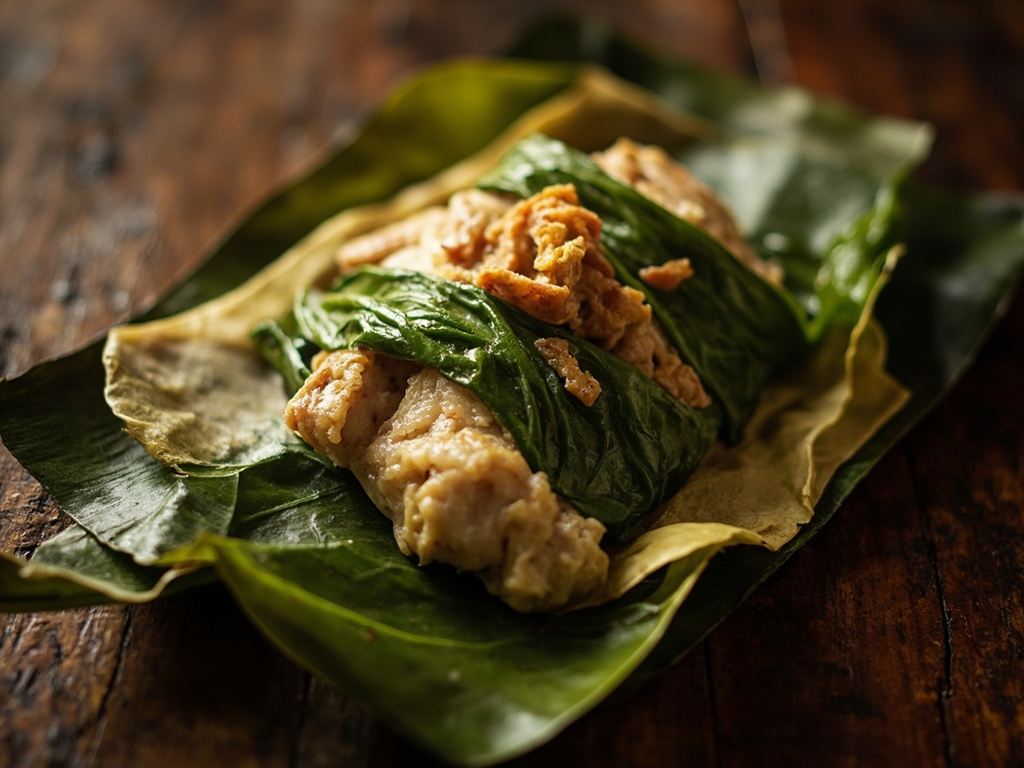
A fatty fish and a bit of pork fat, salted, wrapped in tender taro leaves then a ti leaf, tied, and steamed until everything melts. Cooked taro leaves take on a deep spinach-like flavor; the fish becomes silky.
For feast days, let me show you the laulau. One chooses a fine fatty fish, salts it with coarse sea salt, wraps it in young taro leaves — never raw, beware, always well cooked — then closes it all in a ti leaf, tied like a gift. I have seen the men open the imu, that oven dug into the earth and loaded with hot stones, and the steam that rose smelled of sea and forest mingled. Believe me, old chants are never told so well as with a belly full of laulau.
- •Fatty fish (tuna, amberjack) — one portion per guest (heart of the bundle)
- •Pork fat — one piece (tenderness and richness)
- •Young taro leaves (lū'au) — a handful per bundle (edible wrap)
- •Ti leaves — 1 to 2 per bundle (cooking wrapper)
- •Sea salt (pa'akai) — to taste (seasoning)
Fish Laulau with Taro Leaves
A fatty fish and a bit of pork fat, salted, wrapped in tender taro leaves then a ti leaf, tied, and steamed until everything melts. Cooked taro leaves take on a deep spinach-like flavor; the fish becomes silky.
Why this dish? During the large gatherings where the genealogies she studied were chanted, Beckwith saw the imu, the earth oven, opened, from which steaming bundles emerged. This festive dish embodies the moment when the ethnographer stops observing and sits down among the guests.
For feast days, let me show you the laulau. One chooses a fine fatty fish, salts it with coarse sea salt, wraps it in young taro leaves — never raw, beware, always well cooked — then closes it all in a ti leaf, tied like a gift. I have seen the men open the imu, that oven dug into the earth and loaded with hot stones, and the steam that rose smelled of sea and forest mingled. Believe me, old chants are never told so well as with a belly full of laulau.
Ingredients (period version)
- Fatty fish (tuna, amberjack) — one portion per guest (heart of the bundle)
- Pork fat — one piece (tenderness and richness)
- Young taro leaves (lū'au) — a handful per bundle (edible wrap)
- Ti leaves — 1 to 2 per bundle (cooking wrapper)
- Sea salt (pa'akai) — to taste (seasoning)
Ingredients
- Tuna or salmon fillet — 4 × 120 g (heart of the bundle)
- Pork belly — 150 g, sliced thin (tenderness and richness)
- Young spinach or Swiss chard leaves — 300 g (replaces taro leaves)
- Parchment paper + aluminum foil — 4 squares (replaces ti leaf)
- Sea salt — 2 tsp (seasoning)
Method
- Salt the fish and pork. Wash and stem the green leaves.
- In the center of a bed of leaves, place a fish fillet and a few slices of pork; salt.
- Fold the leaves around, then wrap tightly in parchment and foil to form a sealed packet.
- Steam (or bake at 160 °C in a covered dish with a little water at the bottom) for 1 hour 30 minutes to 2 hours: the leaves must be completely melted and the fish confit.
- Open the packet at the table, in the fragrant steam, and serve with poi.
How it was made : The imu was dug in the morning: volcanic stones were heated red-hot, covered with banana and ti leaves, the laulau and other foods were placed inside, then covered with earth. The slow, steam-trapped cooking could last half a day and fed the entire community.
The contemporary twist : Present the closed packet on the plate and let each guest open it themselves: the cloud of fragrant steam is the whole imu invited to the table.
Sources : Martha Warren Beckwith, Hawaiian Mythology, 1940 · Margaret Titcomb, Native Use of Fish in Hawaii
Martha Beckwith · Charactorium