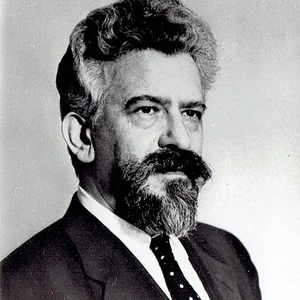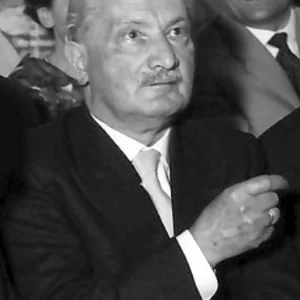

German philosopher, a major figure of phenomenology and existentialism. His masterwork, *Being and Time* (1927), reframes the question of being (ontology). His thought profoundly shaped twentieth-century philosophy, despite the lasting controversy over his commitment to Nazism.
Martin Heidegger(1889 — 1976)
Martin Heidegger
Allemagne, Troisième Reich, république de Weimar, Allemagne de l'Ouest
5 min read
Frequently asked questions
Key Facts
- Born in 1889 in Messkirch (Germany) and died in 1976
- Publishes *Sein und Zeit* (*Being and Time*) in 1927, his fundamental work on the question of being
- Student and assistant of Edmund Husserl, the founder of phenomenology
- Rector of the University of Freiburg in 1933 and a member of the Nazi party, a commitment that has sparked lasting controversy
- Develops the concepts of Dasein (being-there) and being-in-the-world, influencing Sartre and existentialism
Works & Achievements
His masterwork, which raises anew the question of being starting from human existence (the *Dasein*); one of the most influential books of the 20th century.
Inaugural lecture at Freiburg that probes the “nothing” and the nature of metaphysics.
A bold rereading of **Kant**'s *Critique of Pure Reason* in light of his own thinking of being.
A major postwar text in which he distances himself from **Sartre**'s existentialism and develops his thinking about language.
A collection of essays on art, technology, and truth, including the famous text on “The Origin of the Work of Art.”
An influential lecture analyzing the essence of modern technology as an “enframing” (*Gestell*) of the world.
Late reflections on language, which he regarded as “the house of being.”
Anecdotes
Heidegger spent much of his life in a small wooden cabin at Todtnauberg, in the Black Forest. It was in this austere retreat, without modern comforts, that he wrote some of his major works, convinced that thought needed the silence of the mountains.
In 1933, shortly after Hitler came to power, Heidegger became rector of the University of Freiburg and joined the Nazi party. His enthusiastic rectoral address remains one of the most debated stains on his biography: an immense philosopher compromised with a criminal regime.
As a young man, Heidegger intended to become a Catholic priest and entered the Jesuit seminary. Heart problems forced him to leave, and he then turned to philosophy, without ever ceasing to ponder the religious question.
His relationship with his student Hannah Arendt, the future great Jewish philosopher who had to flee Nazism, was intense and then shattered by History. Decades later, they renewed their dialogue, a troubling symbol of the contradictions of the age.
Heidegger coined strange German words and new ways of writing (such as crossing out the word “being”) to force his readers to rethink a worn-out vocabulary. His translators still tear their hair out over terms like “Dasein” or “Gestell.”
Primary Sources
We call Dasein this being that we ourselves are in each case and that has, among other things, the possibility of questioning as a way of being.
Taking on the rectorship is the commitment to spiritually lead this institution of higher learning.
Language is the house of being. In its shelter dwells the human being.
Philosophy will not be able to bring about any immediate change in the present state of the world.
Key Places
Small town in Baden where Heidegger was born in 1889 and where he is buried; his father was the sexton of the church there.
University where he studied, became Husserl's assistant, then a professor and rector in 1933.
Village in the Black Forest where his cabin stood, a place of retreat and writing facing the mountains.
Where he taught from 1923 to 1928 and prepared *Being and Time*; it was there that he met Hannah Arendt.
Typical Objects

A small wooden cabin in the Black Forest where Heidegger would withdraw to think and write, far from university life.

The founding text of his thought, written by hand and then published in 1927 in Husserl's Yearbook.

Heidegger wrote by hand, attached to the slow gesture of writing, which he considered closer to thought than the typewriter.

Traditional costume of the Baden region that he liked to wear, displaying his attachment to his native land and to peasant life.

Heidegger skied on the slopes of the Black Forest around his hut; skiing was part of his physical relationship with the mountains.
School Curriculum
Vocabulary & Tags
Key Vocabulary
Daily Life
Morning
When he stayed at Todtnauberg, Heidegger rose early in the silence of the mountains. The morning was devoted to focused writing, pen in hand, in the main room of the chalet.
Afternoon
In the afternoon, he liked to walk the trails of the Black Forest or chop wood, convinced that physical work and contact with nature nourished thought. During teaching terms in Freiburg, he gave lectures and seminars at the university.
Evening
The evening sometimes brought a few students or colleagues together for philosophical conversation. In the countryside, the evening was often spent near the stove, by lamplight.
Food
His life at the chalet was frugal, close to that of the region's peasants: bread, soups, and simple products of the Black Forest. He embraced this sobriety as a way of life in keeping with his thought.
Clothing
Heidegger favored clothing of peasant and regional inspiration, sometimes a traditional Alemannic costume, which displayed his rootedness in his native Baden rather than any urban elegance.
Housing
He divided his life between a family home in Freiburg and his famous wooden chalet at Todtnauberg, a rustic refuge with few comforts, which he considered the true place of his work.
Historical Timeline
Period Vocabulary
Liens externes & ressources
Références
Œuvres
Être et Temps (Sein und Zeit)
1927
Qu'est-ce que la métaphysique ?
1929
Kant et le problème de la métaphysique
1929
Lettre sur l'humanisme
1946
Chemins qui ne mènent nulle part (Holzwege)
1950
La question de la technique
1954
Acheminement vers la parole
1959