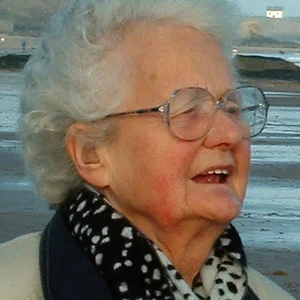

Mary Midgley (1919-2018) was a British moral philosopher, known for her work in animal ethics and her critique of scientific reductionism. She defends a vision of the human being as a moral animal rooted in nature.
Mary Midgley(1919 — 2018)
Mary Midgley
Royaume-Uni
6 min read
Frequently asked questions
Key Facts
- Born in 1919 in London, she studied philosophy at Oxford during the Second World War
- Published her first book, *Beast and Man* (1978), at nearly 60 years old, a foundational work in her reflection on human and animal nature
- A fierce critic of Richard Dawkins's “selfish gene” and of scientific reductionism
- A major figure in animal ethics and 20th-century moral philosophy
- Died in 2018 at the age of 99, intellectually active until the end
Works & Achievements
Her first book, which situates the human being as one animal among others and grounds her thinking about human nature and ethics.
A major work of animal ethics questioning the moral boundary between humans and other animals.
An essay on the nature of moral evil, which she refuses to explain through an external force and instead ties to ordinary human tendencies.
A critique of the use of the theory of evolution as an all-encompassing belief system.
A denunciation of scientism, that is, of science turned into a quest for salvation or a substitute religion.
A reflection on human freedom and moral responsibility in the light of evolution.
An analysis of the role of metaphors and images (such as the “machine” or the “selfish gene”) in scientific thought.
An autobiography retracing her life, her studies at Oxford, and her late vocation as a writer.
Anecdotes
Mary Midgley published her very first book, Beast and Man, at the age of only 59. She said she had written no book before then because, in her view, she did not yet have anything truly clear to say. She went on to become one of Britain's most prolific philosophers, writing well past the age of 90.
A student at Oxford during the Second World War, she was part of a remarkable circle of four young women philosophers — alongside Elizabeth Anscombe, Philippa Foot and the novelist Iris Murdoch. She explained that the departure of many male students for the front had left women an unusual space to think and debate freely.
In 1979, she took on Richard Dawkins and his book The Selfish Gene head-on, in an article with the scathing title “Gene-Juggling.” She accused him of turning biology into a moral fable and of attributing intentions to genes. This debate, at times very heated, lasted for decades.
Mary Midgley was wary of grand theories that claim to explain everything. She often compared ideas and concepts to tools: in her view, one must know which tool suits which task, rather than believing that a single hammer will solve every problem.
Her entire teaching career took place at the University of Newcastle, far from the prestige of Oxford or Cambridge. She saw an advantage in this: being away from intellectual fashions allowed her, she said, to think more freely and keep her feet on the ground.
Primary Sources
We are not fallen angels, but evolved primates. Understanding our animal nature is not about demeaning humankind, but about situating it honestly within nature.
To speak of “selfish” genes is to mistake a metaphor for an explanation. Genes can no more be selfish than they can be stupid or ambitious.
The boundary we draw around the human species to decide who deserves moral consideration is far less clear-cut than is often claimed.
I wrote no book until I was nearly sixty, and I am glad I waited, because before that I do not think I had anything clear to say.
Key Places
Birthplace of Mary Scrutton in 1919, into a family connected to the Church of England.
College where she studied classics and philosophy during the war, alongside other future great women philosophers.
Institution where she taught philosophy from the 1960s onward and which remained the centre of her intellectual life.
City in north-east England where she lived most of her life, wrote her work, and died in 2018.
Typical Objects

The philosopher's working tool, on which she drafted her essays before the computer age. She wrote the bulk of her work after the age of 60, at a steady pace.

A medium for spreading her ideas, aimed as much at the general public as at academics. Midgley championed a clear and accessible philosophy.

A scholarly periodical such as the journal Philosophy, where she published her polemical articles. It was in this setting that her attack on Dawkins appeared.

A handwriting instrument for drafts, notes, and correspondence. Midgley kept up a rich correspondence and took notes constantly.

A teaching aid used in the lecture halls and classrooms of Newcastle. There she laid out arguments for generations of students.

An everyday British object, central to the long philosophical discussions among friends and colleagues. The ritual of tea accompanied her debates of ideas.
School Curriculum
Vocabulary & Tags
Key Vocabulary
Tags
Daily Life
Morning
Like many academics, Mary Midgley devoted her mornings to reading and writing, often on a typewriter. After she retired from teaching, these morning hours became the heart of her intense activity as an author.
Afternoon
During her career, her afternoons were paced by lectures, seminars, and discussions with students and colleagues at Newcastle. She loved to debate vigorously, but always with humour and clarity.
Evening
Evenings were spent with family alongside her husband, the philosopher Geoffrey Midgley, and their sons, or in long conversations among friends. For her, philosophy was never an activity cut off from ordinary life.
Food
Her diet was that of a twentieth-century British middle-class family: simple meals, bread, vegetables, meat, and the indispensable tea shared throughout discussions. Sensitive to the animal cause, she reflected on the moral status of the animals we eat.
Clothing
She wore the plain, practical clothes of a British academic of her time: skirts, woollen cardigans, and comfortable outfits, with no concern for showy elegance.
Housing
She lived in an ordinary house in Newcastle upon Tyne, filled with books, where family life and intellectual work intermingled. This modest setting, far from the great prestigious universities, suited her well.
Historical Timeline
Period Vocabulary
Liens externes & ressources
Références
Œuvres
Beast and Man: The Roots of Human Nature
1978
Animals and Why They Matter
1983
Wickedness: A Philosophical Essay
1984
Evolution as a Religion
1985
Science as Salvation
1992
The Ethical Primate
1994
The Myths We Live By
2003