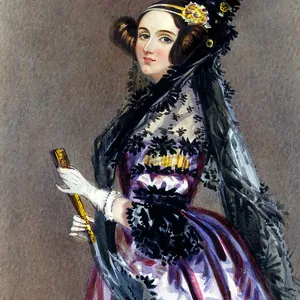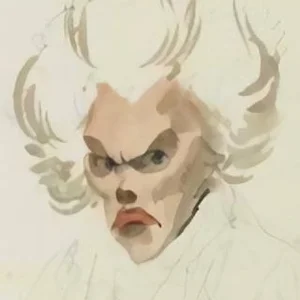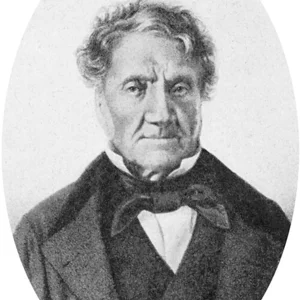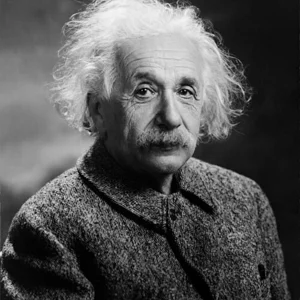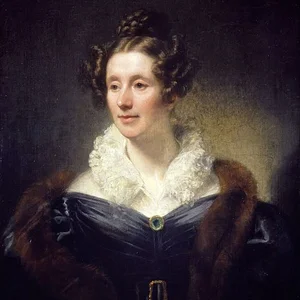

Scottish mathematician and scientist (1780–1872), a pioneer of science in the 19th century. She popularised the works of Laplace and contributed to celestial mechanics. Together with Caroline Herschel, she was one of the first women to be elected an honorary member of the Royal Astronomical Society.
Mary Somerville(1780 — 1872)
Mary Somerville
Royaume-Uni de Grande-Bretagne et d'Irlande
8 min read
Frequently asked questions
Famous Quotes
« The study of mathematics develops the faculties of the mind and trains one in the rigour of reasoning.»
Key Facts
- 1780: Born in Jedburgh, Scotland
- 1831: Publication of *The Mechanism of the Heavens*, an adaptation of Laplace's work
- 1835: Elected honorary member of the Royal Astronomical Society alongside Caroline Herschel
- 1869: Publication of *On Molecular and Microscopic Science* at the age of 89
- 1872: Died in Naples; Somerville College, Oxford, was named in her honour in 1879
Works & Achievements
Translation and expansion of Laplace's Mécanique céleste, immediately adopted as a textbook at Cambridge. This work firmly established Mary Somerville's scientific reputation and remained a standard reference for decades.
A synthesis of the major natural sciences (astronomy, physics, geography, meteorology), reprinted ten times during the author's lifetime. The fourth edition (1842) contains a hypothesis about a planet perturbing Uranus, which inspired the discovery of Neptune.
A work of physical geography describing the structure of the Earth, its landforms, oceans, and climates. It became a standard school textbook in Great Britain, was translated into several languages, and was reprinted until 1877.
Mary Somerville's last major work, written at the age of 89, devoted to the sciences of matter and microscopy. A remarkable testament to a scientific curiosity that remained undimmed into extreme old age.
An autobiography published after her death by her daughter Martha, invaluable for understanding the journey of a woman of science in the 19th century and the obstacles she overcame to gain access to knowledge.
Anecdotes
When Mary Fairfax stumbled upon algebra by chance in a fashion magazine, her father, Admiral Fairfax, was alarmed: he feared that studying mathematics would ruin his daughter's health. He forbade her from getting up at night to study and confiscated her candles, but Mary continued to memorize her formulas during the day and work through them in the dark.
In 1831, Mary Somerville published Mechanism of the Heavens, an adaptation of Laplace's *Mécanique céleste* — a work so complex that few English scholars could read it. Her book was immediately adopted as a textbook at Cambridge, a remarkable achievement for a woman who had never received any formal university education.
In 1835, Mary Somerville and Caroline Herschel became the first two women elected as honorary members of the Royal Astronomical Society. The ceremony caused a great stir in the press: some newspapers hailed the event, while others expressed outrage that women could be honoured within such a prestigious scientific institution.
In the fourth edition of On the Connexion of the Physical Sciences (1842), Mary Somerville put forward the hypothesis that an unknown planet was disturbing the orbit of Uranus. This suggestion directly inspired John Couch Adams, who calculated the orbit of Neptune — a planet officially discovered in 1846.
Mary Somerville wrote her last scientific memoir at the age of 89 and continued reading the latest mathematical publications until the eve of her death, at 91, in Naples in 1872. Her intellectual longevity commanded the admiration of her contemporaries and became an emblematic argument in favour of women's education.
Primary Sources
I was aware that the astronomer royal for Scotland considered mathematics a science to which the female intellect was inadequate; and that the idea of a woman venturing to write on such subjects was considered not only presumptuous, but indelicate.
Physical astronomy is the science which compares and identifies the laws of motion observed on earth with the motions that obtain in the heavens, and which traces, by an uninterrupted chain of deduction from the law of universal gravitation, the revolutions of the planets.
The progress of modern science, especially within the last five years, has been remarkable for a tendency to simplify the laws of nature, and to unite detached branches by general principles.
I have been studying the Mécanique Céleste of Laplace, which I find extremely difficult in many parts, but I persevere and hope in time to understand it thoroughly.
Your work has been received here with the greatest admiration; it is used at Cambridge as a standard book, and has done more than any other publication to make our students acquainted with the great work of Laplace.
Key Places
Mary Somerville's birthplace in the Scottish Borders. It was in this rural setting that she spent her childhood and developed her curiosity for nature and mathematics, often in secret so as not to displease her father.
The city where Mary Somerville received her modest formal education and first moved in Scottish intellectual circles. Nicknamed the “Athens of the North,” it enjoyed an exceptional cultural and scientific prominence at the turn of the nineteenth century.
The London neighbourhood where the Somervilles lived for many years, hosting a salon and welcoming the greatest minds of the Victorian era. It was here that Mary wrote her major works.
The city where the Somerville family settled from the 1840s onwards, drawn by the climate and the lower cost of living. Mary continued her scientific work there and kept up her connections with European learned circles.
The city where Mary Somerville spent the last years of her life and died in 1872 at the age of 91. She completed her final scientific work there and continued reading mathematical publications until her very last days.
An institution founded in 1820 that elected Mary Somerville and Caroline Herschel as its first female honorary members in 1835 — a landmark moment for the recognition of women in British science.
Typical Objects

Pierre-Simon Laplace's monumental five-volume work, which Mary Somerville translated and expanded into English. She devoted years of intensive study to it and added her own commentary, making the text accessible to British scientists.

An instrument representing the celestial sphere, essential for studying the positions of stars and planets. Mary Somerville used it to illustrate her research in celestial mechanics and to explain astronomical concepts to her children and visitors.

Mary Somerville filled entire notebooks with formulas, deductions, and scientific correspondence. Her rigorous method left behind many pages of calculations attesting to her exceptional mathematical ability for the era.

The universal writing tool of the age, with which Mary Somerville composed her books and letters to Laplace, Herschel, Whewell, and other scholars. She maintained an extensive international scientific correspondence until the end of her life.

A small refracting telescope that cultivated Victorian-era families kept for observing the Moon and planets. Mary Somerville practiced astronomical observation alongside her theoretical work.

An instrument Mary Somerville made great use of in her later years, particularly in writing *On Molecular and Microscopic Science*. It reflects the breadth of her scientific curiosity, spanning from the infinitely large to the infinitely small.

A synthetic representation of the world's landforms, ocean currents, and climate zones, central to her work *Physical Geography* (1848). Mary Somerville was a pioneer in the educational and holistic depiction of the natural world.
School Curriculum
Vocabulary & Tags
Key Vocabulary
Tags
Daily Life
Morning
Mary Somerville rose early and devoted the first hours of the morning to her mathematical work, before domestic obligations took over the day. She worked in the quiet of her study, surrounded by her books and calculation notebooks, often while the children were still asleep.
Afternoon
The afternoon was dedicated to scientific correspondence with her colleagues — Herschel, Playfair, Whewell — and to reading the latest publications from France, Germany, and England. She sometimes received scholarly visitors and accompanied her husband William in his medical and associative activities.
Evening
Evenings were often social: the Somervilles kept a well-regarded salon in Chelsea, bringing together natural philosophers, artists, and reformers. Mary conversed with ease on celestial mechanics, geology, or botany, in an atmosphere that blended intellectual rigour with warm conviviality.
Food
Like the educated Victorian middle class, the Somervilles followed a modest and varied diet: roasted meats, seasonal vegetables, puddings, and tea at all hours. Once settled in Italy, Mary developed a fondness for Mediterranean cuisine — pasta, fish, fresh fruit — which she considered light and conducive to good health.
Clothing
Mary Somerville wore the dress of the respectable Victorian bourgeoisie: high-waisted long gowns in the Regency era, then crinoline styles in the 1850s, always in subdued colours. Her portraits show her in black or dark dresses, with an elegant shawl and a lace cap.
Housing
The Somervilles lived in spacious London townhouses in Chelsea, equipped with a well-stocked library and a study reserved for Mary. After 1838, they resided in comfortable villas in Florence and later Naples, surrounded by gardens and bathed in the light of the Mediterranean climate.
Historical Timeline
Period Vocabulary
Visual Style
Style portrait victorien écossais : lumière douce à la bougie, bureau encombré de globes célestes et de traités mathématiques, palette de bleus ardoise, ivoire et ocre chaud.
Sound Ambience
Ambiance d'un cabinet de travail victorien à Édimbourg ou Londres : plume sur papier, feu de cheminée, carrosse sur pavés humides et murmures d'un salon de savants à la bougie.
Liens externes & ressources
Références
Œuvres
Mechanism of the Heavens
1831
On the Connexion of the Physical Sciences
1834
Physical Geography
1848
On Molecular and Microscopic Science
1869
Personal Recollections, from Early Life to Old Age
1873 (posthume)