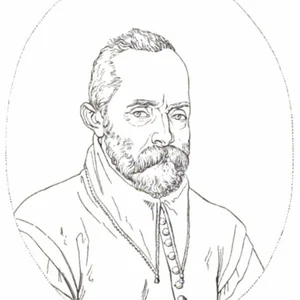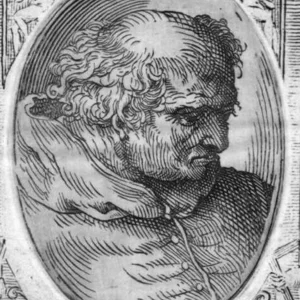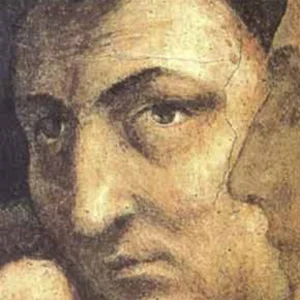

A Florentine painter of the early 15th century, Masaccio is considered one of the fathers of Renaissance painting. He revolutionized pictorial art by introducing linear perspective and a striking naturalism in the representation of human figures.
Masaccio(1401 — 1428)
Masaccio
9 min read
Frequently asked questions
Key Facts
- Born on December 21, 1401, in Castel San Giovanni (Tuscany)
- Created the frescoes of the Brancacci Chapel in Florence (c. 1424–1427), a masterpiece of the early Renaissance
- His fresco of the Trinity (1427) at Santa Maria Novella is one of the earliest examples of mathematical linear perspective in painting
- Died in Rome in 1428 at only 27 years old, under unknown circumstances
- Giorgio Vasari called him the 'father of modern painting' in his Lives of the Artists (1550)
Works & Achievements
A fresco cycle depicting the life of Saint Peter, including the Expulsion from Paradise and The Tribute Money. Masaccio introduces figures of unprecedented monumentality, an expressive treatment of emotion, and a unified light source that mark a turning point in the history of Western painting.
A wall fresco in Santa Maria Novella, Florence, depicting the Trinity beneath an illusionistic barrel vault. It is the first demonstrable example of the rigorous application of single-point perspective in monumental European painting.
A large gilded wood altarpiece commissioned for the Carmine church in Pisa, now dispersed across several museums. The central panel (Madonna and Child, National Gallery, London) reveals a sense of volume and a naturalism unmatched in panel painting of the period.
A panel painting depicting Saint Anne, the Virgin, and the Child (Uffizi, Florence). The figures attributed to Masaccio stand out sharply for their plastic weight and sculptural solidity, reflecting the influence of Donatello.
A fresco depicting Adam and Eve driven from Paradise by an angel. One of the first genuinely emotional portrayals of human anguish in Western painting since Antiquity, it deliberately contrasts with the calmer version by Masolino on the opposite panel.
Anecdotes
His real name was Tommaso di Ser Giovanni, but all of Florence called him “Masaccio,” which roughly means “Clumsy Tom” or “Slovenly Thomas.” Unlike his collaborator Masolino, nicknamed “the graceful one,” Masaccio was known for his disheveled appearance and legendary absent-mindedness — he would regularly forget to collect payment from his patrons.
Masaccio died mysteriously in Rome around 1428, at just 27 years old. His sudden death struck his contemporaries deeply: the poet Poliziano would later write that he had never seen anyone die so young while leaving such a lasting mark. Some even whispered that he had been poisoned, but no historical evidence supports the claim.
To paint the *Trinity* fresco at Santa Maria Novella, Masaccio worked closely with Filippo Brunelleschi, the architect who had just codified linear perspective. The result was astonishing: visitors had the impression of looking into a real chapel carved into the wall. Beneath the plaster, the central nail hole has been found — the one around which a string guided the vanishing lines.
The frescoes of the Brancacci Chapel, left unfinished at Masaccio’s death, remained as they were for sixty years before being completed by Filippino Lippi. Entire generations of Florentine artists, including the young Michelangelo around 1490, came to copy the figures as a way of learning their craft, turning the chapel into an open-air school.
In the Florentine *catasto* of 1427 — the first major tax census in European history — Masaccio himself declared that he owned no real estate and was in debt to several people. This official document, preserved in the State Archives of Florence, is one of the rare direct and authenticated traces of his daily life.
Primary Sources
Tommaso di Ser Giovanni di Mone Cassai, dipintore, del popolo di San Niccolò di Firenze — an inscription confirming Masaccio's official entry into the Florentine painters' guild.
Io Tommaso dipintore fo noto chome io non ò nulla di stabile e sono debitore a più persone — Masaccio declares that he owns no real property and is indebted to several creditors.
A dì 19 di febraio 1426 — pagato a Tomaxo dipintore per resto di sua manifattura dell'altare dipinto per la chiesa del Carmine di Pisa fiorini undici d'oro — a payment record noting eleven gold florins paid to the painter Tommaso for the completion of the altarpiece for the Carmine church in Pisa.
Masaccio was the first to fully imitate natural things, rediscovering perspective and lighting with greater vividness than any painter before him.
Key Places
A small Tuscan town in the Arno Valley where Masaccio was born on December 21, 1401. A municipal museum dedicated to him is now housed in the Basilica of Santa Maria delle Grazie, preserving works by artists from his circle.
A masterpiece created with Masolino around 1424–1428, housing the cycle of Saint Peter and the Expulsion from Paradise. This site became an informal academy for generations of artists — from Filippino Lippi to Michelangelo — who came to study Masaccio's frescoes.
A Dominican church where Masaccio painted his celebrated fresco of the Trinity around 1427 — the first monumental example of trompe-l'œil architecture based on linear perspective. The work was rediscovered in the 19th century, having been hidden behind a Baroque altar.
In 1426, Masaccio painted his large Polyptych here, commissioned by a notary for the Church of the Carmine. The panels were dismembered in the 18th century and are now scattered between the National Gallery in London, the Uffizi, and several other European museums.
Masaccio travelled here in 1428, drawn by the ancient ruins that Florentine artists studied as models. He died there under unknown circumstances, leaving behind a blazing career cut short at the age of 27.
Typical Objects

Preparatory drawing traced in red ochre directly onto the rough plaster layer of the wall (arriccio) before the fresh plaster was applied. After restoration, sinopie are often detached and displayed separately, revealing the painter's graphic thinking.

A thin layer of plaster and lime applied each morning over the surface to be painted (giornata). The *buon fresco* technique requires that pigments be laid onto this damp plaster so they bond chemically with the wall, ensuring preservation for centuries.

The colors used in fresco had to withstand the alkalinity of lime: yellow and red ochres, green earth (*terra verde*), azurite for blues, and carbon black. Masaccio favored a restrained yet powerful palette, in sharp contrast to the gilded ornaments of the late Gothic style.

To construct illusionistic perspective architecture, Masaccio used compasses, rulers, and strings stretched from a central nail toward the vanishing lines. In the *Trinity* fresco, the hole left by the pivoting nail that guided the geometric layout has been identified.

A poplar-wood support covered with several layers of gesso (a mixture of plaster and animal glue), used for easel paintings such as the Pisa Polyptych. The *tavola* was crafted by a specialist carpenter before being handed over to the painter.

A notebook in which a Renaissance painter recorded anatomical studies, drapery sketches, and poses copied from Antiquity or from contemporary sculpture. Masaccio drew particular inspiration from Donatello's figures for the monumental quality of his characters.
School Curriculum
Vocabulary & Tags
Key Vocabulary
Daily Life
Morning
A Renaissance painter's day began early in the bottega. Masaccio or his assistants would grind mineral pigments with a muller, prepare mixtures, and assess the drying state of the previous day's intonaco. The master would define the day's giornata — the area of fresh plaster to be laid and painted before evening — and sometimes sketch preparatory outlines on the arriccio.
Afternoon
The afternoon was devoted to painting proper: applying colors to the damp plaster, retouching dry areas with tempera as needed, and checking the perspective by stepping back several paces. For large frescoes like the Brancacci Chapel, several painters and apprentices worked simultaneously on different sections under the master's direction.
Evening
In the evenings, Masaccio most likely moved in Florentine artisan and humanist circles where architects, sculptors, and scholars crossed paths. Tax records show he lived modestly, in debt to his landlord, far from the comfort displayed by his patrons. Conversations revolved around geometry, perspective, and the study of ancient monuments that Florentine artists were beginning to measure and draw.
Food
The diet of a Florentine craftsman in the early fifteenth century was that of the working classes: wheat or spelt bread, legumes (broad beans, lentils, chickpeas), seasonal vegetables, salted fish on the lean days imposed by the Church, and meat (lamb, pork) on feast days. Local red wine diluted with water was the daily drink, safer than water from the fountains.
Clothing
Masaccio most likely wore the typical Florentine craftsman's dress: a dyed wool tunic (gamurra), hose, and a short cloak (cioppa). His nickname suggests someone who paid little attention to his appearance. During fresco work, he wore sturdy clothes, inevitably stained with plaster and pigments. Leather aprons were common in workshops.
Housing
According to his 1427 catasto declaration, Masaccio owned no property and rented — probably a room or small apartment in the working-class Oltrarno district, close to his work sites. The bottega — a workshop leased by the year — was the true center of his professional and social life, serving as a place to receive clients and train apprentices.