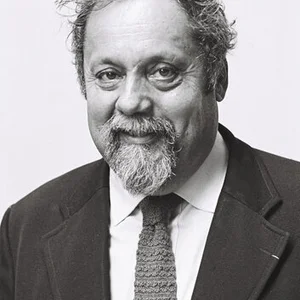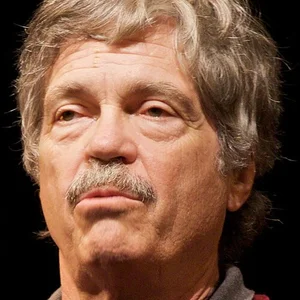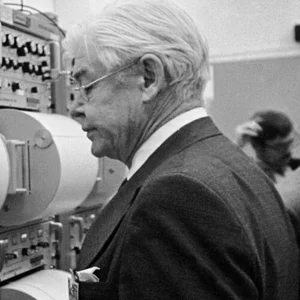

Maurice Ewing was an American geophysicist and a pioneer of oceanography. His research on the seafloor and oceanic crust provided decisive evidence in support of the theory of plate tectonics.
Maurice Ewing(1906 — 1974)
William Maurice Ewing
États-Unis
7 min read
Frequently asked questions
Key Facts
- Born in 1906 in Texas and died in 1974, he devoted his career to the physical study of the oceans.
- In 1949, he founded the Lamont Geological Observatory (now Lamont-Doherty), a major center for Earth sciences.
- He made the first seismic measurements of the thickness of the oceanic crust, demonstrating that it is far thinner than the continental crust.
- Together with Bruce Heezen and Marie Tharp, he contributed to the mapping of the Mid-Atlantic Ridge and its central rift.
- His work provided essential evidence for the theory of seafloor spreading and plate tectonics.
Works & Achievements
First seismic-refraction experiments at sea, demonstrating that the oceanic crust is far thinner than the continental crust.
Identification of a layer of the ocean where sound travels for thousands of kilometers, used for rescue at sea and later for acoustic surveillance.
Creation of an Earth sciences laboratory that became a world reference in oceanography, geophysics, and seismology.
With Bruce Heezen and Marie Tharp, the discovery of the collapse valley running along the ridge, a decisive clue to seafloor spreading.
A reference work (with Jardetzky and Press) on the propagation of waves in stratified media, foundational for modern geophysics.
A major cartographic synthesis of the North Atlantic seafloor, one of the first detailed depictions of undersea relief.
Systematic collection of ocean sediment cores, transforming abyssal mud into an archive of the climate and the history of the Earth.
Anecdotes
In 1935, Maurice Ewing agreed to go down onto a beach with sticks of dynamite to set off small explosions: by measuring how long the shock waves took to travel through the rocks beneath the sea, he invented a way to “X-ray” the ocean floor without ever seeing it.
During the Second World War, Ewing discovered the “SOFAR channel”: a layer of the ocean where sound travels for thousands of kilometers without fading. This finding made it possible to locate airmen who had crashed at sea, thanks to small sound charges they dropped into the water.
In 1953, while analyzing profiles of the Atlantic floor with his mapmaker Marie Tharp and his colleague Bruce Heezen, Ewing's team revealed an enormous valley split open along the crest of the Mid-Atlantic Ridge. Ewing was skeptical at first: this planetary “scar” was major evidence of continental drift.
Ewing was known for almost never stopping work: he spent entire months at sea aboard the ship Vema, taking core sample after core sample of the seafloor. Under his leadership, the Lamont Observatory enforced a famous rule: every ship had to record seafloor data continuously, day and night, even when no one yet knew what it would be used for.
When Ewing pulled up sediment cores from the bottom of the oceans, he read in them the history of climate: the successive layers of mud contained shells of tiny organisms that told of ancient ice ages, turning the abyssal ooze into a true archive of the Earth.
Primary Sources
A central valley (rift) runs along the crest of the Mid-Atlantic Ridge over its entire length, marking a continuous fracture zone in the oceanic crust.
The study of how elastic waves travel through layered media provides the theoretical tools for interpreting the structure of the Earth's crust and the ocean floor.
Cores collected from the North Atlantic reveal a succession of sediment layers that record climate variations and deep-water circulation during the Quaternary.
In the ocean there is a layer where the speed of sound reaches a minimum; sound waves become trapped in it and can travel over very great distances without fading.
Key Places
Small farming town on the plains of northern Texas where Maurice Ewing was born in 1906.
Institution where Ewing pursued his graduate studies in physics and earned his doctorate, laying the foundations for his career as a geophysicist.
Earth sciences research center founded by Ewing in 1949, which became one of the world's leading laboratories for oceanography and geophysics.
Immense underwater mountain range in the middle of the Atlantic, whose central valley (rift) was revealed by Ewing and his team — major evidence for plate tectonics.
Coastal city where Ewing settled in 1972 to continue his marine research, and where he died in 1974.
Typical Objects

Device that recorded the shock waves produced by small explosions to measure the thickness and structure of the crust beneath the ocean. It was the key instrument in Ewing's first “X-rays” of the seafloor.

Long metal tube driven into the seafloor to extract an intact column of sediment. These cores made it possible to read the climatic and geological history of the oceans layer by layer.

Instrument that sent sound pulses toward the bottom and measured their echo to map the underwater relief. The continuous profiles it produced fed the maps of the Mid-Atlantic Ridge.

A former schooner converted into a floating laboratory of the Lamont Observatory, crisscrossing the oceans to collect data and cores. Under Ewing, it accumulated a record number of kilometres of seafloor surveys.

Sensor towed behind the ship to measure variations in the magnetic field of the ocean floor. These measurements revealed the magnetic stripes that confirmed seafloor spreading.

Small explosive charge dropped into the sea to produce a sound detectable over very long distances through the deep sound channel. It was used to locate aviators or sailors in distress during the war.
School Curriculum
Vocabulary & Tags
Key Vocabulary
Tags
Daily Life
Morning
When at sea, Ewing started early, checking the seismic and acoustic recordings accumulated overnight. On land, at Lamont, his mornings were spent analyzing seafloor profiles and organizing expeditions.
Afternoon
The afternoon was devoted to calculations, writing papers, and meetings with his students and researchers. He closely supervised the processing of data brought back by ships like the Vema.
Evening
Renowned as tireless, Ewing often extended his days late into the evening, reviewing results or preparing campaigns. At sea, he remained available at any hour to respond to unexpected measurements.
Food
During the long oceanographic campaigns, he shared the crews' everyday fare: simple meals prepared on board, canned goods, and rations suited to the weeks spent far from shore in the mid-twentieth century.
Clothing
On deck, he wore rugged, waterproof work clothes suited to the marine climate; in the academic setting, he donned the plain suit of American scientists of his era.
Housing
His professional life was split between the cramped cabins of research vessels and the buildings of the Lamont Observatory, set on the wooded heights of the Palisades overlooking the Hudson River.
Historical Timeline
Period Vocabulary
Liens externes & ressources
Références
Œuvres
Mesures sismiques de la croûte océanique
à partir de 1935
Découverte du canal sonore SOFAR
1944
Fondation du Lamont Geological Observatory
1949
Identification du rift de la dorsale médio-atlantique
1953
Elastic Waves in Layered Media
1957
The Floors of the Oceans: The North Atlantic
1959
Programme de carottage des sédiments profonds
années 1950-1960