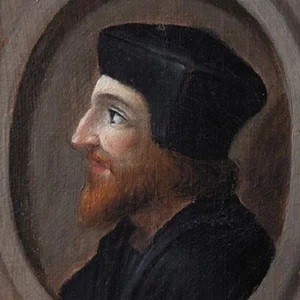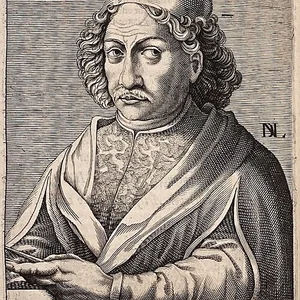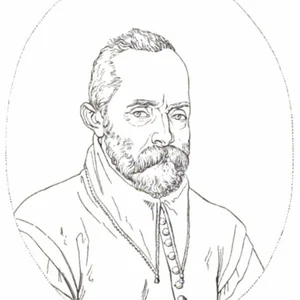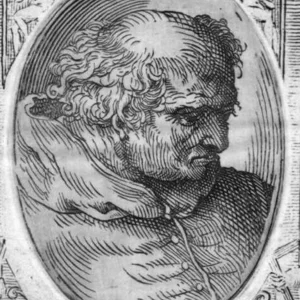

Florentine architect and sculptor of the early Renaissance (1396–1472), Michelozzo was the preferred architect of Cosimo de' Medici. He designed the Palazzo Medici Riccardi in Florence, a model for the Renaissance palace, and collaborated with Donatello on several sculptural works.
Michelozzo di Bartolomeo(1396 — 1472)
Michelozzo
Italie
8 min read
Frequently asked questions
Key Facts
- Born in Florence in 1396, son of a mint worker originally from Burgundy
- Collaborated with Donatello and Ghiberti during the 1420s and 1430s
- Became the trusted architect of Cosimo de' Medici around 1430
- Designed the Palazzo Medici Riccardi in Florence (begun around 1444), the first great Renaissance palace
- Built the library of the convent of San Marco in Florence (1437–1444), commissioned by Cosimo de' Medici
Works & Achievements
The first great masterpiece of the Michelozzo-Donatello collaboration, this marble and bronze tomb introduced the monumental recumbent figure into Florentine funerary art, and its vertical composition set within an architectural niche influenced the whole of Renaissance sculpture.
Michelozzo completely transformed this Dominican monastery into a sober, light-filled architecture ideally suited to contemplative life, and incorporated within it the first humanist library open to the public, funded by Cosimo de' Medici.
Commissioned by Cosimo de' Medici, this palace with its graduated rustication and monumental cornice defined the model of the Renaissance palazzo: restrained, majestic, and harmonious — it was imitated throughout Italy for more than a century.
A marble aedicule commissioned by Piero de' Medici to house a miraculous image of the Annunciation, showcasing Michelozzo's mastery in the art of combining miniature architecture with sculpted decoration.
A medieval fortress transformed into a country villa for the Medici, this was one of the earliest examples of the humanist suburban villa in Tuscany, foreshadowing an architectural type that would come into full bloom in the sixteenth century.
A marble tribune adorned with Donatello's celebrated dancing putti, for which Michelozzo designed the architectural framework — a masterpiece of collaboration that exemplifies the creative synergy between the two Florentine artists.
Anecdotes
In 1433, when Cosimo de' Medici was banished from Florence by his political rivals, Michelozzo freely chose to follow him into exile in Venice. During this period, he designed a library for the convent of San Giorgio Maggiore, demonstrating unwavering loyalty to his patron and a remarkable ability to work far from his Florentine workshop.
Cosimo de' Medici had initially approached Filippo Brunelleschi to design his palace in Florence, but rejected the proposal as too grand and ostentatious, fearing it would stoke the envy of his fellow citizens. It was ultimately Michelozzo who received the commission in 1444 and delivered a building of restrained majesty, whose graduated rusticated façade would define the architecture of Florentine palaces for over a century.
Michelozzo began his career as a goldsmith and bronze founder before turning to sculpture and architecture. This remarkable versatility allowed him to collaborate closely with Donatello on the tomb of Antipope John XXIII in the Florence Baptistery, a masterpiece in marble and bronze executed between 1421 and 1428 that revolutionized Florentine funerary art.
The convent of San Marco in Florence, entirely renovated by Michelozzo from 1437 onwards on behalf of Cosimo de' Medici, welcomed the painter Fra Angelico as a resident monk. The sober, light-filled architecture Michelozzo designed for the friars' cells created an ideal setting for the contemplative frescoes Fra Angelico painted there, illustrating the unique convergence of architecture and painting in Quattrocento Florence.
Toward the end of his life, between 1461 and 1464, Michelozzo likely stayed in Ragusa (present-day Dubrovnik, Croatia), where he is thought to have contributed to the harbor fortifications. This journey attests to an international reputation that extended far beyond the borders of Tuscany, making him one of the most sought-after architects of his time.
Primary Sources
Michelozzo Michelozzi, scultore et architetto fiorentino, fu molto amico di Cosimo de' Medici e da lui molto adoperato; e seguì la sua fortuna nell'esilio di Vinezia, dove fece alcune fabbriche di molta importanza.
Michelozzo è uno degli architetti che ha saputo unire con grande senno la maniera antica con la pratica moderna, come si vede chiaramente nell'opera del palazzo edificato per Cosimo.
Ho fatto fare e fabricare el monasterio di Santo Marco con ogni sollicitudine et spesa conveniente, acciò che i frati abbino cella et luogo degno per la loro vita religiosa.
Key Places
Michelozzo's birthplace and the center of his entire professional activity. It was in this republican city, under the patronage of the Medici, that he produced his major works and trained his apprentices.
Michelozzo's architectural masterpiece, begun in 1444 for Cosimo de' Medici. Its rusticated facade with graduated stonework and monumental cornice established a new standard for Renaissance civic architecture, widely imitated throughout Italy.
A Dominican monastery completely renovated by Michelozzo between 1437 and 1452, commissioned by Cosimo de' Medici. He incorporated within it the first humanist library open to the public, the Bibliotheca Medicea, and created the space where Fra Angelico painted his celebrated frescoes.
The city where Michelozzo accompanied Cosimo de' Medici during his exile from 1433 to 1434. There he designed a library for the convent of San Giorgio Maggiore, adapting his Florentine style to Venetian architectural traditions.
An Adriatic port city where Michelozzo is believed to have stayed around 1461–1464 to work on its fortifications. This journey illustrates the international reach of his work, extending far beyond Tuscany.
Typical Objects

Fundamental instruments of the Renaissance architect, used to draw plans, verify right angles, and calculate proportions on the building site. Michelozzo handled them daily to design and supervise his constructions.

A small-scale wooden model of a planned building, presented to the patron before construction began. Cosimo de' Medici is said to have examined the *modello* of the Palazzo Medici before approving Michelozzo's design, having rejected Brunelleschi's proposal.

A steel chisel used to carve marble or stone, an essential tool for every Florentine sculptor. Michelozzo, trained first as a goldsmith and then as a sculptor, had mastered these instruments before devoting himself to architecture.

A blue-grey sandstone quarried at Fiesole, the material of choice in Florentine Quattrocento architecture. Michelozzo used it extensively for the pilasters, arches, and window surrounds of the Palazzo Medici and the convent of San Marco.

A notebook on parchment or paper in which the architect recorded surveys of ancient buildings, project sketches, and proportion calculations. An indispensable tool for the humanist architect seeking to understand and emulate the Ancients.

A terracotta mould used to cast decorative bronze elements using the ancient lost-wax technique. Michelozzo, trained as a goldsmith and founder, had mastered this method and put it to use in his collaborations with Donatello.
School Curriculum
Vocabulary & Tags
Key Vocabulary
Daily Life
Morning
Michelozzo's day began early, often before dawn, with Mass at one of Florence's many churches. He would then make his way to his bottega, where apprentices and journeymen waited for the day's instructions: surveys to carry out, plans to draw, materials to order from the quarrymen of Fiesole.
Afternoon
The afternoon was devoted to site visits, by mule or on foot depending on the distance. On-site, Michelozzo checked the plumb of walls with a plumb line, inspected the cutting of *pietra serena* stones, and negotiated the execution details of cornices and capitals with the master masons.
Evening
In the evenings, Michelozzo would sometimes join the learned circle of Cosimo de' Medici, where philosophers, poets, and artists debated recently rediscovered ancient texts. Otherwise, he would return home to annotate his sketches and study the architectural treatises he had managed to obtain.
Food
Like any prosperous Florentine craftsman of the Quattrocento, Michelozzo ate bread, boiled vegetables, cheese, and braised meats on ordinary days. Wine diluted with water was the daily drink, and on banquet days at the Medici household, the table offered more elaborate fare — roasted fowl, river fish, and honey pastries.
Clothing
In his workshop and on building sites, Michelozzo wore a short tunic of wool or linen in a plain color, protected by a leather apron against stone dust. When visiting the Palazzo Medici or attending an official ceremony, he put on a long robe of fine woolen cloth and a chaperon, the distinctive headwear of prosperous Florentine craftsmen.
Housing
Michelozzo lived in Florence in the house of a prosperous craftsman, close to his *bottega* in the city center. His home had a workshop on the ground floor and living quarters above, with walls bearing a few devotional paintings and shelves overflowing with models, treatises, and measuring instruments.
Historical Timeline
Period Vocabulary
Liens externes & ressources
Références
Œuvres
Rénovation du couvent de San Marco, Florence
1437-1452
Palazzo Medici Riccardi, Florence
1444-1460
Tabernacle de la Santissima Annunziata, Florence
1448-1452
Villa Medici de Cafaggiolo, Mugello
c. 1451
Chaire extérieure du Duomo de Prato (avec Donatello)
1428-1438