
Mictlantecuhtli is the god of death in Aztec mythology, ruler of Mictlan, the kingdom of the dead located in the deepest reaches of the underworld. Depicted as a skeleton adorned with necklaces of human eyes and cobwebs, he embodied natural death and the cycle of existence.
Mictlantecuhtli
Mictlantecuhtli
9 min read
Frequently asked questions
Key Facts
- Mictlantecuhtli rules over Mictlan, the ninth and deepest level of the Aztec underworld, alongside his wife Mictecacíhuatl
- The souls of those who died ordinary deaths had to complete a four-year journey through nine trials before reaching his kingdom
- He is depicted as a skeleton or a man with a skull face, wearing necklaces of torn-out human eyes and draped in cobwebs
- The month of Títitl in the Aztec calendar was dedicated to him, with rituals held in his honor
- During the creation of the current world (the Fifth Sun), the god Quetzalcóatl had to descend into Mictlan to steal the bones of humans from Mictlantecuhtli in order to recreate humanity
Works & Achievements
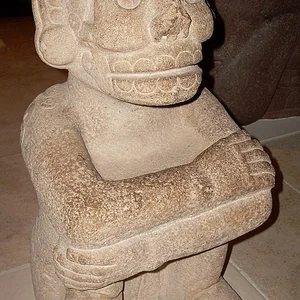
A near-life-size ceramic sculpture depicting the god as a skeleton with holes in the skull symbolizing hair torn out as a sign of mourning. A masterpiece of Aztec funerary art, discovered during excavations of the Templo Mayor.
Several pages of the Codex Borgia illustrate Mictlantecuhtli in cosmic opposition to Quetzalcóatl, life against death. These images are the richest iconographic sources for understanding his place in Aztec cosmology.
A ceramic figurine depicting the two deities back to back, symbolizing the fundamental duality of the Aztec universe. This piece perfectly illustrates the Mexica conception of cosmic balance between life and death.
A stone relief depicting the attributes of Mictlantecuhtli, discovered during excavations of the Templo Mayor in Mexico City. It testifies to the central role given to the cult of death in official Aztec religion.
A ritual structure discovered beneath the historic center of Mexico City, containing ritually prepared human remains. This archaeological find confirms the existence of a place of worship specifically dedicated to Mictlantecuhtli in the Aztec capital.
Anecdotes
Mictlantecuhtli ruled over Mictlan, a kingdom of the dead divided into nine levels that the souls of the deceased had to journey through over four years. Each level presented terrifying ordeals: winds of obsidian knives, icy rivers, fields of black wind. The living would place food, tools, and even a dog in tombs to guide the dead through this journey.
According to the Aztec myth of human creation, Quetzalcóatl descended into Mictlan to steal the bones of ancient humans in order to recreate humanity. The cunning Mictlantecuhtli tried to trap him by ordering his servants to make the feathered serpent god stumble. Quetzalcóatl barely escaped with the precious bones, which were then sprinkled with his blood to restore life to humankind.
Mictlantecuhtli was often depicted with stars on his body, symbolizing the night sky and the underworld. This iconography reminded the Aztecs that death was not an end but a transformation: the souls of warriors who died in battle became stars and accompanied the sun on its daily journey across the sky.
During the great Aztec festival of Miccailhuitontli (the little feast of the dead, ancestor of Día de los Muertos), offerings were laid in honor of Mictlantecuhtli. Priests wore skull-shaped masks and performed elaborate rituals to honor the deceased and maintain the cosmic balance between the world of the living and that of the dead.
In the Aztec ritual calendar (tonalpohualli), Mictlantecuhtli was associated with the number ten and certain ill-omened days. People born under his sign were believed to have a destiny tied to death or the mysteries of the underworld, and were required to perform special rituals to earn his favor.
Primary Sources
The Codex Borgia depicts Mictlantecuhtli in opposition to Quetzalcóatl across several pages, illustrating the fundamental life-death duality of Mesoamerican cosmology. The god appears as a skeleton adorned with necklaces of human eyes, seated on a throne in Mictlan.
This manuscript illustrates the nine levels of Mictlan and the deities that preside over them, with detailed depictions of Mictlantecuhtli and his wife Mictecacíhuatl ruling over the kingdom of the dead.
They said that those who died of natural causes went to Mictlan, the place of the dead, and that the lord of that place was Mictlantecuhtli... and that the soul took four years to cross this dark place before reaching rest.
Quetzalcóatl went to Mictlan and said to Mictlantecuhtli: 'I have come to seek the precious bones that you keep.' Mictlantecuhtli replied: 'What will you do with them, Quetzalcóatl?' And he answered: 'The gods are troubled, for who will inhabit the earth?'
Mictlantecuhtli is the god of the underworld, lord of Mictlan, which the Indians call the place of torments. His wife is Mictecacíhuatl. He is depicted with a skull for a head and dressed in paper.
Key Places
A cosmic domain located in the deepest part of the Aztec underworld, divided into nine levels. Mictlantecuhtli ruled there alongside his wife Mictecacíhuatl over the souls of those who had died of natural causes.
The great temple of Tenochtitlan, whose northern section was dedicated to Tláloc and portions of which were used for funerary rituals. Recent excavations (2006) uncovered a temple dedicated to Mictlantecuhtli containing ritualized human bones.
Home to the most important sculptures and representations of Mictlantecuhtli, including a life-size ceramic statue discovered at Tenochtitlan. This museum is the essential reference for understanding the iconography of the Aztec god of death.
A pre-Aztec site whose culture shaped the Mexica conception of the underworld. The Avenue of the Dead (Miccaotli) and the Pyramid of the Moon reflect funerary beliefs that foreshadow the cult of Mictlantecuhtli.
A Zapotec site where early representations of death deities reveal the Mesoamerican cultural continuities that influenced the Aztec conception of Mictlantecuhtli.
Typical Objects

Priests of Mictlantecuhtli wore skull masks during funeral ceremonies. These gemstone-encrusted masks symbolized the god's presence among the living and allowed officiants to identify themselves with him.

A distinctive iconographic attribute of Mictlantecuhtli, this necklace of eyeballs signified his all-seeing power over the realm of the dead. In codex illustrations, it is consistently present to identify the deity.

Spider webs adorned representations of Mictlantecuhtli, evoking the darkness and desolation of Mictlan. They also symbolized the passage of time and the inevitable decomposition of the body.

Copal incense burned in these sacred vessels served as a means of communicating with Mictlantecuhtli during funeral rites. The smoke was believed to carry prayers and offerings to the realm of the dead.

These hairless dogs, considered sacred by the Aztecs, were sometimes sacrificed and buried alongside the deceased to guide them through the nine levels of Mictlan. It was believed they helped souls cross the underground river separating the world of the living from the world of the dead.

Mictlantecuhtli was often depicted wearing strips of amate paper, the foremost ritual material in Aztec culture. This paper was also used to make offerings that were burned in his honor during festivals dedicated to the dead.

The ashes of the deceased were placed in urns decorated with motifs associated with Mictlantecuhtli, symbolizing their journey to Mictlan. These vessels, found in large numbers by archaeologists, testify to the importance of Aztec funerary worship.
School Curriculum
Vocabulary & Tags
Key Vocabulary
Tags
Daily Life
Morning
As a deity, Mictlantecuhtli does not experience the day-night cycle of mortals: he reigns perpetually in the eternal darkness of Mictlan. The priests who serve him begin their day with ritual purifications and offerings of burning copal incense to maintain contact with the underworld. Funeral chants accompany these morning ceremonies to honor the souls recently arrived in his realm.
Afternoon
In the temples of Tenochtitlan, afternoons were devoted to elaborate rituals honoring the dead. The priests of Mictlantecuhtli prepared offerings made of amate paper, food, and objects belonging to the deceased. During the great funerary festivals of the ritual calendar, solemn processions moved through the city.
Evening
Sunset marked a particularly sacred moment connected to Mictlantecuhtli, for it was the hour when the sun began its nightly journey through the underworld. Priests lit torches in the sanctuaries, burned copious amounts of copal, and recited hymns to guide souls through the nine levels of Mictlan.
Food
Food offerings to Mictlantecuhtli included tamales, corn, and dried foods symbolizing the long, arid journey to the underworld. The priests in his service observed strict ritual fasts alternating with ceremonial meals consumed in a sacred setting. The ritual drink octomate (fermented maguey water) could be offered during certain funerary ceremonies.
Clothing
Depictions of Mictlantecuhtli show him dressed in strips of white amate paper, the quintessential funerary material in Aztec culture. His distinctive headdress is made of curled hair and feathers, sometimes shown with bone nose ornaments. The priests in his service wore black and white garments during ceremonies, along with skull masks made of obsidian or stone.
Housing
Mictlantecuhtli resides in Mictlan, described in Aztec sources as a vast underground realm of nine levels crossed by icy rivers, fields of cutting wind, and total darkness. In the earthly world, his cult was centered on specific temples in Tenochtitlan — archaeological excavations in 2006 uncovered a sanctuary where human bones had been ritually prepared to honor the god.
Historical Timeline
Period Vocabulary
Visual Style
Esthétique funéraire aztèque inspirée des codex mésoaméricains : formes géométriques plates, squelette orné d'attributs rituels, contraste saisissant entre noir obsidienne et blanc osseux.
Sound Ambience
Ambiance souterraine et solennelle de Mictlan, le royaume des morts aztèque : échos caverneux, vents d'obsidienne et percussions rituelles lentes accompagnant le voyage des âmes.
Liens externes & ressources
Références
Œuvres
Statue de Mictlantecuhtli (Musée National d'Anthropologie, Mexico)
XIVe-XVIe siècle
Représentations dans le Codex Borgia
avant 1521
Statue double Mictlantecuhtli-Quetzalcóatl (British Museum)
XVe-XVIe siècle
Plaque de la mort (Lápida de la muerte, Musée du Templo Mayor)
XVe siècle
Temple de Mictlantecuhtli (fouilles Tenochtitlan, 2006)
XVe siècle