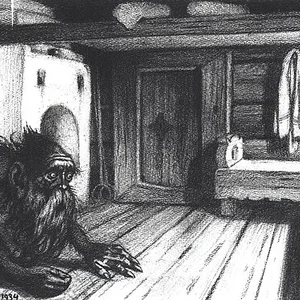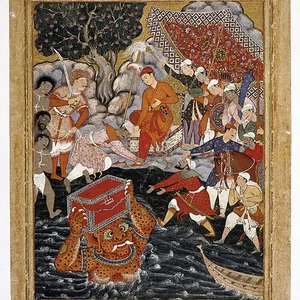

The ifrit is a powerful category of jinn in Islamic tradition, created from smokeless fire. Known for their cunning and danger, they appear in the Quran and One Thousand and One Nights. These supernatural beings hold a central place in medieval Muslim folklore and cosmology.
Ifrit
Ifrit
9 min read
Frequently asked questions
Key Facts
- Mentioned in the Quran (Surah An-Naml, verse 39): an ifrit offers Solomon to bring him the throne of the Queen of Sheba.
- In Islamic tradition, jinn are created from smokeless fire, unlike humans (clay) and angels (light).
- Ifrits are described as the most powerful and malevolent class of jinn in Islamic folklore.
- They appear abundantly in One Thousand and One Nights (compiled between the 8th and 14th centuries), often as formidable antagonists.
- Belief in jinn and ifrits is theologically recognized in Islam, distinguishing between visible beings (humans) and invisible ones (jinn, angels, demons).
Works & Achievements
The founding text that explicitly mentions ifrits and jinn as real beings. These passages form the primary source for all Islamic theology concerning creatures of fire.
The first major Arab scholarly encyclopedia to attempt a philosophical classification of living beings, placing jinn and ifrits within an Aristotelian framework adapted to the Islamic context.
A major literary corpus that brought ifrits into world culture; dozens of stories feature these fire-beings with extraordinary powers, portrayed as both threatening and wondrous.
A grand geographical and historical encyclopedia of the medieval Islamic world that incorporates ifrits into a comparative cosmology drawing on Arab, Persian, and Greek traditions.
A Sufi mystical summa offering an esoteric reading of ifrits as intermediary spiritual forces; its influence on both Eastern and Western Islamic mysticism has been lasting.
A theological treatise affirming the reality of jinn and ifrits, distinguishing those who submit to Islamic law from those who defy it; a normative reference in medieval Sunni scholarship.
Anecdotes
In the Quranic surah An-Naml (verse 39), an ifrit offers the prophet Solomon (Sulayman) to bring him the throne of Bilqis, the Queen of Sheba, before he could even rise from his seat. This episode illustrates the extraordinary power attributed to these beings, capable of accomplishing in an instant tasks that would be impossible for humans.
According to medieval Islamic cosmology, jinn — of which ifrits are the most fearsome class — were created from 'smokeless fire' (nār al-samūm), while angels were made of light and humans of clay. This hierarchy of creatures is described in several hadiths and Quranic commentaries, and profoundly shaped medieval theological thought.
In One Thousand and One Nights, the story of 'The Fisherman and the Jinni' features an ifrit imprisoned in a copper jar sealed with the seal of Solomon. Confined for centuries, he had at first promised treasures to whoever freed him, but consumed by rage over time, had resolved to kill his liberator instead — only to be ultimately outwitted by the fisherman's cunning.
The theologian and philosopher Al-Jahiz (776–869), in his encyclopedia Kitāb al-Hayawān, devotes several passages to jinn and ifrits, attempting to reconcile their Quranic descriptions with Greek natural philosophy. He classifies them among fire-born beings endowed with reason, distinct from animals and humans alike, reflecting the scholarly interest of the Abbasid world in these entities.
The term 'ifrit' came to mean, in medieval popular usage, any particularly cunning or malevolent being, human or otherwise. Chroniclers such as Al-Masudi report that the expression 'he is an ifrit' was used to describe a man of extraordinary skill or wickedness, attesting to how deeply these creatures were embedded in everyday imagination.
Primary Sources
An ifrit from among the jinn said: 'I will bring you her throne before you rise from your place. Indeed, I am strong and trustworthy for this.'
Say: 'It has been revealed to me that a group of jinn listened [to the Quran] and said: We have heard a wondrous recitation that guides to righteousness.'
Jinn are beings of airy fire endowed with intelligence and will; the most powerful among them, the ifrits, can take any form and cross vast distances in the blink of an eye.
Inside the jar was a genie of the race of rebellious ifrits, whom King Solomon, son of David, had imprisoned there for refusing to submit to his commands.
The Arabs count among the ifrits those jinn who have chosen rebellion and pride, refusing to submit to either God or the prophets; their power surpasses that of all other jinn.
Key Places
Birthplace of Islam and the place where the first mentions of jinn were revealed in the Quran. Ifrits are part of the Islamic cosmology that emerged from this pre-medieval Arabian context.
Capital of the Abbasid Caliphate and center of medieval scholarly culture where the tales of One Thousand and One Nights developed; stories of ifrits were collected, expanded, and set down in writing there.
Region associated with the Queen of Sheba (Bilqis), whose throne was brought to Solomon by an ifrit according to the Quran. This place roots the figure of the ifrit in a real geography and a specific scriptural episode.
The main center for the transmission and copying of One Thousand and One Nights manuscripts from the 13th century onward; it was here that the corpus was greatly enriched with tales of marine and urban ifrits.
Hub of Sunni theological tradition where Ibn Taymiyya wrote his treatises on jinn and ifrits, seeking to frame popular belief within an orthodox religious framework.
Typical Objects

A traditional vessel used to imprison rebellious ifrits, sealed with the Seal of Solomon. In the Thousand and One Nights, this jar symbolizes both the prophet's power and the threat posed by the chained ifrit.

A magic ring engraved with the name of God, attributed to the prophet Solomon, the only one capable of subduing the most powerful ifrits and djinn. Whoever possesses it holds absolute authority over beings of fire.

A symbol of the substance from which ifrits are made, according to the Quran — the 'smokeless fire' (nâr al-samûm). Medieval miniaturists often depicted ifrits surrounded by glowing red embers.

An object frequently associated with djinn and ifrits in medieval Arabic literature, serving as a dwelling or a prison; Aladdin's lamp, though a later addition, belongs to this age-old tradition.

A magical text used by medieval sorcerers and magicians in attempts to summon or control ifrits. These talismans combined Quranic verses with esoteric formulas inherited from pre-Islamic traditions.

The form an ifrit takes to manifest itself to humans, according to many medieval accounts. This spectacular apparition reflected the being's fiery nature and its ability to transform at will.

In the Quran, an ifrit offers to instantly transport this monumental throne from Yemen to Palestine for Solomon, providing a vivid illustration of these beings' supernatural power.
School Curriculum
Vocabulary & Tags
Key Vocabulary
Tags
Daily Life
Morning
The ifrit, a being unconstrained by human solar cycles, spends the daylight hours in places abandoned by people: ruins, deep caves, ocean depths, or the interstitial spaces between the visible and invisible worlds. According to tradition, djinn withdraw at dawn to their own dwellings, located in wild and impure places.
Afternoon
According to medieval accounts, ifrits can travel vast distances in an instant thanks to their fiery nature. They observe the human world — sometimes invisible, sometimes disguised as animals or humans — always guided by their cunning and their own will, whether benevolent toward their allies or hostile toward their enemies.
Evening
It is at nightfall that ifrits are said to be most active and dangerous, according to medieval Islamic folklore. Believers would recite protective Quranic verses (known as verses of protection, especially the Ayat al-Kursi) to ward off their appearances. The ifrit then manifests as a column of fire or as a gigantic being.
Food
As a being of fire rather than flesh, the ifrit does not eat in any human sense. According to certain hadiths and medieval theological commentaries, djinn feed on smoke, burnt bones, excrement, or whatever humans leave behind without pronouncing the name of God — which explained certain ritual purification rules.
Clothing
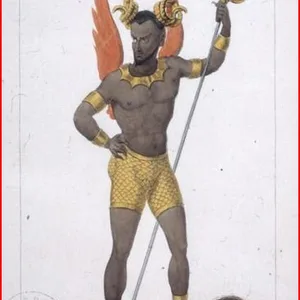
Ifrits have no clothing in the conventional sense, but medieval miniaturists and storytellers often depicted them draped in veils of flame or clad in dark armor forged from a metal unknown to humans. When they take human form to deceive mortals, they wear garments suited to their disguise.
Housing
According to the Thousand and One Nights, ifrits inhabit underground or underwater palaces of a splendor surpassing the finest human constructions. In stricter theological tradition, they reside in liminal spaces — deserts, ruins, latrines, crossroads — all places that human civilization has not sanctified through prayer.
Historical Timeline
Period Vocabulary
Visual Style
Un style inspiré des enluminures de manuscrits abbassides du XIIIe siècle, dominé par le rouge braise, le noir profond et l'or, avec une figure de feu monumentale surgissant d'ornements calligraphiques arabesques.
Sound Ambience
Une atmosphère sonore entre désert nocturne et caverne souterraine, dominée par le crépitement du feu sans fumée et des vents surnaturels évoquant la puissance invisible des êtres de feu.
Liens externes & ressources
Références
Œuvres
Le Coran — Sourate An-Naml et Sourate Al-Jinn
Vers 610–632
Kitâb al-Hayawân (Le Livre des Animaux), Al-Jahiz
Vers 847–868
Alf Layla wa-Layla (Les Mille et Une Nuits)
IXe–XIIIe siècle (compilation progressive)
Murûj al-Dhahab (Les Prairies d'Or), Al-Masudi
Vers 947
Futûhât al-Makkiyya (Les Révélations mecquoises), Ibn Arabi
XIIIe siècle
Îqâz al-Wahân fî Amr al-Djinn, Ibn Taymiyya
Début XIVe siècle