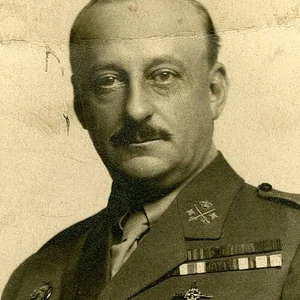

A Spanish general born in 1870, he established a dictatorship in Spain from 1923 to 1930 following a coup d'état. His authoritarian regime, backed by King Alfonso XIII, preceded the political crisis that led to the Second Spanish Republic.
Miguel Primo de Rivera(1870 — 1930)
Miguel Primo de Rivera
Espagne
9 min read
Frequently asked questions
Key Facts
- 1870: born in Jerez de la Frontera (Andalusia)
- 13 September 1923: military coup and seizure of power with the approval of King Alfonso XIII
- 1923–1930: establishment of a military dictatorship, suspension of the Constitution
- 1930: forced resignation amid growing opposition, died in exile in Paris
- His son José Antonio Primo de Rivera founded the Spanish Falange in 1933
Works & Achievements
The founding act of his dictatorship, the coup suspended the Constitution of 1876, dissolved Parliament, and established a government of generals. It was the central political act of his life, bringing an end to the liberal regime of the Restoration.
Primo de Rivera launched a sweeping infrastructure modernisation programme: construction of national roads, expansion of the railway network, and rural electrification. These tangible achievements secured him a degree of popular support in the early years of his dictatorship.
In coordination with France, Primo de Rivera organised the landing at Alhucemas in northern Morocco, which led to the defeat of Abd el-Krim and the pacification of the Rif. This military victory was presented as the redemption of Spanish honour after the disaster of Annual.
An attempt to create a mass party loyal to the regime, the Patriotic Union brought together local notables, conservative Catholics, and civil servants. It remained a fragile instrument, lacking any coherent ideology, and disappeared along with the dictatorship.
After the purely military phase, Primo de Rivera attempted to institutionalise his regime by creating an assembly with no real legislative powers, tasked with drafting a new constitution. The project failed in the face of opposition and produced no adopted text.
The regime organised two simultaneous international expositions: the Barcelona International Exposition and the Ibero-American Exposition of Seville. Showcased as symbols of Spain's modernisation, they left behind heavy debts that contributed to the fall of the dictatorship.
Anecdotes
On the night of September 12–13, 1923, Primo de Rivera had his manifesto posted on the walls of Barcelona before even informing King Alfonso XIII. This coup by way of wall posters was typical of the Spanish-style *pronunciamiento*: the general presented himself as an "iron surgeon" come to heal a Spain sick with corruption and political disorder.
An opponent of press freedom, Primo de Rivera did not hesitate to publish, in the newspapers himself
unofficial notes" written in the first person, in a familiar and sometimes impulsive tone. These texts were surprising for their conversational style, unusual for a dictator, yet concealed a fierce censorship of any dissenting opinion.
Miguel de Unamuno, the great philosopher and rector of the University of Salamanca, dared to publicly insult Primo de Rivera and the king. In retaliation, the dictator had him removed from his post and exiled to the Canary Islands in 1924. Unamuno escaped and continued his criticism from Paris, becoming a symbol of intellectual resistance to the dictatorship.
After governing Spain for six years, Primo de Rivera consulted the army's captain-generals in January 1930 to find out whether he still had their confidence. Faced with their evasive answers, he understood he had been abandoned and handed his resignation to the king on **January 28, 1930**. He died in Paris, alone and penniless, less than two months later, on **March 16, 1930**.
His son, **José Antonio Primo de Rivera**, founded the Spanish Falange in 1933, a fascist-inspired movement, to avenge his father's honor. The family name would thus run through the entire tragedy of the Second Republic and the Spanish Civil War, linking two generations to the darkest chapter of contemporary Spanish history.
Primary Sources
Spaniards: The moment has arrived — more feared than awaited — to gather the longings of the people, to heed the clamorous call of all those who, loving the Fatherland, see no salvation for it other than to free it from the professional politicians.
The Military Directorate considers the temporary suspension of constitutional guarantees necessary to ensure public order and the cleansing of Spanish political life.
Spain needs a profound regeneration that cannot come from the old, worn-out parties, but from the renewing energy of the people themselves, guided by honest and patriotic men.
Sire: Having lost the confidence of the army's captain generals, the supreme office of the nation, General Primo de Rivera considers it his duty to place at Your Majesty's disposal the power that was entrusted to him in September 1923.
Key Places
Birthplace of Miguel Primo de Rivera, born in 1870 in this Andalusian city with a long tradition of military and aristocratic influence. Several members of his family had already served in the Spanish army before him.
It was from Barcelona, where he commanded the military garrison as Captain General of Catalonia, that Primo de Rivera launched his coup d'état on September 13, 1923. The city, stirred by anarchism and separatism, was the symbolic starting point of his national 'regeneration.'
The seat of the dictatorship's government from 1923, Madrid was the center of Primo de Rivera's power for six years. It was there that he led the Military and then Civil Directorate, receiving ambassadors and publishing his famous unofficial notes.
Primo de Rivera served in Morocco several times during his military career, and it was the Moroccan crisis (the Annual disaster, 1921) that hastened his coup. The pacification of the Rif in 1925 was his greatest military and political success.
After his resignation on January 28, 1930, Primo de Rivera went into exile in Paris, where he died on March 16, 1930, alone, ill, and penniless. His swift death, met with general indifference, was seen as a symbol of the failure of his authoritarian attempt to regenerate Spain.
Typical Objects

Primo de Rivera wore the captain general's uniform at all times — the highest rank in the Spanish army. This military dress, heavy with decorations, symbolized his authority and legitimized his power in the eyes of the military institution.

Born into a military family from Andalusia, Primo de Rivera had cut his teeth in the cavalry. The sabre was a strong marker of identity for officers of his generation, a symbol of honor and Spain's warrior tradition.

A modernist man of government in his own way, Primo de Rivera made extensive use of the telephone to communicate directly with the military governors of the provinces. The instrument allowed him to exercise centralized, immediate control over the entire territory.

The dictator had a habit of sending newspapers "unofficial notes" written in his own hand, commenting on current events in a direct, personal style. These texts — halfway between an official communiqué and a personal column — were his primary tool for shaping public opinion.

A devoted cigar smoker, Primo de Rivera was often depicted with a cigar — an attribute associated in the popular imagination of the era with the authoritarian man of power. The image contributed to his persona as a virile, resolute leader.

A veteran of Cuba, the Philippines, and Morocco, Primo de Rivera wore numerous military medals on his uniform. These distinctions recalled his long career in the colonies and grounded his legitimacy as a military commander before it ever rested on his role as a political leader.
School Curriculum
Vocabulary & Tags
Key Vocabulary
Daily Life
Morning
General Primo de Rivera began his day early, true to military discipline. He received reports from his directors-general and military civil governors, reviewed police notes on the state of public opinion, and signed urgent decrees before attending Directorate meetings.
Afternoon
Afternoons were devoted to official audiences: foreign ambassadors, military commanders, representatives of the Church and business circles. Primo de Rivera also enjoyed walking the streets of Madrid incognito to take the pulse of the population, or visiting cafés to listen to ordinary opinion.
Evening
The dictator's evenings blended social obligations with personal relaxation. He frequented the military and aristocratic circles of Madrid, occasionally attended the theatre or the *zarzuela* (Spanish operetta), and often wrote late into the night the unofficial notes he sent to newspapers.
Food
Like most Andalusian officers of his generation, Primo de Rivera was devoted to traditional Spanish cuisine: gazpacho, fried fish, Iberian ham, and meat stews. An avid lover of Jerez wine (sherry), he kept a generous table, characteristic of the aristocratic military sociability of the era.
Clothing
In public, Primo de Rivera wore his captain-general's uniform almost invariably, laden with decorations and gold braid. This military attire was a permanent assertion of the military nature of his power. In private, he occasionally allowed himself the more relaxed dress of an Andalusian gentleman.
Housing
As head of government, Primo de Rivera resided at the Palace of Buenavista in Madrid, the seat of the Ministry of War which he also held. He maintained ties with Andalusia, where the family estates were located, but Madrid was the centre of his life throughout the dictatorship.
Historical Timeline
Period Vocabulary
Liens externes & ressources
Références
Œuvres
Coup d'État et instauration du Directoire militaire
13 septembre 1923
Programme national de travaux publics
1923-1930
Campagne d'Alhucemas et pacification du Rif
1925
Création de l'Union Patriotique
1924
Assemblée nationale consultative
1927
Expositions de 1929 (Barcelone et Séville)
1929