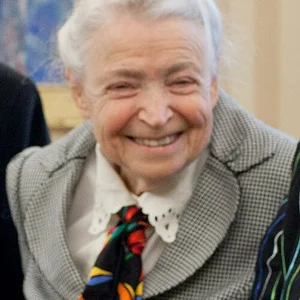

American physicist nicknamed the “queen of carbon” for her pioneering work on the electronic structure of graphite and carbon-based materials. Her research paved the way for carbon nanotubes and graphene.
Mildred Dresselhaus(1930 — 2017)
Mildred Dresselhaus
États-Unis
5 min read
Frequently asked questions
Key Facts
- Born in 1930 in the Bronx, New York, into a modest background
- Earned her doctorate at the University of Chicago in 1958, where she was encouraged by Enrico Fermi
- Became a professor at MIT and the first woman there to obtain a tenured professorship in engineering (1968)
- Received the National Medal of Science in 1990 for her work on carbon-based materials
- Received the Presidential Medal of Freedom in 2014; died in 2017
Works & Achievements
Completed at the University of Chicago in the wake of Enrico Fermi, it studies the microwave properties of superconductors. This work launches her career as an experimental physicist.
She explores how to insert other atoms between the layers of graphite to alter its electrical properties. This research makes her a world expert on carbon.
With her colleagues, she calculates that a nanotube can be conducting or semiconducting depending on its geometry. This theoretical prediction precedes many experiments.
With her student Lyndon Hicks, she shows that nanostructures can convert heat into electricity far more efficiently. This idea revives an entire field of research.
A landmark co-authored work that brings together the knowledge on the new forms of carbon. It trains a generation of researchers in nanoscience.
Barack Obama awards her the highest American civilian honor for her entire body of scientific work. She is hailed as the “queen of carbon.”
Anecdotes
As a teenager in a modest Bronx neighborhood, Mildred Dresselhaus took classes from Rosalyn Yalow at Hunter College. This teacher, who would later receive the Nobel Prize in Medicine, spotted her talent and encouraged her to turn toward physics, a field then almost entirely closed to women.
At the University of Chicago, the young researcher lived very close to the famous physicist Enrico Fermi. They often walked to campus together, discussing science. These conversations left a lasting mark on the way she approached research.
She was nicknamed the “queen of carbon” because she devoted her career to studying this single element in all its forms. Her work on graphite paved the way for the discovery of nanotubes and graphene, materials that are transforming modern electronics.
A passionate musician, Mildred Dresselhaus played the violin all her life. As a child, she even earned a little money through music, before discovering her calling for science.
In February 2017, just a few days before her death, she appeared in an advertisement for the company General Electric. The film imagined a world where women scientists would be treated like celebrities, in order to encourage young girls to choose these careers.
Primary Sources
“Follow your interests, get the best possible education and training, aim high, be persistent and flexible, keep your options open, accept the help offered to you, and be ready to help others.”
“Rosalyn Yalow, who would later win the Nobel Prize, was my physics teacher at Hunter College; she was the one who encouraged me to pursue this path.”
Key Places
Neighborhood where she was born in 1930 into a family of poor immigrants. She then grew up in the neighboring Bronx.
Institution where she studied and met future Nobel laureate Rosalyn Yalow. It was there that her scientific calling was born.
Place where she earned her doctorate in 1958, within the intellectual environment of Enrico Fermi.
She studied there thanks to a Fulbright scholarship in the early 1950s, an important step in her training.
Institution where she spent most of her career, from the Lincoln Laboratory to the title of Institute Professor. There she trained generations of researchers.
Typical Objects

A device that illuminates a material with a laser and analyzes the scattered light to reveal its structure. It is one of her favorite instruments for studying carbon.

An instrument capable of magnifying matter millions of times using a beam of electrons. It makes it possible to see structures as fine as carbon nanotubes.

A block or sheet of pure carbon, the same material as the lead in a pencil. It serves as the base material for her experiments on electronic structure.

A cooled coil producing a very intense magnetic field. She uses it to study the behavior of electrons in carbon-based materials.

The physicist's everyday tool for writing out her equations and teaching her students. The theory of carbon is sketched there before the experiments.

An instrument she plays passionately all her life. Music has accompanied her since childhood and remains her favorite pastime outside the laboratory.
School Curriculum
Vocabulary & Tags
Key Vocabulary
Tags
Daily Life
Morning
A mother of four children, Mildred Dresselhaus organizes her day early, between home and the laboratory. She heads to **MIT** in the morning for her experiments and to prepare her classes.
Afternoon
Her afternoons are split between laboratory work, data analysis, and mentoring her students. She places great importance on dialogue with young researchers.
Evening
In the evening, after taking care of her family, she often returns to her calculations and scientific reading. She also makes time for the violin, her lifelong passion.
Food
She follows the ordinary diet of a 20th-century American middle-class family. Meals are simple, eaten between two days of intense work.
Clothing
She wears the plain, practical attire of a university professor. Her unassuming appearance contrasts with the great renown of her work.
Housing
She lives in a house in the suburbs of **Boston**, near **MIT**. Her home is where both family life and the relentless work of a researcher take place.
Historical Timeline
Period Vocabulary
Liens externes & ressources
Références
Œuvres
Thèse de doctorat sur les supraconducteurs sous champ magnétique
1958
Travaux sur les composés d'intercalation du graphite
années 1970-1980
Prédiction des propriétés électroniques des nanotubes de carbone
1992
Théorie des matériaux thermoélectriques de basse dimension
1993
Livre « Science of Fullerenes and Carbon Nanotubes »
1996
Médaille présidentielle de la Liberté
2014