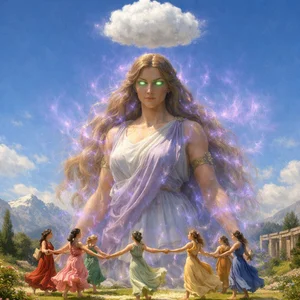

Greek Titaness personifying Memory, daughter of Ouranos and Gaia. United with Zeus for nine consecutive nights, she gave birth to the nine Muses, divine patrons of the arts and sciences. Her name is the origin of the word “mnemonic.”
Mnemosyne
Mnemosyne
10 min read
Frequently asked questions
Key Facts
- Titaness, daughter of Ouranos (the Sky) and Gaia (the Earth), according to Hesiod’s *Theogony* (c. 700 BCE)
- United with Zeus for nine consecutive nights in Pieria, giving birth to the nine Muses
- Personification of Memory in the Greek pantheon, guardian of the transmission of myths and poetry
- In the Orphic tradition, a freshwater spring named Mnemosyne stands in opposition to Lethe (Forgetfulness) in the realm of the dead
- Her name gave rise to the learned prefix “mnemo-” (mnemotechnics, mnemonics)
Works & Achievements
Mnemosyne's crowning achievement was giving birth to the nine Muses with Zeus. These goddesses — Calliope (epic poetry), Clio (history), Erato (lyric poetry), Euterpe (flute), Melpomene (tragedy), Polyhymnia (hymns), Terpsichore (dance), Thalia (comedy), and Urania (astronomy) — are the living embodiment of Memory deified, the guardians of all human creation.
Mnemosyne is the guardian of a spring in the Underworld, a true soteriological institution offering initiated souls the possibility of escaping the cycle of reincarnation. This “divine work” is attested by the Orphic gold tablets discovered archaeologically in several tombs throughout Magna Graecia.
Before alphabetic writing, Mnemosyne embodied the oral transmission of all human knowledge. The bards and rhapsodes who recited the Iliad and the Odyssey from memory for hours on end were considered servants of the goddess, who “lent” her divine power to their recitations.
Plato develops in the Meno and the Phaedo a theory according to which learning is nothing but remembering knowledge acquired before birth. This major philosophical concept of anamnesis (re-membering) is directly inspired by the mythological role of Mnemosyne, goddess of eternal Memory.
The Oracle of Trophonius at Lebadea incorporated an elaborate ritual featuring Mnemosyne through a spring bearing her name. This rite, described in precise detail by Pausanias in the 2nd century CE, attests to the deep cultic roots of the goddess within concrete Greek religious practice.
Anecdotes
Mnemosyne is a Titaness born of the union of Ouranos (the Sky) and Gaia (the Earth), making her one of the oldest deities in the Greek pantheon. Her name literally means "Memory" in ancient Greek, and she embodies the ability to preserve and transmit knowledge across time.
According to Hesiod in the Theogony, Zeus united with Mnemosyne for nine consecutive nights in Pieria. From this union were born the nine Muses — Calliope, Clio, Erato, Euterpe, Melpomene, Polyhymnia, Terpsichore, Thalia, and Urania — guardians of the arts, poetry, music, history, and the sciences. Mnemosyne is thus the symbolic mother of all artistic and intellectual creation.
In the Orphic tradition, Mnemosyne is associated with a spring located in the Underworld, set in opposition to the river Lethe (Oblivion). The souls of the deceased who had been initiated into the Orphic mysteries were to drink from this spring in order to preserve their memory in the afterlife, thereby avoiding the cycle of reincarnation. Gold tablets discovered in Greek tombs dating to the 5th century BC contain instructions to guide the soul toward this sacred spring.
Her name is directly at the origin of the word "mnemonic
which refers to techniques for improving memory. In ancient Greece, before writing became widespread, memory was considered the foundation of all civilization: the aoidoi (singer-poets) memorized thousands of verses to pass down the Iliad and the Odyssey from generation to generation, invoking the Muses — daughters of Mnemosyne — at the start of each recitation.
Mnemosyne was venerated at several Greek sanctuaries, most notably at Lebadea in Boeotia, where the oracle of Trophonius was located. Before descending into the oracular cave, those who came to consult the oracle had to drink from two separate springs: first from Lethe, to forget their ordinary lives, and then from Mnemosyne, to memorize everything they would see and hear in the depths of the earth.
Primary Sources
"Fair-haired Mnemosyne, whose fields adorn the slopes of Eleutherae. United with father Zeus, she bore the nine golden-crowned Muses, who delight in feasts and melodious song."
"You will find to the left of the house of Hades a spring, and beside it stands a white cypress. Do not approach this spring. Further on you will find the cool water flowing from the lake of Mnemosyne; guardians stand before it."
"It is through the Muses and Apollo that men are poets and lyre-players upon the earth; kings come from Zeus. Happy is he whom the Muses love!"
"Silver-armed Memory, mother of the Muses, has willed that the brilliant victory won at Pisa should also be celebrated."
"At Lebadeia, whoever wishes to consult the oracle of Trophonius must first spend several days in the sanctuary of Agathos Daimon. He then drinks from the spring of Lethe to forget, then from the spring of Mnemosyne in order to remember everything he will see."
Key Places
Mountainous region of northern Greece where, according to Hesiod, Zeus united with Mnemosyne for nine consecutive nights, giving birth to the nine Muses. Pieria is considered the birthplace of the Muses' cult in Greek tradition.
Sacred mountain of central Greece where the main sanctuary of the Muses, daughters of Mnemosyne, was located. The springs Hippocrene and Aganippe, gushing from its slopes, were believed to grant poetic inspiration to artists who came to pray there.
Oracular sanctuary in Boeotia where two springs bore the names of Lethe and Mnemosyne. Pilgrims had to drink successively from these two springs before descending into the oracle's cave — a ritual symbolizing the forgetting of one's ordinary past, followed by a purified memory.
The highest mountain in Greece and home of the Olympian gods, where Mnemosyne resided as a Titaness allied with the Olympians after the Titanomachy. It was from Olympus that the Muses, her daughters, bestowed their artistic and intellectual gifts upon humanity.
Mythological place in the depths of Hades where the spring of Mnemosyne was located, as described in the Orphic tablets. In contrast to the Lethe (river of forgetting), this spring allowed initiated souls to preserve their identity and memories in the afterlife.
Typical Objects

A ritual cup or bowl containing water from the spring of Memory in the Underworld. In the Orphic tradition, drinking from this cup allowed the soul of the deceased to preserve its identity and memories for eternity, in opposition to the oblivion granted by the river Lethe.

An ephemeral writing surface used in ancient Greece, often employed as a metaphor for human memory. Plato, in the *Theaetetus*, compares the mind to a wax tablet on which impressions are stamped — an image directly inherited from the divine role of Mnemosyne.

The sacred plant of Apollo, closely associated with the Muses, daughters of Mnemosyne. Poets and artists inspired by the Muses were crowned with laurel, a symbol of the divine memory passed down through their Titaness mother.

The emblematic instrument of the Muses and Apollo, representing the harmony of the arts born of Mnemosyne. Music, before the advent of writing, was the primary means of fixing stories in the memory, making the lyre the concrete tool of Memory made divine.

The preferred writing medium of the Hellenistic Greek world, it symbolizes humanity's attempt to immortalize memory through the written word. The great libraries of antiquity, such as that of Alexandria, can be seen as earthly sanctuaries dedicated to Mnemosyne.

In Greek and Orphic cosmology, springs of pure water represent knowledge and memory. The spring of Mnemosyne in the Underworld is described as a place of absolute clarity where the water preserves what time erases — a powerful image of the persistence of memory.
School Curriculum
Vocabulary & Tags
Key Vocabulary
Daily Life
Morning
Mnemosyne, an immortal Titaness, is not subject to the daily cycle of mortals. According to the Hesiodic tradition, she dwells sometimes on Olympus among the gods, sometimes in the depths of the Earth from which she sprang. Her mythic “morning” corresponds to the time of recounting origins: Greek bards invoked her at the dawn of their poetic performances, asking the Muses — her daughters — to breathe into them the memorial inspiration needed for the recitation of epics.
Afternoon
In the Greek imagination, Mnemosyne fulfills her role as guardian of collective memory through the song and speech of her daughters the Muses. Each afternoon on Mount Helicon, the Muses danced and sang in a circle, perpetuating under their mother’s guidance the tales of divine and heroic exploits. This “daytime” activity symbolizes the continuous work of preserving knowledge that the goddess embodies.
Evening
In the evening, according to Orphic tradition, Mnemosyne watches over the souls of the dead as they make their way through the Underworld. It is the time of passage between life and death, the moment when memory becomes vital for preserving the soul’s identity. The dead who had been initiated into the Orphic mysteries had to recall, at the twilight of their lives, the sacred formulas needed to find the spring of Mnemosyne and avoid straying toward the Lethe.
Food
As an immortal Titaness, Mnemosyne does not consume mortal food but sustains herself, like all Greek gods, on nectar and ambrosia. These divine substances symbolize immortality and preservation — a perfect analogy for the role of Memory, which “preserves” the events of the past. In Greek rituals held in her honor, offerings of pure water were poured as libations, recalling the spring that bears her name.
Clothing
Mnemosyne is depicted in Greek iconography as a majestic woman dressed in a chiton (a draped linen or wool tunic) and a himation (a large cloak), often in purple or white — colors associated with divine royalty and purity. Her garments bear no warrior ornaments, reflecting her intellectual and contemplative nature. She is sometimes depicted veiled, symbolizing the elusive nature of memory.
Housing
Mnemosyne resides on Olympus, the mountain of the gods, but her true “domain” is Pieria at the foot of Olympus, the birthplace of her daughters the Muses. She is also present in the Underworld, where her spring flows deep within the Earth — a reminder of her chthonic origins as a daughter of Gaia. Her realm is therefore both celestial (Olympus, transmission of knowledge to the gods) and subterranean (Hades, preservation of souls).
Historical Timeline
Period Vocabulary
Liens externes & ressources
Références
Œuvres
Les neuf Muses
Avant le VIIIe siècle av. J.-C. (tradition archaïque)
La source de Mnémosyne aux Enfers
Tradition orphique, VIe-Ve siècle av. J.-C.
L'institution de la mémoire poétique et orale
Époque archaïque grecque, IXe-VIIe siècle av. J.-C.
Le mythe de l'anamnèse platonicienne
IVe siècle av. J.-C.
Les rites d'incubation à Lébadée
Ve-IIe siècle av. J.-C.