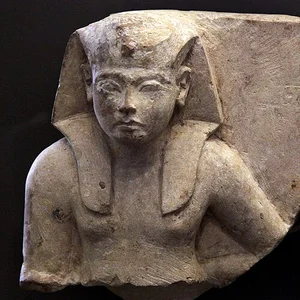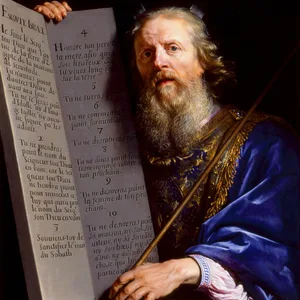

Moses is a central figure in the Hebrew Bible and Judaism. According to biblical tradition, he led the Hebrew people out of Egypt during the Exodus and received the Ten Commandments on Mount Sinai. He is venerated as the great lawgiver and prophet of the people of Israel.
Moses
Jean-Charles Moise
Haïti
8 min read
Frequently asked questions
Key Facts
- Leading the Exodus: liberation of the Hebrews from Egypt (biblical tradition, 13th–12th century BCE)
- Receiving the Ten Commandments on Mount Sinai
- Authorship of the Torah (according to Jewish tradition)
- Establishment of the Covenant between God and the people of Israel
- Leadership of the Hebrews for 40 years in the desert
Works & Achievements
Fundamental moral and religious code revealed to Moses on Mount Sinai, according to the Bible. It forms the ethical foundation of Judaism, Christianity, and, indirectly, Islam.
The first five books of the Bible (Genesis, Exodus, Leviticus, Numbers, Deuteronomy) are traditionally attributed to Moses. They contain the Law, the history of the Hebrew people, and the foundations of monotheism.
A body of civil, social, and religious laws transmitted by Moses to the Hebrew people in Exodus (chapters 20–23). It governs communal life and foreshadows Western legal codes.
Moses oversaw the construction of the Tabernacle, a portable sanctuary designed to house the Ark of the Covenant during the sojourn in the desert. It is the first organized place of worship in Hebrew monotheism.
A victory hymn sung by Moses and the Hebrews after crossing the Sea of Reeds (Exodus 15). It is considered by scholars to be one of the oldest poems in the Hebrew Bible.
Anecdotes
According to biblical tradition, Moses was born during a period of persecution: Pharaoh had ordered the killing of all newborn Hebrew males. His mother hid him for three months, then placed him in a wicker basket on the Nile. He was discovered by Pharaoh's daughter, who adopted him and gave him the name 'Moses', meaning 'drawn from the water' in Egyptian.
One of the most famous episodes in Moses's life is that of the Burning Bush: while tending a flock on Mount Horeb, he saw a bush that burned without being consumed. It was there that, according to the Bible, God revealed his name — YHWH — and entrusted him with the mission of freeing the Hebrew people from Egypt.
During the crossing of the desert, the Bible recounts that the Hebrew people grumbled against Moses for lack of water. God then commanded him to strike a rock with his staff: a spring immediately gushed forth, quenching the thirst of all the people and their flocks. This episode, known as the 'Waters of Meribah', illustrates Moses's role as mediator between God and his people.
On Mount Sinai, Moses spent forty days and forty nights without eating or drinking, according to tradition, in order to receive the Tablets of the Law. Upon his return, he found the people worshipping a golden calf. In a fit of anger, he shattered the first Tablets, before ascending the mountain again to obtain new ones.
Moses died, according to the Bible, within sight of the Promised Land, on Mount Nebo (in present-day Jordan), without ever entering it. He was 120 years old according to the biblical text. His tomb remained undiscovered, which fuelled many traditions and legends across the three monotheistic religions.
Primary Sources
God said to Moses: 'I am who I am.' He added: 'You shall say to the children of Israel: I am has sent me to you.' (Ex 3:14)
Israel is laid waste, his seed is no more. Palestine has become a widow for Egypt.
Hear, O Israel: The Lord our God is the one Lord. You shall love the Lord your God with all your heart, with all your soul, and with all your strength. (Dt 6:4-5)
Moses was of remarkable beauty and superior intelligence; he commanded the Egyptian armies and won victories over the Ethiopians before becoming the leader of his people.
Moses was instructed in all the wisdom of the Egyptians, and he became mighty in words and deeds. He was the greatest of the philosophers and lawgivers the world has ever known.
Key Places
Region of the eastern Nile Delta where the Hebrews lived according to the Bible, employed notably in the construction of the cities of Ramesses and Pithom. It is here that Moses was born and where his mission began.
Sacred mountain where Moses received the Ten Commandments according to biblical tradition. The traditional site is identified as Jebel Musa on the Sinai Peninsula (present-day Egypt).
Body of water miraculously crossed by the Hebrew people during the Exodus, according to the Bible. Its exact location is debated: some identify it with the Red Sea, others with lakes in the northern Sinai.
Desert oasis where the Hebrew people camped for a long period during their forty years of wandering. It is a major stopping point of the Exodus journey according to the Bible.
Summit from which Moses beheld the Promised Land, without ever entering it, just before his death. It is today a place of pilgrimage for the three monotheistic religions.
Territory that God promises to Abraham and his descendants, according to the Bible. Moses's entire mission tends toward the deliverance of the people and their return to this land.
Typical Objects

The staff is the emblematic attribute of Moses in the Bible. It allows him to perform miracles: transformation into a serpent before Pharaoh, parting the waters of the Red Sea, or making water spring forth from a rock.

Two stone tablets on which the Ten Commandments are engraved, received from God on Mount Sinai. They symbolize the covenant between God and the people of Israel, and form the foundation of Mosaic law.

A sacred chest made of acacia wood covered in gold, built on divine order transmitted by Moses to contain the Tablets of the Law. It symbolizes the divine presence among the people during their journey through the desert.

According to the Bible, it was in a basket coated with bitumen and pitch that Moses's mother placed him on the Nile to save him from Pharaoh's death decree. This object recalls the exceptional destiny of the figure from birth.

The central symbol of Moses's calling, the bush that burns without being consumed represents the place of divine revelation. It has become a universal image of God's presence in all three monotheistic traditions.

A mysterious substance that fell from the sky each morning to feed the Hebrew people for forty years in the desert, according to biblical tradition. It symbolizes divine providence and the trust that Moses asks his people to have.
School Curriculum
Vocabulary & Tags
Key Vocabulary
Tags
Daily Life
Morning
During the years spent in the royal palace of Egypt, Moses began his day in the manner of an Egyptian prince: ritual purification, a light meal of bread and fruit, followed by military or administrative instruction. After his calling, his mornings were devoted to prayer and divine consultation.
Afternoon
During the wandering in the desert, Moses spent his afternoons dispensing justice: the Hebrews would bring their disputes before him and he would rule in the name of divine Law. On the advice of his father-in-law Jethro, he delegated this task to deputy judges so as not to be overwhelmed.
Evening
In the evening, the people gathered around the campfires. Moses addressed the elders of Israel, conveyed the divine commandments, and recalled the history of the people. The Tent of Meeting, a portable sanctuary, was the spiritual heart of the community where Moses would withdraw to commune with God.
Food
In the desert, the Hebrew people subsisted mainly on manna — a mysterious substance gathered each morning — and on quails that fell, according to the Bible, on certain evenings. Dates, figs, and water from oases supplemented this survival diet during the forty years of wandering.
Clothing
According to traditional iconography and the texts, Moses wore clothing typical of the ancient Near East: a tunic of wool or linen, a loose cloak, and leather sandals. After his descent from Sinai, the Bible says his face shone with a light so intense that he had to veil it with a cloth.
Housing
In the pharaoh's palace, Moses grew up amid the opulence of Egyptian architecture: stone columns, painted ceilings, and precious furniture of cedar and acacia. During the Exodus, he lived like his people under a tent in the desert, his personal tent — known as the 'Tent of Meeting' — serving as a place of communication with God.
Historical Timeline
Period Vocabulary
Visual Style
Esthétique mêlant l'art de l'Égypte du Nouvel Empire et le Proche-Orient ancien : déserts ocre et or, scènes monumentales, lumière dramatique et vêtements de lin blanc.
Sound Ambience
Ambiance sonore du désert du Sinaï et du voyage de l'Exode : vents arides, troupeaux, marche d'un peuple en mouvement, prières collectives et orages sur les montagnes sacrées.
Liens externes & ressources
Références
Œuvres
Les Dix Commandements (Décalogue)
Tradition : XIIIe siècle av. J.-C.
Le Pentateuque (Torah)
Mis par écrit entre le IXe et le Ve siècle av. J.-C.
Le Code de l'Alliance
Tradition : XIIIe siècle av. J.-C.
La construction du Tabernacle
Tradition : XIIIe siècle av. J.-C.
Le Cantique de Moïse (Chant de la Mer)
Tradition ancienne, texte parmi les plus anciens de la Bible