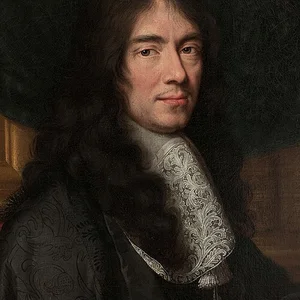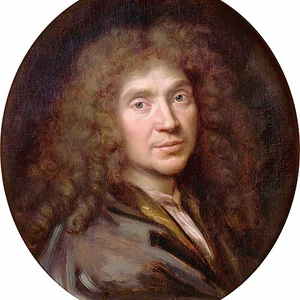

Molière (1622-1673) is the greatest French playwright of the 17th century. Founder of his own theatrical company, he created works of comic genius that critique the flaws and vices of the society of his time.
Molière(1622 — 1673)
Molière
royaume de France
8 min read
Frequently asked questions
Famous Quotes
« The duty of comedy is to correct the vices of men.»
« People of quality know everything without ever having learned anything.»
Key Facts
- 1643: Founds the Illustre Théâtre with his companions
- 1659: Meets Louis XIV and becomes playwright-actor at the royal court
- 1664: Premiere of Tartuffe, a controversial play that scandalizes the Court and the Church
- 1666: Premiere of The Misanthrope, his greatest dramatic work
- 1673: Dies on February 17th shortly after a performance of The Imaginary Invalid
Works & Achievements
Molière's first major Parisian comedy, it mocks young bourgeois women who ape the refinements of the aristocracy. Its immediate success launched the playwright's career in Paris.
A five-act comedy that questions the education of women and male tyranny. The play sparked a lively literary quarrel and established Molière as a leading playwright.
A masterpiece of comedy of character, the play denounces religious hypocrisy through the figure of the false devout Tartuffe. It remains one of the most performed plays in the world.
A bold comedy depicting a cynical libertine who defies God and society. The play was quickly censored but bears witness to Molière's philosophical ambition.
A complex portrait of Alceste, a man devoted to absolute sincerity in a society built on hypocrisy. Considered Molière's most profound play, it blends comedy with moral reflection.
A comedy inspired by Plautus, centred on Harpagon, an old miser obsessed with his strongbox. The character has become the universal embodiment of avarice in French culture.
A comedy-ballet created for Louis XIV, it ridicules Monsieur Jourdain, a bourgeois who desperately wants to imitate the nobility. It also offers a sharp satire of social vanity.
Molière's last play, it mocks medicine and hypochondriacs through the character of Argan. Molière died symbolically while playing the title role during the fourth performance.
Anecdotes
Molière died on stage — or almost. On February 17, 1673, he played the role of the hypochondriac Argan while he himself was gravely ill. Struck by a fit during the performance, he managed to finish the show, but died a few hours later at home, the victim of a pulmonary hemorrhage.
Because he was an actor, Molière nearly ended up buried like a dog. The Church refused Christian burial to actors who had not renounced their profession before dying. Louis XIV had to personally intervene with the Archbishop of Paris to have him quietly interred, at night, in the Saint-Joseph cemetery.
In 1662, Molière married Armande Béjart, a young woman twenty years his junior, who was either the daughter or the sister of his actress and former companion Madeleine Béjart. This marriage scandalized Parisian society and fueled the most malicious rumors about his private life.
Louis XIV himself was the godfather of Molière's first son in 1664, a sign of the exceptional royal favor the playwright enjoyed. This royal protection allowed him to have Tartuffe performed despite the ban by the devout, who had succeeded in having the play suppressed for five years.
Molière began his career with a stinging failure in Paris in 1645 with the Illustre-Théâtre, a company he had founded with the Béjarts. Riddled with debts, he was even briefly imprisoned at the Châtelet. He then spent thirteen years touring the provinces before returning triumphantly to Paris in 1658.
Primary Sources
HARPAGON: What the devil was he going to do in that galley? […] A plague on miserliness and misers!
CLÉANTE: […] There are false devotees just as there are false brave men; and just as we do not see that true brave men are those who make a great noise where honour leads them, so the good and true devout, whom we should follow in their steps, are not those who make so many grimaces.
DON JUAN: […] I believe that two and two make four, Sganarelle, and that four and four make eight.
ALCESTE: I want people to be sincere, and that as men of honour, they utter no word that does not come from the heart.
If one takes the trouble to examine my comedy in good faith, one will perhaps find that it does not stray far enough beyond the bounds of honest and permissible satire.
Key Places
Theatre where Molière's company settled in 1661 and where most of his major plays were first performed. It was the heart of his Parisian activity until his death.
The venue for many premieres of comedy-ballets commissioned by Louis XIV, including Le Bourgeois gentilhomme (1670) and Les Fâcheux (1661). Royal favour was expressed through these grand festivities.
Jean-Baptiste Poquelin was born in 1622 in the family home in the Les Halles district, at the heart of commercial Paris. This bourgeois and artisan milieu sharpened his keen eye for society.
A town in Languedoc where Molière and his company stayed on several occasions during their provincial tours (1650–1657). The barber's chair is preserved there, in the shop where Molière reportedly observed ordinary people.
Molière was quietly buried here at night in February 1673. His remains were transferred to Père-Lachaise in 1817, where his tomb is still visible today.
Typical Objects

A legacy of the Italian commedia dell'arte, the mask symbolizes performance and disguise. Molière freed himself from it by developing an expressive facial style of acting, distinctive to French comedy.

Essential tools of the playwright, used to write plays, often under the pressure of royal commissions. Molière would sometimes compose comédie-ballets for the festivities at Versailles in a matter of weeks.

Embroidered coat, powdered wig, and buckled shoes made up the typical attire of 17th-century actors. Molière performed in his own plays and paid particular attention to costumes in order to enhance character-based comedy.

17th-century playhouses were lit by candlelight, which created a warm but smoky atmosphere. The management of lighting influenced the pace and mood of performances.

Molière was at once author, actor, and theatre director; he managed finances, fees, and contracts. The account books of the Palais-Royal troupe have preserved invaluable records about theatrical life of the era.

An indispensable means of transport for travelling to Versailles for performances commissioned by Louis XIV. Molière and his actors regularly made the journey between Paris and the royal court.
School Curriculum
Vocabulary & Tags
Key Vocabulary
Tags
Mouvement
Daily Life
Morning
Molière would wake up relatively late, in keeping with theater people whose lives are shaped by evening performances. He devoted part of the morning to writing and revising his texts, often seated in his study with a quill and ink. He also received visits from actors, musicians, or royal patrons.
Afternoon
The afternoon was dominated by rehearsals at the Palais-Royal, where Molière directed his troupe with a firm but benevolent hand. He himself played the main comic roles and worked on the details of staging, costumes, and musical effects. Performances took place three times a week before a popular audience mixing bourgeois and aristocrats.
Evening
On performance nights, Molière prepared in his dressing room before taking the stage in front of several hundred spectators. After the show, he would sometimes receive distinguished visitors backstage or dine with members of his troupe. On some evenings, he was invited to Versailles for royal festivities where his plays were performed with great pomp.
Food
The table in 17th-century Paris included bread, thick soups, roasted meats (pork, poultry, game) and boiled vegetables. Ordinary wine was the daily beverage, while chocolate and coffee were beginning to appear in bourgeois households. The financial hardships of the troupe's early years had accustomed Molière to relative frugality, although his later successes allowed him a more comfortable life.
Clothing
In the city, Molière wore the justaucorps — a fitted jacket with skirts — along with woolen breeches, silk stockings, and buckled shoes, the attire of a prosperous bourgeois. A lace collar or muslin cravat completed the ensemble, paired with a curled wig following the fashion of Louis XIV's reign. On stage, the costumes were far more sumptuous: embroidered velvet, feathers, masks, and accessories helped visually define each character.
Housing
In Paris, Molière lived near the Palais-Royal in a comfortable but unpretentious apartment. The dwelling also housed members of his family and sometimes his troupe. After his successes of the 1660s, he was able to settle more comfortably, yet he continued to closely manage his company's finances.
Historical Timeline
Period Vocabulary
Visual Style
Esthétique baroque du Grand Siècle : lumière de chandelles, velours grenat et or, costumes brodés, jeu expressif des visages sur la scène du Palais-Royal.
Sound Ambience
L'atmosphère sonore du Palais-Royal : rires du parterre, clavecin, chandelles qui crépitent et rumeur de la rue parisienne du Grand Siècle.
Liens externes & ressources
Références
Œuvres
Les Précieuses ridicules
1659
L'École des femmes
1662
Tartuffe ou l'Imposteur
1664 (autorisé en 1669)
Dom Juan ou le Festin de Pierre
1665
Le Misanthrope
1666
Le Bourgeois gentilhomme
1670