
Irish Celtic goddess of war, fate, and death, belonging to the mythical people of the Tuatha Dé Danann. Present in medieval Irish texts that preserve much older oral traditions, she embodies sovereignty and the violence of the battlefield. She appears notably in the Ulster Cycle epic, in confrontation with the hero Cú Chulainn.
Morrigan
Morrigan
8 min read
Frequently asked questions
Key Facts
- Belongs to the Tuatha Dé Danann, the divine people of Irish mythology, whose stories were passed down orally before being recorded by Irish monks from the 7th century onward
- Capable of shapeshifting, most notably into a crow or raven — a bird symbolizing death on the battlefield in Irish Celtic tradition
- Plays a central role in the Táin Bó Cúailnge (The Cattle Raid of Cooley), the principal epic of the Ulster Cycle, in which she confronts the hero Cú Chulainn
- Her name is often translated as 'Great Queen' or 'Phantom Queen' in Old Irish, highlighting her connection to sovereignty and the otherworld
- She is sometimes conceived as a trinity of war goddesses — Badb, Macha, and Anand (or Nemain) — depending on the version of the medieval texts
Works & Achievements
The central epic of the Ulster Cycle, in which the Morrigan serves as the primary supernatural antagonist of Cú Chulainn. Her interventions — seduction, shapeshifting, curses — shape several key sequences of the narrative.
An account of the Second Battle of Mag Tuired, in which the Morrigan, having joined forces with the Dagda, fights against the Fomorians and proclaims the victory of the Tuatha Dé Danann in a celebrated prophetic poem.
A chant delivered by the Morrigan at the close of the battle, addressed to the natural elements of Ireland. This poem is one of the rare 'works' directly attributed to the goddess in the Irish literary tradition.
The 'Book of the Taking of Ireland' establishes the Morrigan's genealogy (daughter of Ernmas, sister of Badb and Macha) and her place in the pantheon of the Tuatha Dé Danann, cementing her status as a major mythological figure.
Anecdotes
The Morrigan once appeared before Cú Chulainn in the form of a beautiful woman and offered him her love and aid in battle. The hero arrogantly rejected her, not recognizing who she was. In revenge, she confronted him in succession as an eel, a she-wolf, and a red heifer during his battle against Loch mac Emonis, hindering his movements each time.
After the Battle of Mag Tuired, in which the Tuatha Dé Danann defeated the Fomorians, the Morrigan climbed a hill and proclaimed the victory to the forces of nature — mountains, rivers, and forests — in a prophetic poem. Yet this same song foretold the end of a golden age and the coming of chaos, embodying her ambivalent role between victory and destruction.
The Morrigan had the power to transform into a black crow (in Old Irish: 'badb catha', the crow of battle). She was said to fly over battlefields, and Celtic warriors interpreted her presence as an omen of imminent death. This association between the crow and war is one of the oldest attested beliefs in Irish mythology.
In the Táin Bó Cúailnge, after being wounded by Cú Chulainn during her attempts to harm him, the Morrigan took the form of an old woman tending a sick cow. The hero, unaware of her identity, blessed her three times while asking for a healing — and his three blessings cured the three wounds he had inflicted upon her, unwittingly granting her his grace.
Primary Sources
The Morrigan came to Cú Chulainn in the form of a young woman in a red cloak and said: 'I have come to love you, for I have heard of your bravery.' He replied: 'This is no time for me to concern myself with a woman.' And she said: 'I will be against you when you fight.'
Then the Morrigan, daughter of Ernmas, came and urged the Tuatha Dé Danann to fight with courage and vigor. And after the battle, she proclaimed this great victory to the royal mountains of Ireland.
Three women appeared to the warriors: Badb, Macha, and the Morrigan. They took the form of crows and perched on the posts of the house, and their presence was an omen for the assembled heroes.
Ernmas bore three daughters: Badb, Macha, and the Morrigan, who were also known as Anand and Fotla. They were the goddesses of war and fate, and their wrath fell upon the enemies of Ireland.
Key Places
Site of the two great mythic battles where the Morrigan fought alongside the Tuatha Dé Danann. This location in Connacht remains one of the most sacred sites in Irish mythology.
The river fords of northern Ireland are recurring sites where the Morrigan appears in the Táin Bó Cúailnge, manifesting to wash the armor of those doomed to die.
The underground and parallel world where the Tuatha Dé Danann dwell after their withdrawal from Ireland. The Morrigan, like her divine kin, belongs to this invisible Otherworld.
A megalithic passage tomb in the Boyne Valley, associated with the Dagda and the Tuatha Dé Danann. This monumental prehistoric site is the spiritual heart of the mythic world to which the Morrigan belongs.
The legendary capital of the kingdom of Ulster and center of the Ulster Cycle. It is within this setting that the clashes between the Morrigan and the hero Cú Chulainn unfold.
Typical Objects

The Morrigan's totem animal and preferred shape-shifting form. A crow circling over a battlefield signaled her presence and foretold the death of warriors.

Iconic weapon of the Irish war gods. The Morrigan is associated with bladed weapons, which she inspires or manipulates to determine the outcome of battles.

River fords are sacred places in Irish mythology where the Morrigan often appears to wash the armor of warriors fated to die — a fatal omen for the one whose garments she washes.

An object of power belonging to the Tuatha Dé Danann, associated with regeneration and abundance. As a deity of this people, the Morrigan is linked to the sacred artifacts of her divine race.

The garment the Morrigan wears in several appearances in the Táin Bó Cúailnge when she takes on a seductive human form. The color red evokes both blood and royalty.

Animal forms the Morrigan takes to battle Cú Chulainn. These transformations illustrate her shape-shifting powers, a defining characteristic of the divine beings of the Irish Sídhe.
School Curriculum
Vocabulary & Tags
Key Vocabulary
Tags
Daily Life
Morning
In Irish mythological tradition, the Morrigan has no mortal routine, but she is depicted at daybreak roaming the previous night's battlefields in the form of a crow. She surveys the survivors and the dead, gathering the souls of fallen warriors and weaving the threads of fate for battles yet to come.
Afternoon
The Morrigan spends her days moving between the world of men and the Otherworld (An Saol Eile), appearing at river fords to wash bloodied armor. She takes the form of an old woman or a beautiful young girl depending on her designs, manipulating events to decide which army will emerge victorious.
Evening
At dusk, the Morrigan joins the other deities of the Tuatha Dé Danann in the underground Síd or atop sacred hills. She utters prophecies and incantations to influence the wars to come, sometimes uniting with the Dagda in rituals symbolizing the fertility of the land and the power of Irish sovereignty.
Food
As a deity, the Morrigan partakes in the immortal feasts of the Tuatha Dé Danann, where magical foods that bestow immortality are served. The texts speak of sacred banquets (fled) featuring meats, mead, and Otherworld fare, distinct from mortal sustenance.
Clothing
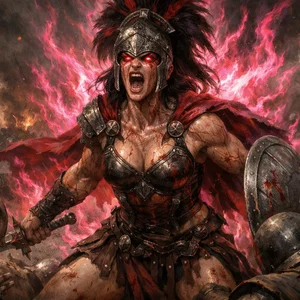
The Morrigan is described in the texts as wearing a long bright red cloak during her seductive human appearances, or cloaked in black crow feathers during her warrior manifestations. Her garments shift with her transformations, each time reflecting her intent — seduction, combat, or prophecy.
Housing
The Morrigan dwells in the Síd, the underground realm of Ireland's enchanted hills, inaccessible to ordinary mortals. This invisible palace coexists alongside the human world, sometimes reachable during festivals such as Samhain (the ancestor of Halloween), when the boundaries between worlds grow thin.
Historical Timeline
Period Vocabulary
Visual Style
Esthétique mythologique irlandaise sombre : déesse-corneille en manteau cramoisie, entrelacs celtiques, brumes des tourbières d'Ulster au crépuscule.
Sound Ambience
Ambiance de champ de bataille celtique irlandais : cris de corneilles, tonnerre lointain, brumes des marais d'Ulster et incantations guerrières au crépuscule.
Liens externes & ressources
Références
Œuvres
Táin Bó Cúailnge — rôle de la Morrigan
Tradition orale antique ; transcription vers 1100 apr. J.-C.
Cath Maige Tuired — prophétie de victoire
Tradition orale antique ; transcription XIVe siècle
Poème de victoire après Mag Tuired
Temps mythique ; conservé dans des manuscrits irlandais médiévaux
Présence dans le Lebor Gabála Érenn
Compilation XIe siècle