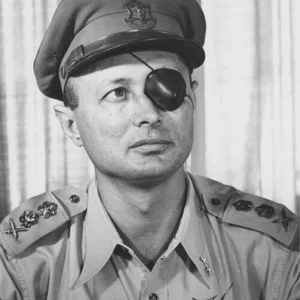

Moshe Dayan (1915-1981) was an Israeli general and politician, famous for the black patch over his left eye. As Chief of Staff and later Minister of Defense, he embodied Israel's military victories during the Six-Day War (1967).
Moshe Dayan(1915 — 1981)
Moshe Dayan
Israël
6 min read
Frequently asked questions
Key Facts
- Born in 1915 in the kibbutz of Degania, the first kibbutz in Mandatory Palestine.
- Lost his left eye in 1941 during a military operation in Lebanon, hence his iconic eye patch.
- Chief of Staff of the IDF (1953-1958), he was in command during the Suez Crisis of 1956.
- Minister of Defense during the Six-Day War (1967), Israel's lightning victory over its Arab neighbors.
- As Minister of Foreign Affairs, he took part in the Camp David Accords (1978) with Egypt.
Works & Achievements
As chief of staff, Dayan planned and led the lightning conquest of the Sinai, demonstrating the IDF's doctrine of rapid maneuver.
As Minister of Defense, he led the campaign that resulted in the capture of the Sinai, the West Bank, East Jerusalem, and the Golan in six days.
After 1967, Dayan established an administration of the occupied territories that permitted economic exchanges with Jordan, in order to limit tensions.
Memoirs in which Dayan recounts his military and political career, a major book for understanding Israel's wars seen from the inside.
As Minister of Foreign Affairs, he played a key role in the negotiations that led to peace between Israel and Egypt.
Dayan helped bring about the first peace treaty between Israel and an Arab country, a historic turning point in the Middle East.
A book in which Dayan connects the landscapes and archaeology of Israel to the biblical narratives, reflecting his passion for ancient history.
Anecdotes
Moshe Dayan lost his left eye in 1941 during an assault on Vichy positions in Lebanon: a bullet struck the binoculars he was holding to his eyes, sending fragments of metal and glass flying. Unable to wear a suitable prosthesis, he adopted the black eyepatch that would become his worldwide image — a symbol he nevertheless hated, finding it too conspicuous.
A passionate archaeologist, Dayan personally excavated ancient sites in Israel to build an immense private collection of artifacts. This passion earned him sharp criticism: he was accused of looting protected sites, and he was even injured in 1968 when a cavity he was exploring alone collapsed.
In 1967, during the Six-Day War, Dayan ordered soldiers to stop smoking near the freshly recaptured Western Wall and had the Israeli flag that had been planted on the Dome of the Rock taken down, to avoid inflaming the Muslim world. He immediately handed control of the Temple Mount over to the Islamic Waqf.
As a young man, Dayan was imprisoned by the British in 1939 at Acre Prison for his activities in the Haganah, the clandestine Jewish paramilitary organization. Released in 1941, he immediately joined the British army to fight the Vichy forces — a reversal typical of the shifting alliances of Mandatory Palestine.
In October 1973, caught off guard by the Egyptian and Syrian attack of the Yom Kippur War, Dayan, then Minister of Defense, sank into a pessimism so deep that he spoke of “the destruction of the Third Temple.” Although Israel ultimately turned the situation around, this initial shock shattered his political career.
Primary Sources
I never liked the black eyepatch. It drew attention to me in a way I found distasteful, but I had no choice.
We have returned to our holiest places, we have returned to them never to part from them again.
Our aim was to strike fast and hard, to outpace the enemy before he could organize his defense in the desert.
The situation is grave; we must face reality: the enemy has caught us by surprise and we are fighting on two fronts.
Key Places
First kibbutz in Palestine, founded in 1910 on the shore of the Sea of Galilee, where Moshe Dayan was born in 1915.
Moshav (cooperative village) in the Jezreel Valley where Dayan grew up and where he would be buried.
Former Ottoman fortress used by the British as a prison, where Dayan was incarcerated in 1939-1941 for his activity in the Haganah.
Vast Egyptian desert that was the stage for the Israeli offensives of 1956 and 1967 that Dayan led or oversaw.
Holy city whose eastern part was captured in 1967; Dayan gave a famous speech there and entrusted the Temple Mount to the Waqf.
Major Israeli city where Dayan carried out his ministerial duties and where he died in 1981.
Liens externes & ressources
Références
Œuvres
Campagne du Sinaï (opération Kadesh)
1956
Victoire de la guerre des Six Jours
1967
Politique du « pont ouvert »
1967-1970
Histoire de ma vie (autobiographie)
1976
Participation aux accords de Camp David
1978
Traité de paix israélo-égyptien
1979
Living with the Bible
1978