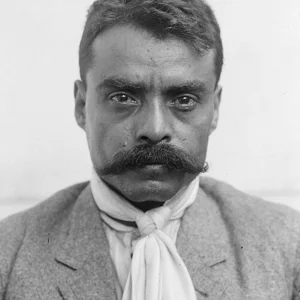

Emiliano Zapata (1879-1919) was a Mexican peasant leader and a major figure of the Mexican Revolution. A champion of the southern peasants, he demanded the return of land to rural communities under the rallying cry “Tierra y Libertad” (Land and Liberty).
Emiliano Zapata(1879 — 1919)
Emiliano Zapata
Mexique
6 min read
Frequently asked questions
Famous Quotes
« Tierra y Libertad»
« I would rather die on my feet than live on my knees»
Key Facts
- Born in 1879 in Anenecuilco, in the state of Morelos, into a family of mestizo peasants
- Took up arms in 1911 against the regime of Porfirio Díaz and joined the revolution led by Francisco Madero
- Proclaimed the Plan of Ayala in 1911, demanding the return of land to dispossessed peasants
- Led the Liberation Army of the South (Ejército Libertador del Sur) during the Mexican Revolution
- Assassinated on 10 April 1919 at Chinameca, the victim of an ambush set by the government forces of Carranza
Works & Achievements
Revolutionary manifesto demanding the return of land to the peasants. The founding text of the Zapatista program.
The Liberation Army of the South, a peasant force organized by Zapata that became one of the great armies of the revolution.
The establishment of agrarian commissions that returned land to rural communities — the country's first concrete agrarian reform.
A legal and political battle to win recognition of the ancestral property titles held by the peasants of his village.
Zapatista ideas about land ownership inspired Article 27, which laid the foundations of Mexican agrarian reform.
A social and political movement born around Zapata, whose legacy continues to inspire Mexican peasant struggles.
Anecdotes
In 1909, at just 30 years old, Emiliano Zapata was chosen by the people of his village of Anenecuilco to defend their land titles—documents so old they dated back to the Spanish colonial era. The peasants saw in him a brave and honest man, capable of standing up to the wealthy landowners who were stealing their fields.
Zapata was an exceptional horseman and a renowned horse trainer throughout the state of Morelos. It is said that he won *charrería* contests (the Mexican art of horsemanship) and that his mastery of horses impressed peasants and great landowners alike, the latter sometimes calling upon his talents.
In December 1914, Zapata and Pancho Villa, the two great peasant leaders of the revolution, marched triumphantly into the capital, Mexico City, at the head of their armies. During a famous meeting, Villa was invited to sit in the presidential chair for a photograph; Zapata, distrustful of power, declared that it ought to be burned because it corrupted those who sat in it.
Disappointed by President Madero, who was slow to return the land to the peasants, Zapata proclaimed the Plan de Ayala in November 1911, a revolutionary manifesto demanding the return of the stolen land. His rallying cry, “Tierra y Libertad” (Land and Liberty), became the battle cry of thousands of peasants in the south.
Zapata was killed in an ambush on April 10, 1919, at the hacienda of Chinameca. Colonel Jesús Guajardo led him to believe he wanted to join his cause; when Zapata arrived, hidden soldiers opened fire. His death immediately made him a martyr and a legend whose image continues to inspire Mexican peasant movements.
Primary Sources
The lands, forests, and waters usurped by the hacendados, científicos, or caciques under the shadow of tyranny and venal justice shall be taken into possession, effective immediately, by those who hold the corresponding titles.
The Mexican people do not aspire to mere changes of rulers, but to the restoration of their lands and their freedom.
The revolution of the South struggles for the restoration of the people's rights, especially those of the peasants stripped of their lands by the great landowners.
We want the land to return to those who work it with their own hands, for it must not be the privilege of a few but the common good of the communities.
Key Places
Zapata's native village in the state of Morelos. It was in defending its lands that he entered politics.
A town in Morelos captured by the Zapatistas in 1911 after fierce fighting, a victory that helped bring about the fall of Díaz.
Capital of the state of Morelos, the main center of the area controlled by the Zapatistas during the revolution.
The country's capital, which Zapata entered triumphantly alongside Pancho Villa in December 1914.
A large estate in Morelos where Zapata was lured into a trap and assassinated on April 10, 1919.
Typical Objects

A repeating rifle used by the fighters of the revolution. The Zapatistas equipped themselves with it by capturing weapons from the federal army.

A large wide-brimmed felt hat typical of Mexican horsemen. Zapata wore it almost constantly, and it became a central part of his image.

A leather strap lined with cartridges worn crossed over the chest. An emblematic symbol of the Mexican revolutionaries.
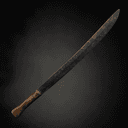
A large knife used to cut sugarcane in the fields of Morelos, but also a weapon of the rebelling peasants.

An ornate leather saddle of Mexican horsemen. Zapata, a renowned horse trainer, used one every day.

A manifesto from 1911 demanding the return of land to the peasants. The founding text of the Zapatista movement.
School Curriculum
Vocabulary & Tags
Key Vocabulary
Tags
Daily Life
Morning
An early riser, Zapata often began the day on horseback, traveling through villages and camps to meet his supporters. In times of peace, he tended the horses and the fields; in war, he inspected his troops and prepared their movements.
Afternoon
Afternoons were devoted to meetings with local leaders, military planning, and listening to the grievances of the peasants. Zapata received many visitors who came to demand justice for their land.
Evening
In the evening, around a fire or in a village house, people shared a simple meal and discussed the next moves. The music of *corridos*, those popular folk songs, often accompanied these gatherings.
Food
The diet was that of the peasants of Morelos: corn tortillas, black beans (*frijoles*), chili peppers, and sometimes a little meat or chicken. People drank coffee, *pulque* (a fermented agave beverage), or water.
Clothing
Zapata wore the costume of the Mexican *charro*: fitted trousers, a short jacket, a shirt, a scarf knotted at the neck, and a large sombrero. His well-groomed mustache and his crossed bandoliers completed the silhouette that became famous.
Housing
He lived in the modest village houses of Morelos, made of adobe (sun-dried mud bricks) with tile or thatch roofs. During the war, he stayed in makeshift camps or in occupied haciendas.
Historical Timeline
Period Vocabulary
Liens externes & ressources
Références
Œuvres
Plan de Ayala
1911
Création de l'Ejército Libertador del Sur
1911
Redistribution des terres à Morelos
1914-1915
Défense des titres d'Anenecuilco
1909
Influence sur l'article 27 de la Constitution de 1917
1917
Le zapatisme
1911-1919