A Swahili poetess from the East African coast (Zanzibar or the coastal region), Mwana Hashima belongs to the rich Swahili literary tradition with its strong Islamic imprint. Her poetic work in the Swahili language reflects Sufi spirituality and the moral values of coastal society.
Mwana Hashima
Mwana Hashima
8 min read
Frequently asked questions
Key Facts
- Poetess of the Swahili literary tradition, heir to poetic forms such as the *utendi* and the *shairi*
- Her name “Mwana Hashima” means “child of dignity/honor” in Swahili
- Her work is part of a corpus of 19th-century Swahili women poets, of whom Mwana Kupona is the best-known figure
- Swahili poetry of this era blends the Kiswahili language, Arabic rhetoric, and Islamic spirituality
Works & Achievements
A collection of short Swahili poems following the strict shairi form (four stanzas of four lines each), transmitted orally and attributed to poetesses of the coast. These poems deal with piety, mystical love, and social morality.
A didactic epic poem composed by Mwana Kupona and addressed to her daughter Mwana Hashima, which became the defining text of Swahili women's literature. It conveys moral and spiritual teaching across 102 stanzas of four lines.
Poetic compositions evoking the mystical journey of the soul (*ruhani*) toward God, in the tradition of the Qadiriyya brotherhood, which had a strong presence along the coast. These poems are recited during the *dhikr* ceremonies of Swahili Sufi orders.
Poetic compositions sung during wedding ceremonies, a genre in which the literate women of the coast excelled. These songs blended moral guidance, religious blessings, and celebration of feminine beauty and dignity.
Anecdotes
Mwana Hashima composed her poems in the Swahili language according to the strict form of the shairi, a fixed-structure poetic genre inherited from the Arabic tradition. Each verse follows precise rules of syllable count and rhyme, passed down orally from master to student in the learned circles of the coast. This poetic discipline is regarded as an act of devotion as much as of art.
In the Swahili oral tradition, poems of Sufi inspiration are attributed to Mwana Hashima, in which she evokes the soul's journey toward God through the metaphors of a dhow voyage across the Indian Ocean. The image of a boat lost at sea represented the believer seeking their path toward divine light. These maritime images were immediately understood by her contemporaries, a seafaring people.
Like many Swahili poetesses of her era, Mwana Hashima is said to have received her Quranic and literary education in a coastal madrasa, alongside the sons of Arab and Swahili merchants. Literate women of the coast held a special status: their poems were recited at wedding ceremonies and funeral wakes, weaving the social fabric of the entire community.
The Swahili literary tradition attributes to certain legendary poetesses the gift of composing poetic visions (ruwaza) inspired by God during sleep. Mwana Hashima is presented in some versions of coastal folklore as an inspired figure, whose verses are said to have sprung forth in dreams. This gift of nocturnal poetic revelation connects her to the Sufi mystical traditions that profoundly shaped Swahili literature of the 19th century.
The poems attributed to Mwana Hashima address moral themes aimed at women of Swahili society: patience, piety, household management, and dignity. This didactic genre, exemplified by the well-known Mwana Kupona, places these poetesses in the role of spiritual teachers. Their works continue to be recited at wedding ceremonies along the East African coast, keeping their teachings alive.
Primary Sources
A didactic poem in Swahili composed around 1858 by the poetess Mwana Kupona Msham of Lamu, addressed to her daughter Mwana Hashima. This founding text of Swahili women's literature sets out the spiritual and moral duties of a pious woman according to coastal Islamic tradition.
A collection of Swahili poems by Muyaka bin Haji (c. 1776–1840), a poet from Mombasa representative of the coastal poetic style. His *mashairi* address politics, love, and spirituality, working within the same formal tradition as the women poets of his era.
A long Swahili epic poem narrating a battle of the Prophet Muhammad, composed in Pate around 1728. This genre, the *utenzi* (or *utendi*), represents the most prestigious literary form of the coast, blending Islamic spirituality with Swahili poetic art.
A collection of Arabic and Swahili manuscripts gathered from the Lamu archipelago, attesting to the richness of coastal literary production in the 18th and 19th centuries. These texts include religious poems, epics, and women's didactic writings, in which names such as Mwana Hashima appear.
Key Places
The main island of the Sultanate of Zanzibar, a commercial and cultural crossroads of the Indian Ocean in the nineteenth century. Its Stone Town is home to palaces, mosques, and houses with carved doors where Swahili literature flourished.
A UNESCO World Heritage island town and the cradle of classical Swahili poetry since the seventeenth century. It was here that the *Utendi wa Mwana Kupona* was composed, the founding text of Swahili women's poetic literature.
A major port city on the Kenyan coast, home of the poet Muyaka and center of a rich network of Swahili literary circles. Its narrow streets and coffeehouses were arenas where poets clashed in public verse duels.
An ancient island city whose ruins bear witness to the golden age of Swahili trade between the tenth and sixteenth centuries. In legendary tradition, Kilwa is the place of memory where the cultural and spiritual identity of the coast is rooted.
Both a mythic space and a tangible reality, the Indian Ocean pervades Swahili poetry as a metaphor for spiritual journey. Its monsoon winds set the rhythm of life along the entire coast, governing the seasons of trade, pilgrimage, and poetic inspiration.
Typical Objects

A Quranic manuscript calligraphed in Arabic, bound in leather and adorned with geometric patterns. For a poetess like Mwana Hashima, reciting and memorizing the Quran forms the foundation of all literary and spiritual education.

A smooth wooden tablet on which verses and poems are written in erasable ink. This teaching tool is central to Quranic and poetic instruction in all the madrasas along the Swahili coast.

A string of 99 beads made of precious wood or coral, used to recite the names of God. In the Sufi tradition that runs through Mwana Hashima's poetry, dhikr (rhythmic invocation) often accompanies the act of poetic composition.

A large rectangle of printed cotton fabric featuring colorful patterns and often bearing a Swahili proverb embroidered along the border. An iconic garment of coastal women, the kanga is also a medium for poetic and moral expression.

A terracotta or metal burner in which agarwood (oud) imported from Arabia is burned. Incense perfumes ceremonies and poetry gatherings, creating the atmosphere conducive to spiritual inspiration and recitation.

A small handcrafted lamp fueled by coconut oil, the only source of light for reading and writing after dark. It is by its glow that the scholars of the coast compose and recite their poems after the evening prayer.
School Curriculum
Vocabulary & Tags
Key Vocabulary
Tags
Daily Life
Morning
Mwana Hashima begins her day before dawn with the fajr prayer, reciting the Quranic verses she learned in childhood at the madrasa. After prayer, she devotes the first hour to meditative silence and inner composition, allowing poetic images to take shape before setting them down on her writing board.
Afternoon
The afternoon is devoted to visits and exchanges in the courtyard of the coral stone house, where literate women gather to recite and discuss their poems. She may also teach the young girls of the neighborhood reading, calligraphy, and the rules of shairi versification, thereby perpetuating the tradition of women's poetry circles.
Evening
In the evening, after the maghrib prayer, Mwana Hashima takes part in poetry recitation gatherings by the light of an oil lamp, where her verses are sung or chanted before an attentive circle of listeners. These oral poetry sessions make up the principal cultural life of the coastal city, blending religious devotion with aesthetic pleasure.
Food
Her diet reflects the wealth and diversity of Indian Ocean trade: spiced pilau rice with cumin and cardamom, grilled fish, chapati, mangoes, and tropical fruits. Strong Arabian coffee (kahawa), spiced with cloves, is served in small cups to every visitor, accompanied by dates imported from the Gulf.
Clothing
Mwana Hashima wears the kanga, a large brightly printed cloth wrapped around the body, over a long white cotton robe (kanzu) of fine cotton. Her hands and feet are adorned with henna patterns at ceremonies, and she drapes a light veil over her head when venturing out into the medina's narrow alleyways, in keeping with the customs of Islamic Swahili society.
Housing
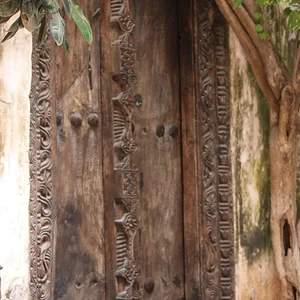
She lives in a coral stone house in the Stone Town of Zanzibar or Lamu, with doors of mango wood finely carved with floral and Quranic motifs. The rooms are arranged around an open inner courtyard planted with jasmine and gardenias, shaded from the midday sun by a colonnaded gallery — an ideal setting for reading and composing poetry in the cool shade.
Historical Timeline
Period Vocabulary
Visual Style
Esthétique inspirée de l'art de Zanzibar et des miniatures omanaises : lumière chaude et tamisée, tissus aux riches couleurs, décors de pierre de corail sculptée et motifs islamiques géométriques.
Sound Ambience
Ambiance sonore de Zanzibar au XIXe siècle : appels à la prière, vagues de l'océan Indien, récitation poétique rythmée dans une cour ombragée, brises de mousson et effluves d'encens.
Liens externes & ressources
Références
Œuvres
Poèmes du genre mashairi (attribués à la tradition)
XIXe siècle
Utendi wa Mwana Kupona (texte fondateur lié à son nom)
vers 1858
Poèmes d'inspiration soufie (tradition orale)
XIXe siècle
Chants de mariage (nyimbo za harusi)
XIXe siècle