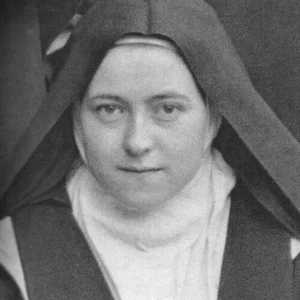

A French Carmelite nun who entered the Carmel of Lisieux at age 15, she developed a spirituality known as the 'Little Way,' accessible to everyone. Author of Story of a Soul, she was canonized in 1925 and declared a Doctor of the Church in 1997.
Thérèse of Lisieux(1873 — 1897)
Thérèse of Lisieux
France
8 min read
Frequently asked questions
Famous Quotes
« My vocation is love.»
« I want to spend my heaven doing good on earth.»
« I will not die, I will enter into life.»
Key Facts
- 1873: born in Alençon into a devout middle-class Catholic family
- 1888: entered the Carmel of Lisieux at the age of 15
- 1894–1897: wrote Story of a Soul under obedience to her superiors
- 1897: died of tuberculosis at the age of 24
- 1925: canonized by Pope Pius XI; 1997: declared Doctor of the Church by Pope John Paul II
Works & Achievements
Composed of three autobiographical manuscripts written between 1895 and 1897 at the request of her superiors, this work sets out the 'little way' of spiritual childhood. Translated into more than 60 languages, it is one of the most widely read religious books in the world.
A foundational theological text in which Thérèse offers herself as a victim to God's love rather than to His justice. This text distills the heart of her spirituality and was adopted as a prayer by many religious communities.
Thérèse composed 54 poems set to popular melodies of her time, blending ardent faith with romantic sensibility. The most celebrated, 'Living on Love,' is still sung in Catholic communities around the world.
Her letters addressed to her family, her sisters in religious life, and her missionary spiritual brothers reveal a precociously insightful spiritual director. They complement the autobiography by showing her daily practice of fraternal charity.
Thérèse wrote and staged short plays performed by the Carmelite sisters during convent feast days. These texts blend humor, spiritual instruction, and portraits of holy figures such as Joan of Arc.
Anecdotes
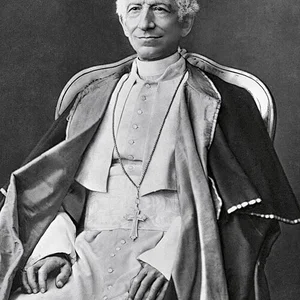
At the age of 15, Thérèse Martin traveled on a pilgrimage to Rome with her father and older brother. During the papal audience on November 20, 1887, defying the protocol that forbade speaking to the Pope, she threw herself at the feet of Leo XIII and directly asked his permission to enter Carmel. The Pope, taken aback, told her that she would enter if God willed it. She had to be carried away by force by the Swiss Guards, her eyes filled with tears.
Thérèse had suffered from fragile health since childhood. At Christmas 1886, when she was 13, she experienced what she herself called her 'conversion': after years of excessive emotional fragility, she suddenly felt an inner strength that transformed her personality. She considered this event the true beginning of her spiritual vocation.
Sister Thérèse was entrusted, at Carmel, with guiding the novices despite her young age. She wrote down her spiritual memories at the request of her prioress and older sister, Mother Agnès (Pauline Martin). These notebooks, written in her cell at night by candlelight, became after her death the most translated book in the world after the Bible.
In 1896, Thérèse coughed up blood on the night of Holy Thursday — the first sign of the tuberculosis that would claim her life. Far from lamenting, she wrote to her spiritual director: 'I have no wish to dwell on it — it is too sweet.' She lived another eighteen months in increasing suffering, but continued to write and to support her sisters until her final days.
Primary Sources
I understood that the Church had a Heart and that this Heart was burning with Love. I understood that Love alone made the members of the Church act, that if Love were ever extinguished, the Apostles would no longer preach the Gospel, the Martyrs would refuse to shed their blood... I understood that my vocation was Love.
My way is all confidence and love; I do not understand souls who are afraid of so gentle a Friend. Sometimes, when I read certain spiritual treatises in which perfection is shown hedged about with a thousand obstacles, my poor little mind grows weary very quickly.
In order to live in a single act of perfect Love, I offer myself as a sacrificial victim to Your merciful Love, imploring You to consume me unceasingly, allowing the waves of infinite tenderness that are held within You to overflow into my soul.
Living on Love is sailing without cease, / Sowing peace and joy in every heart. / Beloved Pilot, Charity urges me on, / For I see You in the souls who are my sisters.
Key Places
Thérèse Martin was born on January 2, 1873 at 36 rue Saint-Blaise in Alençon, now a sanctuary open to pilgrims. It was in this bourgeois Norman house that she spent her earliest childhood before the family moved to Lisieux.
After their mother's death, their father Louis Martin settled the family in this comfortable villa in Lisieux. Thérèse grew up there from age 4 to 15, and it was here that she received the Christmas grace of 1886 that determined her vocation.
Thérèse entered this Carmelite monastery on April 9, 1888 and never left it again. She lived there for nine years, wrote her spiritual works, and died there on September 30, 1897 at the age of 24.
Built from 1929 onward to welcome the millions of pilgrims coming to venerate the saint, this Romano-Byzantine basilica is the second most visited Catholic pilgrimage site in France after Lourdes. It houses the relics of Thérèse.
It was during the papal audience of November 20, 1887 that Thérèse boldly addressed Pope Leo XIII directly to obtain permission to enter the Carmel. This daring episode marks a turning point in her spiritual journey.
Typical Objects

The brown serge robe and rough woolen scapular made up the daily dress of the Carmelite nuns. Thérèse wore this habit from the moment she entered the Carmel at age 15, a symbol of her detachment from the world.

It was in simple school exercise books that Thérèse wrote her spiritual memoirs at the request of her superiors. These notebooks, preserved in the Archives of the Carmel of Lisieux, are now listed as UNESCO heritage.

At the time of her religious profession, Thérèse received a crucifix that she wore over her heart at all times. She inscribed on it the names of Jesus and her spiritual brothers, bearing witness to her missionary vocation.

By candlelight, in the silence of her monastic cell, Thérèse would write her poems and letters at night. The candle's flame has become a symbol of her quiet, persevering spirituality.

The breviary, the liturgical book of the canonical hours, marked the rhythm of the Carmelites' day. Thérèse prayed the Divine Office several times daily according to the rule of Saint Teresa of Ávila as reformed by Saint John of the Cross.

Thérèse cherished the image of rose petals offered to God one by one, symbolizing the small virtues of everyday life. The rose became her principal iconographic attribute after her promise to send "a shower of roses" from heaven.
School Curriculum
Vocabulary & Tags
Key Vocabulary
Daily Life
Morning
The day began at 5 a.m. with the offices of Matins and Lauds sung in choir. After Mass, the Carmelites devoted an hour to silent mental prayer in the chapel before a frugal communal breakfast.
Afternoon
The afternoon was given to manual work — sewing, painting holy images, tending the cloister garden — which Thérèse carried out while maintaining an inner state of union with God. She also directed the novices entrusted to her spiritual care.
Evening
After the sung Vespers and Compline, the community observed the Great Silence from 9 p.m. onward. Thérèse used these hours to write her manuscripts or letters by candlelight in her cell, before lights-out.
Food
Carmelite meals were simple and vegetarian outside of feast days: soup, vegetables from the garden, brown bread, and occasionally eggs or cheese. The liturgical fast was observed for several months of the year, which worsened Thérèse's tuberculosis.
Clothing
The habit of the Carmelites of Lisieux consisted of a dark brown woolen tunic, a scapular of the same color, a brown mantle worn in choir, and a white veil for novices replaced by a black veil upon final profession. Beneath the habit, a hair shirt was worn during times of penance.
Housing
Thérèse's cell at the Carmel of Lisieux measured roughly six square meters: a rope-strung bed, a straw mattress, a prie-dieu, a table, and a chair made up the entire furnishings. The bare stone walls looked out onto the interior cloister.
Historical Timeline
Period Vocabulary
Visual Style
Réalisme religieux de la fin du XIXe siècle, clair-obscur de bougie sur pierre normande, palette de bruns monastiques et de blanc crémeux avec l'accent d'une rose rouge, évoquant la douceur et la profondeur intérieure.
Sound Ambience
Atmosphère de silence monastique ponctué des heures canoniales, du chant grégorien et du grattement d'une plume sur le papier dans la cellule d'une jeune carmélite normande.
Liens externes & ressources
Références
Œuvres
Histoire d'une âme
1898 (posthume)
Acte d'offrande à l'Amour miséricordieux
9 juin 1895
Poèmes (54 poèmes)
1893–1897
Correspondance (266 lettres)
1877–1897
Récréations pieuses (8 pièces de théâtre)
1894–1897