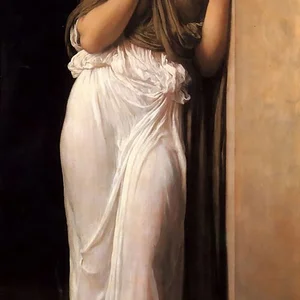

Nausicaa is a Phaeacian princess from Greek mythology, the daughter of King Alcinous and Queen Arete. In Homer's Odyssey, she discovers the shipwrecked Odysseus on the shore of the island of Scheria and welcomes him to her father's court.
Nausicaa
Nausicaa
6 min read
Frequently asked questions
Key Facts
- Daughter of Alcinous, king of the Phaeacians, and Queen Arete, she lives on the island of Scheria
- She appears in Book VI of the Odyssey, composed around the 8th century BC
- Guided by Athena, she goes to the bank of a river to wash the laundry and there discovers the shipwrecked, naked Odysseus
- She clothes Odysseus, feeds him and shows him the way to the palace of Alcinous, embodying xenia (Greek hospitality)
- The Phaeacians then give Odysseus a ship that brings him back to Ithaca
Works & Achievements
A founding act of hospitality (xenia): Nausicaa rescues the unknown stranger and allows him to finally return to Ithaca.
A central character of the Phaeacian episode, a figure of youth, modesty, and generosity in the Homeric epic.
She tells the hero how to present himself and entreat Queen Arete, thereby securing his return to his homeland.
An ancient play now lost, a testament to the character's literary legacy from the classical era onward.
The subject of Greek ceramics, paintings, and modern works, a symbol of the encounter between innocence and heroic wandering.
Anecdotes
In the Odyssey, Nausicaa goes down to the riverbank to wash her family's laundry, and it is there that she discovers Odysseus, naked and crusted with salt after his shipwreck. While her handmaidens flee in fright, she stays brave and speaks to him with dignity.
Athena sends Nausicaa a dream in which the goddess, taking the form of a friend, suggests she go and wash her clothes in preparation for her future marriage. It is this divine pretext that leads her to the shore where Odysseus lies.
Nausicaa provides Odysseus with oil, clean clothes and food, but asks him not to enter the city at her side so as to avoid the gossip of the Phaeacians, who would chatter about a princess accompanied by a stranger.
As he leaves the court, Odysseus promises Nausicaa to honour her like a goddess for the rest of his days, because she saved his life. Their relationship stays chaste: no marriage takes place, which makes her one of the most delicate figures in the epic.
The comic poet Sophocles is said to have written a lost play entitled Nausicaa (or The Washerwomen) in which, according to ancient tradition, he himself played the role of the young girl playing ball, showing off her grace.
Primary Sources
She stood firm before him and pondered: should she beg the fair-faced maiden, or rather, from a distance, with gentle words, entreat her to give him clothing and to show him the way to the city?
Stranger, you seem to me neither wicked nor foolish; it is Zeus himself who dispenses happiness to men, to the good as to the wicked, to each according to his will.
Nausicaa, daughter of great-hearted Alcinous, may you remember me in my homeland, for it is to you above all that I owe my life.
The Phaeacians, a people close to the gods, dwelt on the island of Scheria, ruled by Alcinous, whose daughter welcomed Odysseus.
Key Places
Mythical island home to the Phaeacians, fabulous seafarers ruled by Alcinous. Homeland of Nausicaa, often identified with Corfu in ancient tradition.
Beach where Odysseus is washed ashore after the shipwreck caused by Poseidon. It is there that Nausicaa finds him exhausted among the brushwood.
Stream where Nausicaa and her handmaids come to wash the royal linen. The setting of the decisive encounter between the princess and the hero.
Radiant dwelling of the king of the Phaeacians, adorned with bronze, gold and wondrous gardens. Nausicaa brings Odysseus there, where he is lavishly received.
Marvelous orchards of the palace where fruit ripens in every season. An ideal image of Phaeacian abundance surrounding Nausicaa's childhood.
Typical Objects

Cart drawn by mules on which Nausicaa carries the laundry to the river. Her maidservant drives the team while the princess takes her seat.

Garments and fabrics from the household of Alcinous that Nausicaa goes to clean at the washing place. Tending to them symbolically heralds the wedding preparations.

Vial of scented oil that Nausicaa gives to Odysseus so he can anoint his body after his bath in the river. A gesture of refined hospitality.

Ball with which Nausicaa and her maidservants play near the shore after the washing. A missed throw and their cries awaken Odysseus, asleep in the bushes.

Clean garments that Nausicaa offers to Odysseus to cover his nakedness. The gift of clothing seals the sacred duty of Greek hospitality (xenia).

Royal insignia of Nausicaa's father, symbol of the authority that reigns over the Phaeacians and guarantees the welcome offered to Odysseus.
School Curriculum
Vocabulary & Tags
Key Vocabulary
Daily Life
Morning
A Phaeacian princess, Nausicaa awakens in the bronze palace of Alcinous. On the morning the goddess Athena visits her dreams, she obtains from her father a mule-drawn cart to carry the royal laundry down to the river.
Afternoon
By the washing pools, she directs her handmaidens to beat the cloths and spread them to dry in the sun. Once the laundry has dried, the young women share a meal, then play ball at the water's edge.
Evening
Back at the palace, she returns to the refined life of the Phaeacian court, where people listen to the bards sing of the exploits of heroes. She sees to the proper welcome of her father's guests.
Food
Like the Phaeacians, a people favored by the gods, she feeds on bread, fruit from the wondrous orchards, roasted meats, and wine. Lavish banquets lie at the heart of the culture of hospitality.
Clothing
She wears a finely woven linen *peplos*, fastened with brooches, and adorns herself with jewels worthy of her rank. Homer compares her beauty to that of **Artemis** among her nymphs.
Housing
She lives in the sumptuous palace of Alcinous, with walls of bronze, doors of gold and silver, surrounded by marvelous gardens where the fruit never ceases to ripen.
Historical Timeline
Period Vocabulary
Liens externes & ressources
Références
Œuvres
Accueil d'Ulysse naufragé
récit de l'Odyssée
Rôle dans l'Odyssée, chants VI à VIII
vers VIIIe siècle av. J.-C.
Conseil donné à Ulysse pour gagner la cour
récit de l'Odyssée
Tragédie perdue Nausicaa de Sophocle
Ve siècle av. J.-C.
Figure inspiratrice des arts
Antiquité à nos jours