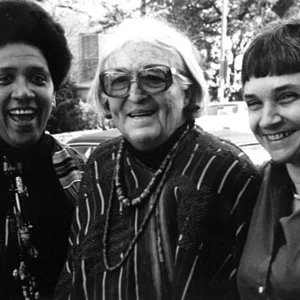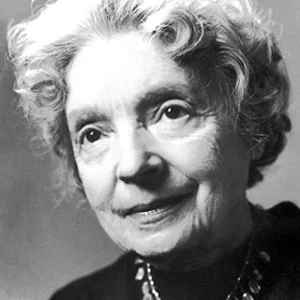

German Jewish poet and playwright, forced into exile in Sweden in 1940 to flee Nazism. Her work, shaped by the Holocaust, earned her the Nobel Prize in Literature in 1966.
Nelly Sachs(1891 — 1970)
Nelly Sachs
Suède, Allemagne
6 min read
Frequently asked questions
Famous Quotes
« O the chimneys on the ingeniously devised habitations of death»
Key Facts
- Born on December 10, 1891, in Berlin into a well-off Jewish family
- Fled Nazi Germany in 1940 and found refuge in Sweden with the help of Selma Lagerlöf
- Published the collection 'In the Habitations of Death' (In den Wohnungen des Todes) in 1947, a tribute to the victims of the Holocaust
- Received the Nobel Prize in Literature in 1966, shared with Shmuel Yosef Agnon
- Died on May 12, 1970, in Stockholm
Works & Achievements
Her first major collection devoted to the Shoah, including the poem “O the Chimneys.” It established her as a leading voice in the memory of the genocide.
A poetic play about the suffering of the Jewish people. It blends drama, mysticism, and collective mourning.
A collection continuing her meditation on exile, night, and disappearance. It confirms her spare, haunted language.
A central collection in which exile becomes perpetual metamorphosis. Here we read the famous line “in place of a homeland, I hold the metamorphoses of the world.”
A gathering of her poetic work that secured her international reputation. The title speaks of her longing to transcend death.
An honor awarded for a body of work that powerfully interprets “the destiny of Israel.” It crowned a lifetime of writing born of exile.
Anecdotes
In May 1940, just as the Gestapo summoned her, Nelly Sachs and her mother fled Germany at the last possible moment thanks to the intervention of the Swedish writer **Selma Lagerlöf**, a Nobel laureate, who helped secure their visa. They took the last civilian flight between Berlin and Stockholm: a few days later, that air route was closed.
A refugee in Stockholm, Nelly Sachs first earned her living translating Swedish poets into German, almost unknown to the general public. She wrote her poems at night, in a small apartment she shared with her mother, clutching the German language like a portable homeland.
In **1966**, she received the Nobel Prize in Literature on the very day of her 75th birthday, **December 10**. She shared the honor with the Israeli writer **Shmuel Agnon**: their two speeches were seen as a joint tribute to Jewish culture after the Shoah.
Nelly Sachs forged a deep and purely epistolary friendship with the poet **Paul Celan**, who was also marked by the Shoah. In their letters they called each other “brother and sister”; they met in person only once, in **1960**, in Zurich.
Haunted by the fear of being tracked down by the Nazis, Nelly Sachs suffered long bouts of anxiety and was hospitalized several times. Poetry was for her a way to survive: she said she wrote to “give a voice to the dead” of the Shoah.
Primary Sources
O the chimneys / On the ingeniously devised habitations of death / when Israel's body drifted as smoke / through the air.
In place of a homeland / I hold the metamorphoses of the world.
Between Paris and Stockholm runs the meridian of sorrow and consolation.
In place of a homeland / I hold the metamorphoses of the world in my hand.
Key Places
Nelly Sachs's birthplace, where she grew up in a cultured Jewish family until the rise of Nazism.
Her land of exile from 1940 onward and the setting for all of her major work. She lived, wrote, and died there.
Site of the 1966 Nobel Prize in Literature ceremony, which she received on her 75th birthday.
The city where Nelly Sachs met the poet Paul Celan in person in 1960, during her only return to a German-speaking country.
The city where she was awarded the Droste Prize in 1960, one of her first major recognitions.
Typical Objects

Notebook where Nelly Sachs jotted down her poems, often at night. Writing was her refuge and her way of bearing witness for the dead.

Gold medal awarded at the 1966 ceremony in Stockholm. It symbolizes the worldwide recognition of a body of work born of exile and the Holocaust.

The working tool of the poet and translator in Stockholm. On it she made fair copies of poems and translations from Swedish into German.

A sheaf of the correspondence exchanged with Paul Celan and other writers. These letters were a vital bond between surviving poets.

The badge that the Nazi regime forced Jews to wear. It haunts Sachs's work as a sign of persecution and mourning.

Luggage carried during the flight to Sweden in 1940. It embodies the wrenching loss of homeland and the life of a refugee.
School Curriculum
Vocabulary & Tags
Key Vocabulary
Daily Life
Morning
In Stockholm, Nelly Sachs would rise in a modest apartment she shared with her elderly mother, whom she cared for. The morning blended household chores with the first hours of work on her translations.
Afternoon
The afternoon was often devoted to translating Swedish poets into German, her livelihood. She also kept up an abundant correspondence with other writers that remained vital to her.
Evening
Evening and night were her hours of creation: it was in the silence that she wrote her poems about the Shoah. Anguish and insomnia frequently accompanied these vigils.
Food
She led the frugal life of a refugee with limited means, especially in her early Swedish years. Meals were simple, marked by the modesty of a secluded existence.
Clothing
Nelly Sachs dressed soberly, in the discreet style of a woman of letters of the mid-twentieth century. Nothing in her attire sought to draw attention.
Housing
She lived for nearly thirty years in a small Stockholm apartment, long alongside her mother. This modest dwelling was at once her refuge and the workshop of her entire body of work.
Historical Timeline
Period Vocabulary
Liens externes & ressources
Références
Œuvres
In den Wohnungen des Todes (Dans les demeures de la mort)
1947
Eli. Ein Mysterienspiel vom Leiden Israels (Eli)
1951
Sternverdunkelung (Éclipse d'étoile)
1949
Flucht und Verwandlung (Fuite et métamorphose)
1959
Fahrt ins Staublose (Voyage dans l'au-delà de la poussière)
1961
Prix Nobel de littérature
1966