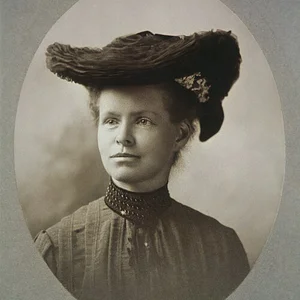

American geneticist and pioneer of cytogenetics. In 1905, she demonstrated that an organism's sex is determined by its chromosomes, identifying the role of the Y chromosome in the mealworm beetle (Tenebrio molitor).
Nettie Stevens(1861 — 1912)
Nettie Stevens
États-Unis
6 min read
Frequently asked questions
Key Facts
- Born on July 7, 1861, in Cavendish (Vermont, United States)
- Earned her doctorate at Bryn Mawr College in 1903
- In 1905, discovered that the sex chromosomes (X and Y) determine sex while studying the mealworm beetle
- Her discovery was made independently and in parallel with that of Edmund Beecher Wilson
- Died prematurely of breast cancer on May 4, 1912
Works & Achievements
Work on the morphology of ciliated protozoa that earned her doctorate and marked the start of her scientific career.
Her major work: in it she demonstrates that the sex of the mealworm beetle depends on the chromosomes, identifying the role of what would become the Y chromosome.
A study of the reproductive cells of aphids confirming the existence of a chromosome linked to sex determination.
An extension of her discovery to other insect species, reinforcing the general significance of chromosomal sex determination.
In just eleven years, she published some forty papers in cytology and genetics, making her a remarkably prolific researcher.
Anecdotes
Nettie Stevens only became a researcher late in life. After high school, lacking the means to continue, she taught and worked as a librarian for about fifteen years. It wasn't until she was 35, in 1896, that she finally enrolled at Stanford University to study biology: proof that a scientific calling can blossom long after adolescence.
In 1905, while observing the reproductive cells of the mealworm beetle (the flour worm) under the microscope, she noticed that the females had twenty large chromosomes, whereas the males had nineteen large ones and one small one. She then understood that it was this tiny chromosome — the future Y chromosome — that determined the male sex. A landmark discovery drawn from the patient observation of a simple pantry insect.
Her discovery was for a long time credited mainly to men: the famous biologist Edmund B. Wilson had reached similar conclusions almost at the same time, and Thomas Hunt Morgan later received the Nobel Prize for his work in genetics. Nettie Stevens's name, meanwhile, fell into oblivion — an example often cited today of the way women in science are made invisible.
To complete her training, she crossed the Atlantic and worked at the Naples Zoological Station, then at the University of Würzburg alongside Theodor Boveri, one of the fathers of the chromosomal theory of heredity. In just eleven years of her career, she published some forty scientific papers.
Her talent was nonetheless recognized during her lifetime: in 1905, she received the Ellen Richards Prize, awarded for scientific research carried out by a woman. Thomas Hunt Morgan, her former professor, praised in her obituary her keen sense of observation and her exemplary rigor.
Primary Sources
The spermatozoa that contain the small chromosome determine the male sex, while those that contain ten chromosomes of equal size determine the female sex. (translated from English)
Her single-minded devotion and dedication, combined with keen powers of observation, with her thoughtfulness and patience united to a well-balanced judgment, account in part for her remarkable accomplishments. (translated from English)
The study of the germ cells of aphids confirms the existence of a distinct chromosome, associated with sex determination, observed in cell divisions. (translated from English)
Key Places
Village in the northeastern United States where Nettie Stevens was born in 1861, into a modest family.
Town where she grew up and attended secondary school at Westford Academy, standing out for her excellent results.
She enrolled there at the age of 35 to study biology, earning her bachelor's degree and then her master's degree.
Women's college where she earned her doctorate in 1903 and then carried out her decisive research on chromosomes.
Famous marine biology research center where she stayed to train under the best European specialists.
There she worked with Theodor Boveri, a pioneer of the chromosome theory of heredity, who profoundly influenced her research.
Typical Objects

An instrument essential to her work, it allowed her to magnify cells hundreds of times in order to count the chromosomes inside them. It was thanks to this tool that she spotted the small chromosome that determines sex.

A small beetle whose larva is the “mealworm.” Stevens studied its reproductive cells, because its low number of chromosomes made observation easier, and it was there that she made her great discovery.

A device used to cut tissues into extremely thin, almost transparent slices. These sections were then placed on slides to be observed under the microscope.

Dyes such as carmine or hematoxylin that coloured the chromosomes to make them visible. Without them, these translucent structures would remain invisible under the microscope.

An optical device attached to the microscope that projected the observed image onto a sheet of paper. It made it possible to draw cells and their chromosomes with precision.

A notebook in which she recorded her observations, her chromosome counts and her sketches. The written, methodical trace of patient and rigorous work.
School Curriculum
Vocabulary & Tags
Key Vocabulary
Tags
Daily Life
Morning
Early in the morning, Nettie Stevens would head to her laboratory at Bryn Mawr. She prepared her samples: slicing tissues with the microtome, staining cells, mounting slides. Daylight was precious for working under the microscope.
Afternoon
Her afternoons were spent bent over the microscope's eyepiece, tirelessly observing and counting chromosomes. Using the camera lucida, she meticulously drew each cell, gathering hundreds of observations before daring to reach a conclusion.
Evening
In the evening, she wrote up her notes, combed through the scientific literature in English, German, and French, and prepared her papers. Unmarried and entirely devoted to research, she dedicated much of her evenings to her work.
Food
Her diet was that of the American middle class of the early 20th century: bread, meat, vegetables, dairy products, and coffee. Meals were simple and without extravagance, in keeping with her modest life.
Clothing
She wore the plain, austere attire of educated women of the era: long skirts, high-collared blouses, and a fitted bodice. In the laboratory, a smock or apron protected her clothes from the dyes.
Housing
She lived modestly, often close to the institutions where she studied or taught, in staff lodgings or boarding houses. Her material life remained frugal, with research always coming before comfort.
Historical Timeline
Period Vocabulary
Liens externes & ressources
Références
Œuvres
Thèse de doctorat sur les infusoires ciliés (Bryn Mawr College)
1903
Studies in Spermatogenesis with Especial Reference to the 'Accessory Chromosome'
1905
A Study of the Germ Cells of Aphis rosae and Aphis oenotherae
1905
Studies in Spermatogenesis, Part II
1906
Ensemble de ses publications scientifiques
1901-1912