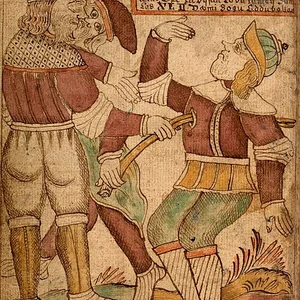

Níðhöggr is a dragon (or serpent) from Norse mythology who relentlessly gnaws at one of the roots of Yggdrasil, the world-tree. Lurking in the spring of Hvergelmir, he also devours the corpses of oath-breakers and murderers, embodying the forces of corruption that threaten the cosmic order.
Níðhöggr
Nídhögg
7 min read
Frequently asked questions
Key Facts
- Constantly gnaws at the root of Yggdrasil that plunges into the spring Hvergelmir, in the cold realm of Niflheim
- The squirrel Ratatoskr scurries up and down the tree to carry insults between Níðhöggr and the eagle perched at the top
- Devours the bodies of oath-breakers, murderers and adulterers in the abode of the dead (Nástrǫnd), according to the Völuspá
- Mentioned in the Poetic Edda (Grímnismál, Völuspá) and Snorri Sturluson's Prose Edda, 13th century
- Survives Ragnarök: he reappears at the end of the Völuspá, flying while carrying corpses on his wings
Works & Achievements
Níðhöggr's endless task: gnawing from below at the root of the world-tree, embodying the force of corruption that perpetually threatens the cosmic order.
In the realm of the dead, Níðhöggr devours the corpses of oathbreakers and murderers, making the dragon the executioner of those who betrayed their oath.
At the very end of the Völuspá, Níðhöggr reappears flying over the reborn world, an enigmatic image of evil's survival after the catastrophe.
A great cosmological poem that mentions Níðhöggr devouring the dead and then surging forth at the end of time. It is our major source on the dragon.
A poem that describes Yggdrasil's sufferings and the squirrel Ratatoskr carrying insults back and forth between the eagle and Níðhöggr.
A text that places Níðhöggr in the spring Hvergelmir, in the world of Niflheim, and explains his role in the structure of the universe.
An Icelandic manuscript that handed down to us the Völuspá and the Grímnismál, and thus the memory of Níðhöggr.
Anecdotes
Níðhöggr is not alone: according to Snorri Sturluson, he lives in the bubbling spring of Hvergelmir, surrounded by so many other serpents “that no tongue could count them.” Together they all gnaw at the root of Yggdrasil, like an invisible army endlessly assaulting the foundations of the world.
A little squirrel named Ratatoskr spends his whole life running up and down the trunk of Yggdrasil to carry insults: he brings down to Níðhöggr, lurking below, the scornful words of the eagle perched at the very top, and back again. He is one of the rare comical “messengers” of Norse mythology, keeping alive an eternal quarrel between the top and the bottom of the world-tree.
Yggdrasil suffers far more than people realize, says the poem Grímnismál: a stag browses it from above, its trunk rots along the sides, and Níðhöggr gnaws it from below. The tree that holds up the universe is thus attacked from every side at once, yet it holds firm — an image of a world that is fragile but resilient.
In the Völuspá, Níðhöggr devours the corpses of oath-breakers, murderers, and those who have betrayed, on a grim shore called Nástrǫnd. The dragon is not merely a monster: he also serves as a punishment for those who have broken their word, which shows just how sacred the oath was among the ancient Scandinavians.
At the very end of the Völuspá, as the world is reborn after Ragnarök (the great final catastrophe), a last vision appears: Níðhöggr comes flying, dark and gleaming, carrying corpses among his feathers. Scholars still debate this mysterious passage — is it a sign that evil is never wholly defeated, or merely an echo of the old world passing away?
Primary Sources
There she saw wading through heavy currents perjurers and murderers… There Níðhöggr sucked the corpses of the dead, the wolf tore men apart.
There comes from below the dark flying dragon, the gleaming serpent, from the Mountains of Darkness; Níðhöggr bears corpses in his feathers, and flies over the plain.
Ratatoskr is the name of the squirrel who must run along the ash-tree Yggdrasill; the eagle's words he carries from above and brings them down below to Níðhöggr.
The ash-tree Yggdrasill endures hardship greater than men know: a hart browses it from above, its sides rot, and from below Níðhöggr gnaws it.
Beneath the root that turns toward Niflheim lies Hvergelmir, and there Níðhöggr gnaws the root from below; more serpents lie there with him than any tongue could count.
Key Places
Bubbling spring located in the world of cold and mist, beneath one of Yggdrasil's roots. Níðhöggr dwells there, surrounded by countless serpents, gnawing at the root of the world-tree.
Cosmic tree linking the nine worlds. Níðhöggr attacks one of its roots day and night, threatening the stability of the universe.
Grim shore of the realm of the dead, where a hall woven from the backs of serpents rises and from which venom drips. It is there that Níðhöggr devours the bodies of oath-breakers and murderers.
Shadowy mountains from which, in the final stanza of the Völuspá, Níðhöggr comes flying forth after Ragnarök, bearing corpses in his feathers.
Icelandic estate where Snorri Sturluson lived and where the Prose Edda was composed. It was here that the figure of Níðhöggr was set down in writing in the 13th century.
Typical Objects

A gigantic cosmic tree that connects the nine worlds and holds up the Norse universe. Níðhöggr endlessly gnaws at one of its three roots, the one that plunges down toward the cold world of Niflheim.

The bodies of oathbreakers, murderers, and traitors washed up on the shore of corpses, in the realm of the dead. Níðhöggr devours them, turning the dragon into an instrument of punishment for those who have broken their oath.

An Icelandic manuscript copied around 1270 that brings together the poems Völuspá and Grímnismál, our oldest sources on Níðhöggr. Without this book, most of Norse mythology would have been lost.

A treatise written around 1220 that explains Norse cosmology for the poets of its time. It is this work that precisely places Níðhöggr in the spring Hvergelmir, gnawing at the root of Yggdrasil from below.

Carved figureheads in the shape of a dragon or serpent that adorned Scandinavian ships. They reveal the place of the serpent-dragon in the Norse imagination, the same world that gave rise to Níðhöggr.

A late Viking art motif in which slender serpentine beasts coil, bite, and intertwine, for example on the portals of the Urnes stave church in Norway. They are often likened to the serpents that gnaw at the roots of Yggdrasil.
School Curriculum
Vocabulary & Tags
Key Vocabulary
Daily Life
Morning
Crouched at the bottom of the bubbling spring of Hvergelmir, in the frozen world of Niflheim, Níðhöggr endlessly gnaws away at the root of Yggdrasil. Around him writhe countless other serpents that also attack the world-tree.
Afternoon
Down the trunk scurries Ratatoskr, the messenger squirrel, who carries to Níðhöggr the scornful words of the eagle perched at the very top. The dragon answers with fresh insults, fueling a quarrel that never ends.
Evening
On the shore of corpses, at Nástrǫnd, Níðhöggr devours the bodies of oath-breakers, murderers, and traitors. Venom drips from the walls of the hall woven from serpents, in an atmosphere of punishment and decay.
Food
Níðhöggr feeds on corpses: he sucks the bodies of the guilty dead and tears apart those who have broken their oaths. Far removed from any human meal, his diet symbolizes the forces of death and decomposition that gnaw at the world.
Clothing
The dragon's “clothing” is his gleaming serpent scales. The Völuspá also gives him feathers: at the end of time, he flies carrying corpses in his dark, shining plumage.
Housing
His dwelling is the spring Hvergelmir, at the foot of the root of Yggdrasil, in the realm of cold and mist. He also haunts Nástrǫnd, the shore of the dead, which makes him a creature of the world's depths and darkness.
Historical Timeline
Period Vocabulary
Liens externes & ressources
Références
Œuvres
Le rongement éternel de la racine d'Yggdrasil
Époque mythologique
Le châtiment des morts à Nástrǫnd
Époque mythologique
Le vol final au Ragnarök
Époque mythologique
Völuspá (« La prophétie de la voyante »)
v. Xe–XIe s. (consigné au XIIIe s.)
Grímnismál (« Les dits de Grímnir »)
v. Xe–XIe s. (consigné au XIIIe s.)
Edda en prose, Gylfaginning (Snorri Sturluson)
v. 1220
Codex Regius (manuscrit)
v. 1270