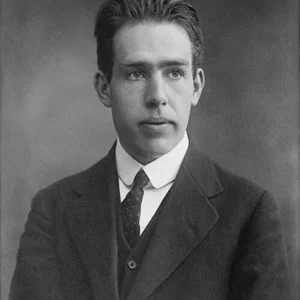

Danish physicist (1885–1962), pioneer of quantum mechanics. He proposed a revolutionary model of the atom and received the Nobel Prize in Physics in 1922.
Niels Bohr
Niels Bohr
Royaume de Danemark
8 min read
Frequently asked questions
Famous Quotes
« Anyone who is not shocked by quantum theory has not understood it.»
« An expert is a person who has made all the mistakes that can be made in a very narrow field.»
Key Facts
- 1885: born in Copenhagen, Denmark
- 1913: publication of the Bohr atomic model (quantized energy levels)
- 1922: Nobel Prize in Physics for his work on atomic structure
- 1927: formulation of the complementarity principle (Solvay Congress)
- 1943: escape from occupied Denmark to the United States, then participation in the Manhattan Project
Works & Achievements
Three papers published in the Philosophical Magazine that form the foundation of the Bohr atomic model. Bohr proposed that electrons orbit the nucleus in stable shells and emit light only when jumping from one orbit to another.
Scientific institution founded by Bohr and partly funded by the Carlsberg brewery. It became the intellectual hub of the quantum revolution, attracting the greatest physicists of the twentieth century.
A conceptual framework developed by Bohr and Heisenberg holding that particles have no definite properties before they are measured. Controversial yet enduring, it remains the most widely accepted interpretation in physics today.
A collection of essays in which Bohr elaborates the principle of complementarity and reflects on the philosophical implications of quantum physics for our understanding of reality.
A paper written in response to the famous Einstein-Podolsky-Rosen paradox, in which Bohr defends the completeness of quantum mechanics and refines the concept of complementarity.
An open letter in which Bohr argues for international control of nuclear energy and an open world where science serves peace — a testament to his ethical commitment in the aftermath of Hiroshima.
Anecdotes
Niels Bohr was famous for his endless discussions with colleagues, which he would carry on late into the night. He had a habit of thinking out loud, reformulating his ideas until he found the perfect wording — much to the despair of his assistants, who had to write everything down.
In 1943, as the Gestapo came to arrest him, Bohr escaped by night in a rowboat to Sweden, then was transported to England in the unpressurized bomb bay of a Mosquito bomber. He lost consciousness along the way from lack of oxygen, but survived — an escape worthy of a spy novel.
A horseshoe hung above the door of his country house. A surprised visitor asked whether he really believed in such superstition. Bohr replied with a smile: “No, of course not — but I’m told it brings good luck even if you don’t believe in it.”
The debates between Bohr and Einstein over quantum mechanics became legendary. At every Solvay conference, Einstein would propose a thought experiment to prove that quantum theory was incomplete, and Bohr would spend the night working to find the flaw — which he invariably did by the following morning.
Bohr had founded his Institute for Theoretical Physics in Copenhagen in 1920, which became the world center of atomic physics. Giants such as Heisenberg, Pauli, Dirac, and Schrödinger all spent time there. He would often pay out of his own pocket for the train tickets of young researchers who could not afford to make the trip.
Primary Sources
In order to explain the results of experiments on scattering of α rays by matter Professor Rutherford has given a theory of the structure of atoms. According to this theory, the atoms consist of a positively charged nucleus surrounded by a system of electrons kept together by attractive forces from the nucleus.
The theory of spectra and atomic constitution has led to a picture of the atom in which electrons move in orbits around a central nucleus, and where the properties of the atom are determined by the laws of quantum mechanics.
Complementarity is not a limitation of our knowledge, but a fundamental feature of quantum reality. The question is not whether the theory is complete, but what 'complete' can mean in this domain.
The quantum postulate implies that any observation of atomic phenomena will involve an interaction with the agency of observation not to be neglected. Accordingly, an independent reality in the ordinary physical sense can neither be ascribed to the phenomena nor to the agencies of observation.
Einstein was not satisfied with what he considered to be the incomplete character of quantum mechanics. But the arguments he successively put forward proved to be compatible with the theory, once the uncertainty principle was taken into account.
Key Places
Bohr's birthplace and the city where he spent his entire career. In 1920 he founded the Institute for Theoretical Physics there, which was renamed after him following his death and became the world capital of quantum physics.
It was in Ernest Rutherford's laboratory in Manchester, in 1912, that Bohr developed the foundational ideas that led him to his model of the atom, published the following year.
Venue of the Solvay Conferences (1911, 1913, 1927…), where Bohr defended the Copenhagen interpretation against Einstein. These landmark debates took place in this city.
Bohr's country cottage on the northern coast of Zealand, where he enjoyed retreating with his family and welcoming colleagues for informal discussions away from Copenhagen.
The secret site of the Manhattan Project during World War II, where Bohr (under the alias Nicholas Baker) participated as a consultant in the design of the atomic bomb.
It was in Stockholm that Bohr received the Nobel Prize in Physics in December 1922, an award that crowned his model of the atom and his pioneering role in quantum physics.
Typical Objects

An instrument that breaks down the light emitted by a chemical element into precise colored lines. It was by observing the spectral lines of hydrogen that Bohr constructed his atomic model in 1913.

An indispensable tool at the Copenhagen Institute: Bohr would spend hours covering blackboards with equations and diagrams of electron orbits during his seminars with colleagues.

A schematic representation of the nucleus surrounded by electrons on circular orbits, which became the iconic image of the atom in the 20th century, directly inspired by Bohr's 1913 model.

Bohr was a notorious pipe smoker. Legend has it that he would think by endlessly lighting and relighting his pipe during intensive working sessions with his students.

Thousands of letters exchanged with Einstein, Heisenberg, Pauli, and Schrödinger form an essential source for the history of quantum physics. Bohr would revise his letters many times before sending them.

It was in this British scientific journal that Bohr published his landmark 1913 trilogy on the constitution of atoms and molecules — articles that would revolutionize physics.
School Curriculum
Vocabulary & Tags
Key Vocabulary
Tags
Daily Life
Morning
Bohr started his day early at his Carlsberg villa (provided by the Danish brewery), often spending the morning reading his international correspondence and preparing his seminars. He had a habit of dictating his ideas to an assistant while pacing around his office.
Afternoon
Afternoons were devoted to work sessions at the Institute, gathered around a blackboard covered in equations and diagrams. Bohr led collective discussions with his students and visiting scholars, questioning every hypothesis and reformulating every argument — sometimes for hours on end.
Evening
Evenings at the Institute often stretched into dinners or informal discussions with the physicists in residence. Bohr enjoyed philosophical debate and could talk well past midnight, pipe in hand, about the nature of quantum reality.
Food
Bohr followed a simple, Nordic diet: rye bread, smoked fish, potatoes, and Danish dairy products. When attending conferences abroad, he ate frugally, preferring to save his energy for scientific exchange rather than elaborate meals.
Clothing
Bohr dressed soberly and conventionally, as befitted a Danish university professor of the early twentieth century: dark suit, white shirt, tie, and an overcoat in winter. He paid little attention to his appearance, his mind usually elsewhere.
Housing
Bohr first lived in modest apartments in Copenhagen, then, following the Nobel Prize, in the honorary villa placed at his disposal by the Carlsberg Foundation — a large, comfortable residence with a garden, a symbol of the prestige Denmark accorded its greatest scientists.
Historical Timeline
Period Vocabulary
Liens externes & ressources
Références
Œuvres
On the Constitution of Atoms and Molecules (trilogie)
1913
Institut de Physique Théorique de Copenhague
1920
L'interprétation de Copenhague de la mécanique quantique
1927
Atomic Theory and the Description of Nature
1934
Can Quantum-Mechanical Description of Physical Reality Be Considered Complete ? (réponse au paradoxe EPR)
1935
Open Letter to the United Nations
1950