
A biblical figure and patriarch in the Judeo-Christian tradition, Noah is the protagonist of the story of the Flood. According to the Bible, he built the Ark to save his family and the animals from the flood sent by God, thereby establishing a new covenant with humanity.
Frequently asked questions
Key Facts
- Built the Ark to save his family and the animals from the Flood (Genesis 6–8)
- Established the covenant between God and humanity after the Flood, symbolized by the rainbow
- Father of Shem, Ham, and Japheth, ancestors of all humanity in the biblical tradition
- Regarded as a righteous and devout man in all three Abrahamic religions (Judaism, Christianity, Islam)
Works & Achievements
Noah builds a giant vessel according to divine instructions to save his family and a pair of every animal species from the Flood. This achievement marks the climax of the Flood narrative and represents a miraculous feat of construction and an act of faith.
Noah witnesses the universal Flood sent by God to punish humanity for its sins, an event that destroys all life on earth except what is preserved in the Ark. This biblical cataclysm stands as a major turning point in religious history.
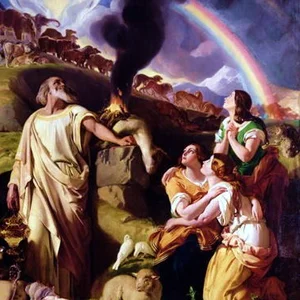
After the Flood, God establishes a new covenant with Noah, symbolized by the rainbow, promising never to send another universal flood. This covenant marks the renewal of the relationship between God and humanity.
Noah and his three sons (Shem, Ham, and Japheth) repopulate the Earth after the Flood, establishing the biblical genealogies of ancient peoples. This achievement is fundamental to the continuity of humanity in the Judeo-Christian tradition.
Noah is the first man mentioned in the Bible as having planted a vineyard and produced wine, symbolizing human agriculture in the wake of the Flood. This act represents the establishment of civilization in a new world.
Anecdotes
According to the biblical account in the Book of Genesis, Noah receives a divine command to build an Ark with precise dimensions: 300 cubits long, 50 wide, and 30 high (roughly 140 meters in length). This monumental construction must shelter his family and a pair of every animal species to save them from the Flood. The text emphasizes that Noah follows the divine instructions exactly, spending 120 years building this extraordinary vessel.
Noah's Ark rests, in the biblical tradition, on an act of absolute trust: Noah must bring the animals aboard without knowing exactly how it will happen. According to the account, the animals come on their own to the Ark — two by two for unclean species and seven by seven for clean ones. This miraculous event illustrates Noah's faith in the word of God.
After the Flood, which lasts forty days according to the Bible, Noah sends out a raven and then a dove to survey the emerging land. When the dove returns with an olive branch in its beak, Noah understands that the waters have receded and that life can begin again. This scene of the olive branch becomes a universal symbol of peace and hope across religious and cultural traditions.
According to the Book of Genesis, Noah establishes a new covenant with God after the Flood: God promises never again to destroy humanity by water. A rainbow appears as a sign of this eternal covenant. This account presents Noah as the founder of a new humanity and a renewed relationship between God and humankind.
Noah is also mentioned as a vintner in the Bible: after leaving the Ark, he plants a vineyard and drinks its wine. This episode, though brief, portrays Noah as a civilization-builder who restores agriculture and human activity. It symbolizes the return to normal life after the catastrophe of the Flood.
Primary Sources
Noah found grace in the eyes of the Lord. Noah was a just man and perfect in his generations; Noah walked with God. Noah begat three sons: Shem, Ham, and Japheth. And the Lord said unto Noah: The end of all flesh is come before me; for the earth is filled with violence through them.
Noah was found perfect and righteous; in the time of wrath he was taken in exchange for the world; therefore was he left as a remnant unto the earth, when the flood came. An everlasting covenant was made with him, that all flesh should perish no more by the flood.
Noah, as the Greeks call him, warned mankind of God's intention to destroy them; he preached repentance to humanity, but few were those who listened. God commanded Noah to build an ark in which he would be saved along with his family and the animals.
In the days of Noah, while the ark was being built, in which a few, that is, eight souls, were saved through water.
Key Places
A historical region of the ancient Near East, considered the cradle of civilization. According to biblical tradition, it forms the geographical backdrop of the story of the Flood and of Noah's life before the construction of the Ark.
A major mountain in the Caucasus region, located in present-day Turkey. According to the biblical account, it was on Mount Ararat that Noah's Ark came to rest after the Flood, marking the end of the catastrophe.
A fertile region of the ancient Near East. Some biblical traditions place the Garden of Eden and the earliest days of humanity in this major river valley, which formed the setting of the antediluvian world.
The central city of Judeo-Christian tradition. Although it postdates Noah, Jerusalem is a place of transmission and veneration of the biblical narratives, including the story of the Flood and of Noah as preserved in the sacred texts.
An ancient Sumerian city in southern Mesopotamia (present-day Iraq). Considered one of the oldest cities in the world, it represents the civilizational context of the antediluvian era according to biblical tradition.
Typical Objects

A large wooden vessel built by Noah according to divine instructions to save his family and the animals from the Flood. It is the central object of the biblical story and the primary symbol of Noah's saving mission.

A bird sent by Noah from the Ark to check whether the floodwaters had receded. It returns carrying an olive branch, a symbol of peace and the end of the catastrophe.

The branch brought back by the dove, signaling the end of the Flood and the renewal of life. It symbolizes hope and the new covenant between God and humanity.

A luminous phenomenon appearing after the Flood as a sign of the eternal covenant between God and Noah. It symbolizes reconciliation and the divine promise never again to destroy the Earth by water.

The tools used by Noah to build the wooden Ark. They represent his role as a builder and his mastery of construction techniques in the biblical ancient world.

Pairs of animals (a male and a female of each species) brought aboard the Ark. They symbolize the preservation of divine creation and the continuity of life after the catastrophe.

A vine cultivated by Noah after the Flood, symbolizing the resumption of agricultural life and civilized humanity. It marks his role in restoring the world after divine judgment.
School Curriculum
Vocabulary & Tags
Key Vocabulary
Tags
Mythologie
Daily Life
Morning
Noah rises before dawn to attend to his domestic and agricultural duties. He checks on his livestock and crops — essential to the survival of a patriarchal family in the 3rd millennium BC. After a light meal, he organizes the day's work with the members of his household.
Afternoon
The afternoon is devoted to farming and pastoral tasks: plowing the fields, irrigation, and tending the herds of goats and sheep. Noah also oversees the construction and upkeep of the structures needed for daily life. He may receive visitors or merchants and barter goods.
Evening
At nightfall, the family gathers around the hearth to share the main meal of the day. Noah takes part in family activities, domestic religious rituals, and the passing down of traditions to his descendants. Sunset marks the end of the day's work, as light is precious and scarce.
Food
Noah's diet consists mainly of grains (barley, wheat), vegetables (lentils, peas), dried fruits, and milk from his herd. Meat is eaten occasionally during religious festivals or sacrifices. Dates, figs, and grapes round out this farm-based diet suited to the ancient Middle East.
Clothing
Noah wears garments woven from linen or wool, naturally dyed in shades of brown and white typical of ancient Levantine peoples. A cloak or cape protects him from changes in weather. His beard — a symbol of patriarchal wisdom — is long and well-kept, reflecting his high social standing.
Housing
Noah lives in a house built of stone or mudbrick, constructed according to the architectural norms of the Middle East in the 3rd millennium BC, with an enclosed courtyard to shelter livestock. The dwelling has several rooms: living areas, crop storage, and animal shelters. A well or nearby water source is essential.
Historical Timeline
Period Vocabulary
Visual Style
Un style combinant l'iconographie biblique et mésopotamienne ancienne, avec des influences des reliefs sumériens et de l'art médiéval. L'ambiance est solennelle et spirituelle, traversée par une lumière dorée divine contrastant avec les nuages d'orage, créant un sentiment d'espoir face à la catastrophe.
Sound Ambience
Une ambiance sonore immersive mêlant les bruits de la construction de l'Arche—coups de marteau et grincements du bois—aux sons terrifiants du Déluge : pluie torrrentielle, tonnerre lointain et cris d'animaux apeurés, évoquant à la fois l'urgence humaine et la puissance divine.
Liens externes & ressources
Références
Œuvres
La construction de l'Arche
Antiquité biblique (chronologie traditionnelle : ~2350 av. J.-C.)
Le Déluge
Antiquité biblique (chronologie traditionnelle : ~2350 av. J.-C.)
L'Alliance de Dieu avec Noé
Antiquité biblique (chronologie traditionnelle : ~2350 av. J.-C.)
Le repeuplement de la Terre
Antiquité biblique (après ~2350 av. J.-C.)
La culture de la vigne
Antiquité biblique (après ~2350 av. J.-C.)