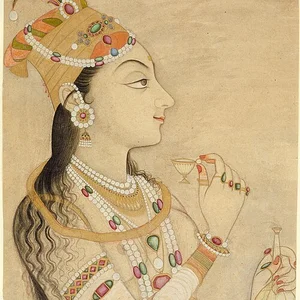

Mughal empress (1577–1645), wife of Emperor Jahangir, she was the only woman to wield real political power under the Mughal dynasty. An administrator, poet, and patron of the arts, she had coins struck in her own name and effectively governed the empire for several years.
Nur Jahan(1577 — 1645)
Nûr Jahân
Empire moghol
8 min read
Frequently asked questions
Key Facts
- Born in 1577 in Kandahar, to a Persian family who had emigrated to the Mughal court
- Married Emperor Jahangir in 1611, becoming his twentieth and final imperial wife
- The first and only Mughal woman to have coins struck in her own name
- Effectively governed the empire during Jahangir's illnesses and absences throughout the 1620s
- Died in 1645 in Lahore, leaving behind a body of poetry in Persian and a mausoleum she had designed herself
Works & Achievements
A funerary monument entirely funded and overseen by Nur Jahan for her parents in Agra. The first large-scale use of white marble and pietra dura inlay technique in Mughal architecture, it directly foreshadowed the Taj Mahal.
A series of gold and silver coins minted in Nur Jahan's name — unique in Mughal history. Struck between 1613 and 1627, these coins attest to her officially recognized status as co-sovereign.
A collection of lyric poems in Persian composed under the pen name 'Makhfi'. Her ghazals, steeped in Sufi mysticism and romantic sensibility, place her in the lineage of the great poetesses of the Persian tradition.
Negotiations and firmans granting trading privileges to the English Company, personally overseen by Nur Jahan. These agreements had a lasting influence on the shape of British presence in the Indian subcontinent.
An imperial garden designed by Nur Jahan in the tradition of the charbagh (four-part garden) of Persian origin. This space reflects her role as an architectural patron and her appreciation for integrating nature into courtly life.
A mausoleum that Nur Jahan had built during her own lifetime in Lahore, marked by a deliberate simplicity that contrasts with the grandeur of Mughal monuments. Historians interpret this aesthetic choice as a lucid meditation on her own condition after the loss of power.
Anecdotes
Nur Jahan was the only woman in Mughal history to have her name engraved on official imperial coins. This privilege, reserved for emperors alone, reflected her unprecedented power: she effectively co-ruled alongside Jahangir, whose declining health and opium dependency gave his wife free rein to govern.
A renowned huntress of exceptional skill, Nur Jahan is said to have killed four tigers with just two shots during an imperial hunt, firing from a howdah — the covered seat atop an elephant's back. The feat was celebrated in a poem by Emperor Jahangir himself, who declared he had never witnessed such bravery in a woman.
Nur Jahan pioneered a textile innovation that spread throughout the empire: an embroidered fabric known as 'nur jahan,' blending gold and silver threads on a lightweight silk background. A trendsetter ahead of her time, she also introduced a new hairstyle and a distinctive way of draping the dupatta, both of which were widely imitated by ladies of the court.
When her father Itimad-ud-Daula died in 1622, Nur Jahan commissioned a mausoleum in Agra entirely clad in white marble inlaid with semi-precious stones using the pietra dura technique. Completed in 1628, this tomb is considered the first fully realized example of this style in Mughal architecture, and is a direct forerunner of the Taj Mahal.
After Jahangir's death in 1627, Nur Jahan was removed from power by her stepson Shah Jahan. She retired to Lahore on an annual pension, and spent the rest of her life writing poetry in Persian, caring for the poor, and overseeing the construction of her own mausoleum — which she designed herself with deliberate simplicity.
Primary Sources
Nur Jahan Begum was granted the title of Empress. Apart from the royal seals, all firmans and grants bear her name. Gold and silver coins are struck in her name.
His Majesty entrusted the entire administration of the empire to Nur Jahan Begum. She dispensed justice, granted lands, and appointed governors with all the authority of a sovereign ruler.
Nur Jahan possessed superior intelligence and unfailing judgment. She managed affairs of state with a competence that few men could have matched, and the emperor approved all her decisions.
This princess exercised such absolute authority over the mind of the Great Mughal her husband that she was regarded throughout all of India as the true sovereign of the empire.
Key Places
Jahangir's favorite capital, where Nur Jahan resided for many years and exercised her power. She died there in 1645 and rests in her mausoleum, which she designed herself with understated elegance.
The tomb of her parents, entirely clad in white marble inlaid with pietra dura, built by Nur Jahan between 1622 and 1628. Often called the 'Baby Taj', it represents the first monumental architectural work in Mughal history to be fully funded and overseen by a woman.
The main imperial residence where Nur Jahan held court, received foreign ambassadors, and made political decisions on Jahangir's behalf. The fort housed the women's quarters (zenana) as well as the audience halls.
The Mughal court's favorite summer retreat, where Nur Jahan accompanied Jahangir every year. She contributed to the creation of terraced gardens in the Persian style, including the famous Shalimar Bagh.
Nur Jahan's birthplace, then under Mughal rule. Her Persian family lived there before joining the court of Akbar in Agra — origins that would fuel her lifelong fascination with Persian culture.
Typical Objects

Imperial gold coin struck in Nur Jahan's name, with Jahangir's seal on the reverse. This currency symbolizes her sovereign power — she was the only woman in Mughal history to have been granted this royal privilege.

Ceremonial water pipe in chiseled and enameled metal, a fixture of the Mughal court during diplomatic gatherings. Nur Jahan is said to have helped popularize a curved-stem design that became characteristic of the Jahangir era.

Light silk veil adorned with zardozi embroidery (gold and silver thread), whose floral motifs Nur Jahan helped reinvent. She created a style of draping that spread throughout Mughal aristocracy.

A finely decorated arquebus, symbol of Nur Jahan's remarkable mastery of the hunting arts. Her feat of shooting tigers was commemorated in an inscription commissioned by Jahangir.

A gilded metal command insignia mounted on a staff, carried before Mughal rulers during processions. Nur Jahan had her own, a mark of her near-sovereign status within the empire.

A calligraphed manuscript gathering her ghazals and quatrains written under the pen name 'Makhfi' (the hidden one). This collection attests to her refined literary education and her place within the Persian poetic tradition of the court.
School Curriculum
Vocabulary & Tags
Key Vocabulary
Tags
Daily Life
Morning
Nur Jahan rose before dawn for ritual prayers, then received the first administrative requests in her zenana apartments, brought by imperial secretaries. She reviewed dispatches from provincial governors, dictated replies, and affixed her personal seal to firmans before the empire officially began its day.
Afternoon
Afternoons were devoted to diplomatic audiences, decisions on the appointment of senior officials, and sometimes hunting expeditions in the royal forests. She also oversaw the imperial workshops (karkhanas), where weavers, jewelers, and architects worked under her artistic direction.
Evening
In the evenings, the court gathered for mushairas — Persian poetry competitions — or for Hindustani classical music concerts. Nur Jahan composed verses herself, discussed literature with scholars, and maintained an active correspondence with poets and intellectuals from across the empire.
Food
The Mughal imperial table bore a strong Persian influence: saffron-scented rice, meats slow-cooked in sauces spiced with cardamom and cinnamon, dried fruits, pomegranates, and mangoes. According to court chroniclers, Nur Jahan favored light preparations and floral sorbets, and is credited with introducing Persian recipes into the royal court cuisine.
Clothing
Nur Jahan wore salwar-kameez of fine muslin or silk, draped with a dupatta embroidered in zardozi (gold and silver thread). Her jewelry — pearl necklaces, jade bracelets, and diamond earrings — reflected the Mughal taste for inlaid gemstone work. She is credited with launching several fashion trends that were widely imitated throughout the aristocracy.
Housing
Nur Jahan resided in the royal zenana quarters within the forts of Agra and Lahore: suites of white marble rooms adorned with indoor fountains, oil lamp niches, and terraced gardens. These spaces blended the luxury of pietra dura inlay, Persian carpets, and sandstone jali screens that allowed her to observe without being seen.
Historical Timeline
Period Vocabulary
Visual Style
Style miniature moghole raffiné : fonds de marbre blanc incrusté aux motifs floraux, soieries brodées d'or, lumière tamisée par des moucharabiehs en grès rouge d'Agra.
Sound Ambience
Ambiance sonore de la cour moghole de Lahore et d'Agra : fontaines, musique de chambre persane, froissement de soieries et travail des artisans lapidaires dans les ateliers impériaux.
Liens externes & ressources
Références
Œuvres
Mausolée d'Itimad-ud-Daula
1622-1628
Monnaies impériales à son nom
1613-1627
Diwan (recueil poétique)
vers 1627-1645
Réformes commerciales avec la Compagnie anglaise des Indes orientales
1615-1620
Jardins de Dilkusha, Lahore
vers 1620
Mausolée de Nur Jahan, Lahore
vers 1627-1645