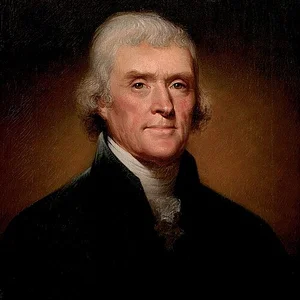

An American statesman, Thomas Jefferson was one of the Founding Fathers of the United States and the principal author of the Declaration of Independence (1776). A philosopher of the Enlightenment, he also served as the third President of the United States (1801–1809).
Thomas Jefferson(1743 — 1826)
Thomas Jefferson
États-Unis
8 min read
Frequently asked questions
Famous Quotes
« All men are created equal.»
« The freedom of the press is one of the great bulwarks of liberty.»
Key Facts
- 1743: Born in Shadwell, Virginia
- 1776: Principal author of the American Declaration of Independence
- 1784–1789: U.S. Minister Plenipotentiary to France, based in Paris
- 1801–1809: Third President of the United States
- 1826: Died on July 4th, the 50th anniversary of American independence
Works & Achievements
The founding document proclaiming the independence of the thirteen colonies from Great Britain. Written primarily by Jefferson, it establishes the principles of natural rights and popular sovereignty that would go on to influence the Atlantic Revolutions.
The only book Jefferson ever published, written in response to a questionnaire from a French diplomat. In it, he describes the geography, wildlife, flora, populations, and political organization of Virginia, alongside philosophical reflections on slavery and religious freedom.
A landmark law separating church and state in Virginia, passed after a lengthy legislative struggle. This text is considered one of the direct sources of the First Amendment to the U.S. Constitution, which guarantees freedom of religion.
A landmark presidential decision by which Jefferson acquired the Louisiana Territory from Napoleon for 15 million dollars. The deal doubled the size of the United States and opened the door to westward expansion.
Jefferson designed and redesigned his Monticello estate over more than forty years, drawing inspiration from the Roman Pantheon and Palladian villas. This architectural masterpiece has been a UNESCO World Heritage Site since 1987.
Jefferson founded, architecturally designed, and pedagogically organized the University of Virginia, the first fully secular university in America. He oversaw its construction until his death and personally drafted its first academic curricula.
Anecdotes
Jefferson drafted the Declaration of Independence in just seventeen days, in June 1776, at a rented house in Philadelphia. The text proclaiming that "all men are created equal" was adopted on July 4, 1776, a date that became the American national holiday.
An avid lover of French wine, Jefferson toured the vineyards of Bordeaux and Burgundy during his time as ambassador to France (1784–1789). He introduced several grape varieties to the United States and built an exceptional wine cellar at Monticello.
Jefferson was a tireless inventor: he improved the moldboard plow, designed an automatic double-leaf door mechanism, and took a keen interest in polygraphs that could copy his letters simultaneously — of which he sent more than nineteen thousand over the course of his life.
One of the most troubling paradoxes of his life: a passionate advocate for natural rights and liberty, Jefferson owned more than six hundred enslaved people at Monticello. He never freed them during his lifetime, despite his writings on human equality — a contradiction that remains one of the most debated in American history.
Jefferson died on July 4, 1826, the fiftieth anniversary of the Declaration of Independence, just hours before his friend and political rival John Adams. This remarkable coincidence made a profound impression on his contemporaries.
Primary Sources
We hold these truths to be self-evident, that all men are created equal, that they are endowed by their Creator with certain unalienable Rights, that among these are Life, Liberty and the pursuit of Happiness.
Can the liberties of a nation be thought secure when we have removed their only firm basis, a conviction in the minds of the people that these liberties are of the gift of God?
I hold it that a little rebellion now and then is a good thing, and as necessary in the political world as storms in the physical.
We are all Republicans, we are all Federalists. If there be any among us who would wish to dissolve this Union or to change its republican form, let them stand undisturbed.
All eyes are opened, or opening, to the rights of man. The general spread of the light of science has already laid open to every view the palpable truth, that the mass of mankind has not been born with saddles on their backs.
Key Places
Jefferson's plantation and primary residence, which he designed himself in a Neoclassical style inspired by Andrea Palladio. The site embodies both his architectural genius and the glaring contradiction of his slaveholding life.
The city where Jefferson drafted the Declaration of Independence in 1776 and where the Continental Congress convened. Independence Hall, the building where it was adopted, is now a UNESCO World Heritage Site.
Jefferson lived in Paris from 1784 to 1789 as U.S. Minister Plenipotentiary. There he moved in Enlightenment philosophical circles, discovered French architecture, and witnessed the early stirrings of the Revolution.
The federal capital whose urban development Jefferson helped oversee, and where he served as president from 1801 to 1809. He lived in the White House, which was still unfinished when he arrived.
Founded and architecturally designed by Jefferson in 1819, the university embodies his vision of secular public education. He drew up its plans around an innovative concept he called an "academical village."
Typical Objects

Jefferson was a prolific letter writer, composing more than nineteen thousand letters over the course of his life. His quill pen and inkwell were the daily instruments of his political and philosophical thought.

Jefferson used this mechanical device to make simultaneous copies of his letters using two linked pens. He made extensive use of it at Monticello to archive his vast correspondence.

Jefferson kept meticulous records of all activities on his Monticello plantation, documenting harvests, expenses, and the labor of enslaved people — revealing the deep contradiction between his ideals and his daily reality.

A great music lover, Jefferson played the violin for several hours a day. He imported sheet music from Europe and considered music essential to the education of a cultivated man.

Passionate about natural science and geography, Jefferson regularly used measuring instruments to survey his lands and contribute to the mapping of the new nation.

Jefferson owned one of the largest private libraries in America, with more than six thousand volumes. He sold it to Congress in 1815 to form the initial collection of the Library of Congress after the burning of Washington.
School Curriculum
Vocabulary & Tags
Key Vocabulary
Tags
Daily Life
Morning
Jefferson rose at dawn and soaked his feet in cold water, a practice he maintained into old age, believing it preserved his health. He devoted his first hours to reading the thermometer, recording weather conditions in his journal, and reviewing his correspondence before anything else.
Afternoon
Afternoons were divided between overseeing his plantation, working in the botanical garden he particularly cherished, and receiving visitors. Jefferson placed great importance on experimental agriculture, testing hundreds of plant varieties on the terraced gardens of Monticello.
Evening
Evenings at Monticello brought together family, political guests, and intellectuals around a carefully prepared meal where Jefferson, a refined gastronome, served French wines and dishes inspired by European cuisine. After dinner, he would often play the violin and carry on philosophical conversations late into the night.
Food
Jefferson had adopted an unusually forward-thinking diet for his time, treating meat as a side dish rather than the main course — contrary to the habits of his contemporaries. A great lover of vegetables, he personally grew rare varieties at Monticello and imported olive oils, cheeses, and fine wines from Europe for his table.
Clothing
As president and statesman, Jefferson wore quality garments tailored from fine cloth, often in dark colors, with knee breeches, silk stockings, and buckled shoes in keeping with 18th-century fashion. He refused, however, to wear the powdered wigs still favored by some of his contemporaries, preferring his naturally red hair tied back simply.
Housing
Monticello, his plantation in the hills of Virginia, was a neoclassical villa that Jefferson designed himself and continued to remodel over forty years. The home, topped by a dome inspired by the Panthéon, housed a library of six thousand volumes, numerous scientific instruments, and mechanical gadgets of his own invention — all maintained through the unpaid labor of several hundred enslaved people.
Historical Timeline
Period Vocabulary
Visual Style
Style néoclassique américain inspiré de Palladio, mêlant la sobriété élégante de l'architecture virginienne, les matières naturelles chaudes et la lumière dorée des Lumières atlantiques.
Sound Ambience
Ambiance sonore mêlant le silence studieux de la bibliothèque de Monticello, la musique de chambre et les sons de la vie rurale virginienne au tournant du XVIIIe siècle.
Liens externes & ressources
Références
Œuvres
Déclaration d'indépendance des États-Unis
1776
Notes on the State of Virginia
1781-1785
Statut de Virginie pour la liberté religieuse
1786
Achat de la Louisiane
1803
Conception architecturale de Monticello
1768-1809
Fondation de l'Université de Virginie
1819