
Creator goddess of Chinese mythology, Nüwa molded the first humans from yellow clay. She then repaired the vault of heaven by melting stones of five colors after the pillars of the sky collapsed.
Nüwa
Nuwa
10 min read
Frequently asked questions
Key Facts
- Nüwa fashioned the first human beings from yellow clay, according to the Fengsutong (2nd century CE)
- She repaired the vault of heaven by melting five-colored stones after it was destroyed by the giant Gong Gong
- She stabilized the Earth by using the legs of a giant tortoise as new pillars of the world
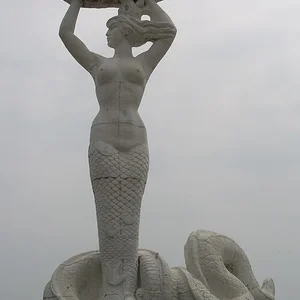
- Often depicted with the body of a serpent or dragon and a human face
- Mentioned among the Three Sovereigns, the mythical rulers who founded Chinese civilization
Works & Achievements
Nüwa molded the first humans from yellow clay and breathed life into them. This founding act makes her the mother goddess of humanity in Chinese mythology, a figure comparable to Prometheus in Greece or the Yahweh of Genesis in other traditions.
After the collapse of the celestial pillars, Nüwa melted stones of five colors to seal the breach and put an end to the disasters. This heroic deed, the most celebrated in all of Chinese mythology, symbolizes the restorative and cosmic power of the divine feminine.
Nüwa is credited with establishing the rites of marriage, enabling humans to reproduce and ensure the continuation of the species. This role as tutelary goddess of unions made her a deity prayed to at betrothals for millennia.
Nüwa is identified as the inventor of the *sheng*, one of China's oldest wind instruments, consisting of bamboo pipes of varying lengths. Used in wedding ceremonies and ancestor offerings, it deepens her association with fertility and cosmic harmony.
To replace the broken pillars, Nüwa severed the legs of the cosmic tortoise and set them at the four corners of the world. This act completes the restoration of cosmic order and gives the earth its lasting stability in Chinese cosmogony.
Anecdotes
According to the Fengsu Tongyi (2nd century CE), Nüwa molded the first humans one by one from the yellow clay of the Yellow River, breathing life into them. Exhausted by this painstaking work, she dipped a rope in the mud and shook it: each drop that fell transformed into a human being. It is said that the first ones, carefully shaped by hand, became the nobles and the wise, while those born from the splattered mud made up ordinary people.
One day, the turbulent god Gonggong, furious at having lost a battle against the god Zhuanxu, struck the mountain Buzhou in his rage — one of the pillars holding up the vault of heaven. The sky cracked, the earth collapsed, flames burst forth, and torrential floods inundated the world. Nüwa, moved by compassion for the humans she had created, set about repairing the sky by melting stones of five colors — red, yellow, blue, white, and black — to seal the breach, thereby restoring cosmic order.
To permanently stabilize the earth after the cataclysm, Nüwa cut off the four legs of a gigantic cosmic tortoise and used them as new pillars at the four corners of the world. This account, recorded in the Huainanzi, illustrates the goddess's ingenuity: unable to restore the ancient pillars, she devised an entirely new solution. The tortoise's shell went on to become a symbol of longevity and cosmic stability throughout Chinese culture.
Nüwa is also venerated as the goddess of marriage and fertility. According to certain traditions, she instituted the rites of marriage so that the humans she had created could reproduce and perpetuate the species. She is also credited with inventing the sheng, a wind instrument made of bamboo pipes whose shape evokes the vault of heaven and whose sounds accompanied wedding ceremonies in ancient China.
In many Chinese iconographic representations, Nüwa appears as a woman with a human torso and a serpent's tail intertwined with that of Fuxi, her brother and husband in certain versions of the myth. This divine couple symbolizes the balance of yin and yang — Nüwa's compass representing the circle and the heavens, Fuxi's set square representing the earth. These images can be seen on funerary silks from the Han period discovered at Mawangdui, bearing witness to the deep antiquity of this symbolism.
Primary Sources
In ancient times, the four pillars had collapsed and the nine provinces had cracked apart. The sky no longer covered everything, the earth no longer bore all things. Flames burned without dying out, waters flowed without stopping. Nüwa smelted stones of five colors to patch the blue sky, and cut off the legs of the great tortoise to set up the four pillars.
It is commonly said that when Heaven and Earth had been separated and humans did not yet exist, Nüwa took yellow clay and molded people from it. But the task was exhausting and her time insufficient, so she dipped a rope into the mud and lifted it: the mud that dripped off also became people.
Nüwa had a body: who made it? How was she able to create and transform herself?
Nüwa, whose entrails transformed into ten deities known as the Intestines of Nüwa, wandering across the plain of Suzhai.
Long ago, Gonggong and Zhuanxu fought to become emperor. In their fury, they struck Mount Buzhou. The pillar of heaven broke, the cords of the earth snapped. Nüwa smelted stones of five colors to repair the sky.
Key Places
Mythical pillar of the sky located in the northwest of the world, which Gonggong shattered in his rage, causing the sky to collapse and devastating floods. This is the triggering location of Nüwa's heroic act.
Sacred mountain of Chinese mythology, residence of the gods and axis mundi linking earth to heaven. A gathering place for deities, it is associated with Nüwa's sojourn during the repair of the sky and the crafting of the five-colored stones.
Cradle of Chinese civilization and the symbolic place where Nüwa is said to have gathered yellow clay to create humanity. This region is considered the ancestral homeland of the Chinese people and the geographical setting of their founding mythology.
The principal temple dedicated to Nüwa in China, built into a cliffside in Hebei with origins dating back to the Han period. A still-active pilgrimage site, it preserves frescoes and statues bearing witness to the millennia-old veneration of the creator goddess.
A mythical place mentioned in the Shanhaijing where Nüwa's entrails transformed into ten deities after her death. This location symbolizes the cosmic dimension of Nüwa, whose very body becomes a source of life and divine order.
Typical Objects

The five stones — red, yellow, blue, white, and black — that Nüwa melted to seal the crack in the sky. They symbolize the five elements of Chinese cosmology (fire, earth, wood, metal, and water) and the cosmic harmony restored by the goddess.

Nüwa used the yellow clay of the Yellow River to shape the first humans. This sacred earth represents, in Chinese culture, the primordial substance of humanity — symbolically explaining the skin color associated with East Asian peoples in their own mythology.

Exhausted from shaping humans one by one, Nüwa dipped a rope in mud and shook it, creating multitudes of people from the droplets it flung outward. This object illustrates the tension between the elite crafted with care and the common masses born of chance.

Nüwa is traditionally credited with inventing the sheng, a wind instrument made of bamboo pipes of unequal lengths. Its circular shape evokes the repaired vault of the sky, and its sounds once accompanied wedding and fertility rites.

In classical iconography, Nüwa holds a compass — an instrument associated with the circle and the heavens — while Fuxi holds a set square associated with the earth. This pair of tools embodies the cosmic order and the foundations of sacred geometry in Chinese thought.

Nüwa severed the four legs of the giant turtle Ao to replace the broken pillars of the sky and stabilize the earth at its four corners. The turtle, a symbol of cosmic longevity, is closely linked to divination through oracle bones in ancient China.
School Curriculum
Vocabulary & Tags
Key Vocabulary
Daily Life
Morning
Nüwa is a primordial deity who exists outside any human sense of time; her mythic "morning" consists of roaming the unorganized spaces of the cosmos, shaping clay from the Yellow River and breathing life into the first human creatures. Every new day is in a sense her creation, for it is she who, according to certain texts, regulates the alternation of day and night after repairing the vault of heaven.
Afternoon
In mythological accounts, Nüwa's afternoon is associated with her work of repair and transformation: she melts stones of five colors in a cosmic crucible, patiently sealing the cracks in the sky with divine patience. Her servants and the ten deities born from her own entrails assist her in this titanic task, which unfolds over the equivalent of many human generations.
Evening
In the evening, Nüwa watches over the humans she created, granting her protection to couples who unite according to the rites she established. In the temples dedicated to her, worshippers burn incense at sunset to secure her benevolence, especially during betrothals and weddings.
Food
As a deity, Nüwa does not eat as humans do: she absorbs *qi* (氣), the vital energy that animates the cosmos. Taoist texts credit her with consuming peaches of immortality and celestial dew — symbolic foods of divine longevity and perpetual renewal.
Clothing
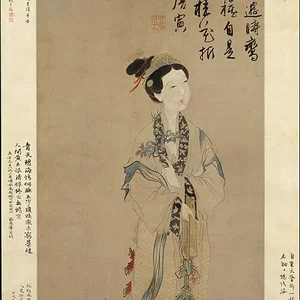
Classical iconography depicts Nüwa dressed in robes in the colors of the cosmos (red, blue, green), embroidered with cloud and dragon motifs. Her serpent's tail, emerging from her garments, evokes her hybrid nature as a primordial deity halfway between the animal realm and the divine. In paintings from the Han period, she wears a headdress adorned with stars and holds a compass.
Housing
Nüwa dwells in the mythical heights of Mount Kunlun, the palace of the gods located at the center of the world according to Chinese cosmology. Her celestial chambers are described as adorned with jade and precious stones in the five colors, similar to those she used to repair the sky. She moves freely between the earthly and celestial spheres, invisible to mortals.
Historical Timeline
Period Vocabulary
Liens externes & ressources
Références
Œuvres
Création de l'humanité (造人, Zào Rén)
Temps mythiques
Réparation du ciel (补天, Bǔ Tiān)
Temps mythiques
Institution du mariage (婚姻制度)
Temps mythiques
Invention du sheng (笙)
Temps mythiques
Stabilisation de la terre aux quatre piliers (立四极)
Temps mythiques