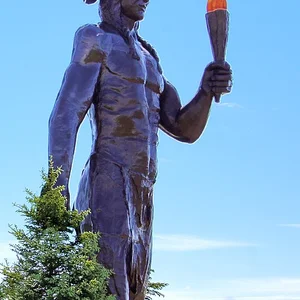

Creator hero and central figure of Mi'kmaq and Abenaki mythology in North America. A cultural being who shaped the world, defeated monsters, and taught humans the arts of survival. A figure from the Indigenous oral tradition of northeastern America, passed down from generation to generation.
Glooscap
Glouscap
8 min read
Frequently asked questions
Key Facts
- Glooscap is the central demiurge hero of Mi'kmaq and Abenaki mythology, peoples of northeastern North America
- According to oral tradition, he shaped the habitable world by battling monstrous creatures that threatened humans
- He is portrayed as the first man or as a supernatural being born before humanity, depending on the narrative variant
- Legend says he did not die but sleeps, ready to awaken when his people need him
- His story was first collected and transcribed by European ethnologists from the 19th century onward (Charles Leland, 1884)
Works & Achievements
Glooscap shaped the mountains, rivers, lakes, and coastlines of the entire northeastern part of North America. He is the demiurge who made the earth habitable for humans by taming the chaotic forces of primordial nature.
Glooscap defeated the giant frog that had hoarded all the water in the world, thereby freeing the lakes and rivers. This foundational myth explains the origins of the hydrographic geography of the Maritime region.
Glooscap reduced giant beavers, otters, and squirrels to their current sizes so that humans could live in harmony with nature. Every animal species in the northeast bears the mark of his regulating hand.
Glooscap taught humans how to build canoes, fish, hunt, and find their way through the forest. His role as a culture hero is fundamental: without him, humanity would not have survived the harsh conditions of the primordial world.
Glooscap fought and put an end to the destructive reign of his twin brother Malsum. This foundational cosmic confrontation established a lasting balance between the creative and destructive forces of the Wabanaki universe.
The full body of Glooscap's adventures forms a vast narrative cycle transmitted by Mi'kmaq, Penobscot, Maliseet, and Passamaquoddy storytellers. Partly recorded by ethnographers in the 19th century, it remains a living oral heritage.
Anecdotes
Glooscap is known for having transformed the gigantic animals that populated the original world into creatures of normal size. According to Mi'kmaq traditions, the beaver was once so large that it dammed every river; Glooscap reduced it to its current size with a single touch, making the waterways navigable for humans once more.
One of the most famous stories tells how a giant frog named Aglebemu had swallowed all the water in the world, condemning the peoples to thirst. Glooscap confronted the monster, cut it open, and released the waters, which gave birth to the lakes and rivers of the northeastern Americas — a founding myth explaining the hydrographic geography of the region.
Glooscap had an evil twin brother named Malsum, embodiment of destructive forces. Their cosmic struggle symbolizes the balance between good and evil in Wabanaki cosmology: Glooscap ultimately defeated his brother, but Malsum passed into the underworld where he continues to exert his harmful influence.
According to oral tradition, Glooscap one day left the human world on an immense stone canoe, promising to return when his people had need of him. This promise of return left a deep mark on Mi'kmaq and Abenaki spirituality, sustaining hope for supernatural aid in times of crisis.
Glooscap shaped the geography of the entire Maritimes region with his own hands. It is said that he created the mighty tides of the Bay of Fundy by disturbing the pool of a magical whale, and that the red cliffs of Blomidon in Nova Scotia are the rock where he slept after his great battles.
Primary Sources
Glooscap was a man, but divine. Before him was darkness and after him came the world as we know it. He fought and overcame the great monsters, and made this world fit for men.
Klooscap made the world, and after making it, lived among men for a long time, teaching them the arts of life, how to make canoes, and how to take fish and game.
The culture hero Gluskabe shaped the world as it is, subduing supernatural powers of nature which were hostile to mankind, and reducing animal beings to their proper proportions.
Klooscap could transform himself, travel through the sky and under the sea, and speak to all living creatures. He was never truly born and will never truly die.
Key Places
According to Mi'kmaq tradition, Blomidon is Glooscap's home and resting place. The peninsula's distinctive red cliffs are said to bear the marks of his passage and his mythic battles.
Glooscap is said to have caused the Bay of Fundy's famous tides — the highest in the world — by disturbing the bath of a giant whale. This site stands at the heart of many Mi'kmaq and Wolastoqiyik stories.
The highest peak in Maine, Katahdin is regarded in Penobscot (Abenaki branch) tradition as one of Glooscap's dwellings and a place of major spiritual power.
In several stories, the mysterious island to which Glooscap retreats after his time among humans is associated with the Minas Basin. Mi'kmaq elders saw it as a gateway to the spirit world.
The full extent of Mi'kmaq territory — Nova Scotia, New Brunswick, Prince Edward Island, and part of Quebec — is the living cradle of the oral tradition of Glooscap, passed down in every community for millennia.
Typical Objects

Glooscap is often depicted carrying a magical bow whose arrows never miss their target. These weapons symbolize his mastery of hunting and his ability to protect humans against evil creatures.

In Mi'kmaq traditions, Glooscap owns a canoe carved from solid rock, capable of crossing seas and skies at tremendous speed. It is aboard this magical canoe that he leaves the human world for good at the end of his time on Earth.

Glooscap uses a sacred pipe in his rituals and during his encounters with spirits. Across all Wabanaki cultures, the smoke of the calumet acts as a messenger between the human world and supernatural forces.

Necklaces and belts crafted from carved shells, wampum serves to seal alliances and preserve great stories. Glooscap's tales are traditionally linked to the passing down of wampum within Mi'kmaq communities.

A central instrument in Wabanaki spiritual ceremonies, the drum provides the rhythm for Glooscap's stories during storytelling gatherings. Its deep, resonant beat mimics the heartbeat of Mother Earth and opens a channel of communication with the spirits.

Glooscap is sometimes depicted holding a club or magical staff with which he shapes hills, carves out valleys, and punishes monsters. This object symbolizes his role as a demiurge molding the very geography of the world.
School Curriculum
Vocabulary & Tags
Key Vocabulary
Daily Life
Morning
In Mi'kmaq mythological tradition, Glooscap begins his day at the summit of the sacred cliffs of Blomidon, scanning the lands and waters he has shaped. He communicates with messenger birds to gather news of the world and learn whether monsters or injustices are threatening his human charges.
Afternoon
Glooscap devotes his afternoons to his demiurgic undertakings: sculpting a valley, leveling an overly proud mountain, or punishing an oppressive giant. He moves at tremendous speed through forests and oceans, often accompanied by his grandmother Noogumee, his faithful dog, and his young page Marten.
Evening
As evening falls, Glooscap receives the humans who have made the long journey to his dwelling to present him with a request. He feasts with them, tells stories around the fire, and teaches the laws of nature and respect for living things before night descends on his mystical domain.
Food
Glooscap eats as the great Mi'kmaq hunters do: deer, moose, and caribou meat, river fish, and wild fruits such as blueberries and hazelnuts. As a supernatural being, he can also sustain himself on the raw power of nature alone, drinking in the mist of waterfalls and the light of the aurora borealis.
Clothing
Glooscap is described as wearing carefully tanned deer and beaver hides decorated with geometric Mi'kmaq patterns embroidered with porcupine quills and wampum beads. His head is adorned with eagle feathers symbolizing his connection to the celestial forces, and his embroidered moccasins allow him to walk silently through the forest.
Housing
Glooscap dwells in a large wigwam or in caves carved into the cliffs of Blomidon, surrounded by impenetrable forests guarded by totemic animals. His home is at once a mythic palace and a hunter's hut, depending on whether one consults the solemn versions or the more familiar accounts of the cycle.
Historical Timeline
Period Vocabulary
Liens externes & ressources
Références
Œuvres
Création et modelage du monde
Temps mythiques
Victoire sur Aglebemu, le géant des eaux
Temps mythiques
Domestication des animaux géants
Temps mythiques
Enseignement des arts de la survie
Temps mythiques
Défaite de Malsum, le frère maléfique
Temps mythiques
Cycle narratif oral Mi'kmaq et Abénaquais
Transmis oralement depuis des millénaires ; premières transcriptions au XIXe siècle