
Sister of Octavian (the future Augustus) and wife of Mark Antony, Octavia was a major figure in the final years of the Roman Republic. Renowned for her loyalty and dignity, she tried in vain to reconcile her feuding brother and husband.
Octavia
Octavia
6 min read
Frequently asked questions
Key Facts
- Born around 69 BC, the elder sister of Octavian, the future emperor Augustus
- Married Mark Antony in 40 BC to seal the Treaty of Brundisium between the triumvirs
- Tried to reconcile her brother and her husband, but was repudiated by Mark Antony in favor of Cleopatra around 32 BC
- After Actium (31 BC), raised her own children along with those of Mark Antony and Cleopatra
- Died in 11 BC, publicly honored by Augustus
Works & Achievements
Through her marriage to Antony, Octavia sealed the reconciliation between the two triumvirs and delayed the civil war by several years.
Octavia acted as an intermediary to renew the triumvirate and ease the tensions between Octavian and Antony.
She took in and raised the children Antony had with Fulvia and Cleopatra, ensuring their integration into the Roman aristocracy.
Through her daughters Antonia the Elder and Antonia the Younger, Octavia became the ancestor of the emperors Claudius and Nero and of the prince Germanicus.
Octavia and Livia were granted by the Senate the right to statues, inviolability (sacrosanctity), and the management of their own property — privileges rare for women.
Upon her death, Augustus gave her a state funeral; her grandsons delivered her eulogy, cementing her status as a model matron.
Anecdotes
In 40 BC, to seal the reconciliation between Octavian and Mark Antony during the Pact of Brundisium, Octavia was married to Antony. Having only just been widowed by her first husband Marcellus, she thus became the living guarantee of peace between the two most powerful men in Rome.
When Antony left again for the East to rejoin Cleopatra, Octavia continued to raise under her roof not only her own children, but also those Antony had had with Cleopatra and with his previous wife Fulvia. This generosity toward her rival's children greatly struck the Romans.
In 35 BC, Octavia set out for the East herself, bringing Antony provisions, money, and soldiers. Antony accepted the reinforcements but ordered her not to join him, a public humiliation that helped turn Roman opinion against him.
Even after Antony had officially repudiated her in 32 BC, Octavia refused to leave his house and continued to defend his interests. On Antony's death, she took in and raised his children, perpetuating her image as a devoted matron.
Octavia's beloved son, Marcellus, was named as a potential heir to Augustus, but he died very young around 23 BC. The poet Virgil paid tribute to him in the *Aeneid*; it is said that Octavia fainted from emotion as she listened to him read these verses.
Primary Sources
Octavia was reputed to be a woman of remarkable beauty, but above all of dignity and good sense; it was hoped that, united to Antony and loved as such a woman deserved to be, she would restore harmony and ensure the safety of all.
Antony sent word for her to remain where she was, because he was preparing for a campaign. Octavia, understanding that this was a pretext, nevertheless asked him where he wished her to send what she was bringing.
Octavia, though wronged, would not leave her husband's house nor cease to care for his children, conduct that made Antony all the more odious.
Augustus married his sister Octavia to Mark Antony to strengthen their alliance, but it was dissolved by Antony's wrongs against a blameless wife.
Key Places
Capital of the Republic and later the Empire, where Octavia lived and exercised her influence at the heart of Augustus's family. There she kept her household open to the children of Antony.
Port in southern Italy where, in 40 BC, the pact reconciling Octavian and Antony was concluded, sealed by Octavia's marriage. A key site of her political role.
Greek city where Octavia stayed with Mark Antony during the first years of their marriage, while he governed the East. The couple were honoured there by the inhabitants.
City in southern Italy where, in 37 BC, Octavia helped negotiate the agreement extending the alliance between her brother and her husband. A testament to her role as mediator.
Vast monumental complex in Rome that Augustus had rebuilt and dedicated in his sister's name, housing libraries and works of art. It preserved her memory within the city.
Typical Objects

Long robe worn over the tunic, a garment reserved for free-born married Roman matrons. It symbolized the respectability and dignity of the wife, qualities attributed to Octavia.

Large draped mantle that matrons pulled over their heads when they went out in public. It embodied the modesty (pudicitia) expected of virtuous women.

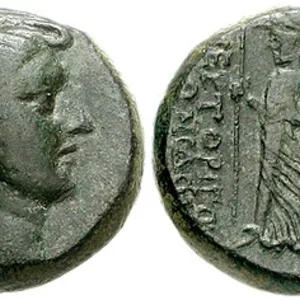
Coins struck by Mark Antony bearing the portrait of Octavia, a rare occurrence for a living Roman woman of that era. They served the propaganda of the alliance between Antony and Octavian.

Engagement and wedding ring that the Roman matron wore on her left hand. Octavia's marriage to Antony was a highly political act sealing the Peace of Brundisium.

Tools for spinning wool, traditional symbols of the good Roman wife occupied with domestic tasks. They represented the ideal of the hardworking matron embodied by Octavia.

Sculpted portrait spreading the idealized image of Octavia, with the sober hairstyle characteristic of matrons of the late Republic. These busts served the dynastic image of Augustus's family.
School Curriculum
Vocabulary & Tags
Key Vocabulary
Daily Life
Morning
The morning of a great Roman lady began with the *salutatio*, when clients and visitors came to pay their respects at the house. Octavia, close to power, received many petitions and oversaw the running of her vast household.
Afternoon
The afternoon was devoted to managing the household, educating the many children placed in her care, and handling family affairs. As the sister of **Octavian**, she also played a discreet role as a political mediator.
Evening
The evening meal, the *cena*, brought together the family and sometimes distinguished guests. The affairs of Rome were discussed there; Octavia embodied the dignity expected of a matron of the highest rank.
Food
The diet of the Roman elite included bread, olives, cheese, vegetables, fish, and meat, accompanied by wine diluted with water. Banquets could offer refined dishes brought from all across the Mediterranean basin.
Clothing
Octavia wore the tunic, the *stola* of matrons, and the *palla* draped over her shoulders and head in public. Her plain hairstyle, with hair parted in the middle and tied into a bun, reflected the Roman ideal of restraint.
Housing
She lived in a vast Roman *domus* arranged around the atrium and the peristyle, adorned with mosaics, frescoes, and statues. The residence also served as a place of political display for the family of **Augustus**.
Historical Timeline
Period Vocabulary
Liens externes & ressources
Références
Œuvres
Médiation du pacte de Brindes
40 av. J.-C.
Négociation de Tarente
37 av. J.-C.
Éducation des enfants d'Antoine
après 30 av. J.-C.
Fondation dynastique julio-claudienne
Ier siècle av. J.-C.
Honneurs publics exceptionnels
35 av. J.-C.
Funérailles publiques
11 av. J.-C.