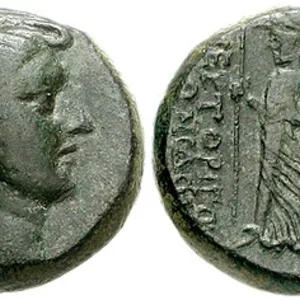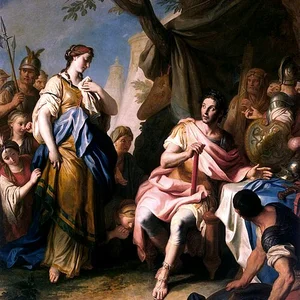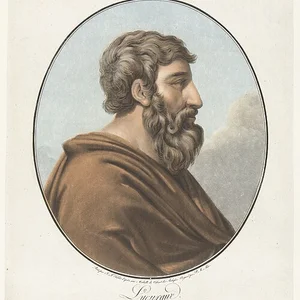

Lycurgus is the legendary lawgiver of Sparta, traditionally regarded as the founder of the city's political, social, and military institutions (the “Great Rhetra”). His historical existence is uncertain and largely belongs to the realm of myth.
Lycurgus(250 av. J.-C. — 210 av. J.-C.)
Lycurgus
7 min read
Frequently asked questions
Key Facts
- Legendary lawgiver of Sparta, dated by tradition to between the 9th and 7th centuries BC
- Said to have established the “Great Rhetra,” the constitutional foundation granting power to the gerousia (council of elders) and the assembly of citizens
- Associated with the creation of the agoge, the collective and military education of young Spartans
- Said to have promoted equality among citizens (homoioi, “the equals”) through the redistribution of land and austerity (eunomia)
- Plutarch devotes a “Life” to him while emphasizing the uncertainty surrounding his actual existence
Works & Achievements
Founding constitutional text attributed to Lycurgus, which organizes the institutions of Sparta (gerousia, kings, assembly of the people). It is the heart of Lycurgus's legislative work.
A council of 28 elders over 60 years old, plus the two kings, tasked with preparing laws and rendering judgments. It balanced the power of the kings and the assembly.
A system of public and military education imposed on boys from the age of seven, founded on discipline, endurance, and group spirit. It forged the identity of the Spartan citizen-soldier.
Mandatory communal tables where citizens ate together, regardless of their wealth. They reinforced equality and military solidarity.
The legendary redistribution of land into equal lots among the citizens, aimed at eliminating disparities in wealth. A measure attributed to Lycurgus to found a city of “equals” (homoioi).
Sparta's distinctive political organization with two simultaneous kings and a board of supervising magistrates. This balance of powers is linked to the Lycurgan tradition.
Anecdotes
According to Plutarch, Lycurgus made the Spartans swear to obey his laws until his return, then left to consult the oracle of Delphi, never to come back: he is said to have starved himself to death so that his city would remain forever bound by its oath. A story that shows just how strongly tradition wished his institutions to be untouchable.
To prevent the accumulation of wealth, tradition holds that Lycurgus banned gold and silver coinage in favor of heavy iron bars dipped in vinegar, worthless anywhere else and impossible to hoard. It was said that a team of oxen was needed to transport a large sum.
Lycurgus is said to have established compulsory communal meals (the *syssitia*), where rich and poor ate the same black broth together, a soup of blood and pork so unappetizing that a foreign king reportedly declared he finally understood why the Spartans did not fear death.
According to Plutarch, Lycurgus wanted to prove the importance of education by presenting two dogs: one of good breeding but poorly trained pounced on a dish of food, while the other, ordinary but well-trained, sprang after a hare. Nature matters less than upbringing, he wished to demonstrate to the Spartans.
Tradition credits Lycurgus with organizing the *agoge*, the collective military education that Spartan boys entered from the age of seven to learn endurance, discipline, and combat, thus founding the reputation of Sparta's warriors.
Primary Sources
“Concerning Lycurgus the lawgiver, we can say nothing at all that is not open to dispute, since the accounts given of his birth, his travels, his death, and above all of his work as a lawgiver, are widely divergent.”
“The Spartans, abandoning their bad laws, adopted those of Lycurgus; and when he died they built him a sanctuary, and to this day they pay him great honours.”
“After building a temple to Zeus Syllanios and Athena Syllania, dividing the people into tribes and into obai, you shall establish a council of thirty members together with the kings; and from season to season you shall summon the assembly of the people.”
“Reflecting one day on Sparta, I wondered how this city, one of the least populous, had proved to be the most powerful and most renowned in Greece; and I came to understand that this was due to the institutions of Lycurgus.”
Key Places
City-state of Laconia whose founding lawgiver is considered to be Lycurgus. Its institutions made it the leading military power in Greece.
A major place of worship in Sparta where the endurance rites for young boys took place (the famous flogging ordeal). It illustrates the harsh education (agoge) attributed to Lycurgus.
The great sanctuary of Apollo where, according to tradition, Lycurgus is said to have gone to consult the Pythia, who approved his laws (the Great Rhetra). He is also said to have died there voluntarily.
An island where, according to Plutarch, Lycurgus is said to have traveled to study laws and institutions, drawing inspiration from them to reform Sparta.
A fertile plain surrounded by mountains where Sparta developed. Its geographical isolation encouraged the inward-looking nature and uniqueness of the Spartan model.
Liens externes & ressources
Références
Œuvres
La Grande Rhêtra
vers IXe-VIIe s. av. J.-C.
La gérousie (conseil des Anciens)
vers IXe-VIIe s. av. J.-C.
L'agôgê (éducation collective)
vers IXe-VIIe s. av. J.-C.
Les syssities (repas communs)
vers IXe-VIIe s. av. J.-C.
Le partage des terres (klèroi)
vers IXe-VIIe s. av. J.-C.
La double royauté et les éphores
vers IXe-VIIe s. av. J.-C.