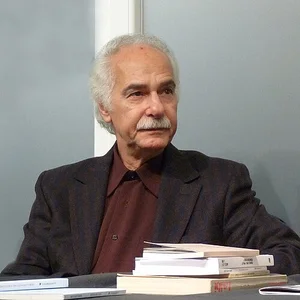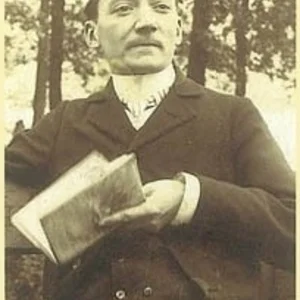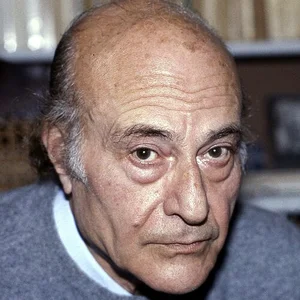

Odysséas Elýtis (1911-1996) was a Greek poet and a major figure of modern Greek poetry. Inspired by surrealism and the light of the Aegean Sea, he received the Nobel Prize in Literature in 1979.
Odysseas Elytis(1911 — 1996)
Odysséas Elýtis
Grèce
6 min read
Frequently asked questions
Key Facts
- Born in 1911 in Heraklion, Crete, into a family originally from Lesbos
- Published his first collection and established himself in the Greek surrealist circle during the 1930s
- Composed “Axion Esti” (Worthy It Is) in 1959, a major work set to music by Mikis Theodorakis
- Received the Nobel Prize in Literature in 1979 for his poetic work celebrating Greece and freedom
- Died in 1996 in Athens
Works & Achievements
Elytis's first collection, luminous and shaped by surrealism, which established his voice in Greek poetry.
A long poem born of the Greco-Italian War, a tribute to the soldiers who died on the Albanian front.
His major work, a vast poem blending Byzantine liturgical tradition with modernity; set to music by Theodorakis.
A concentrated, intense collection that confirms his mastery of image and rhythm.
A collection of his maturity, celebrating light, nature, and memory.
A long love poem of great formal purity, one of his most beloved texts.
A poem in dialogue, more urban and contemporary, in which a young woman embodies a new sensibility.
International recognition of his work by the Swedish Academy.
Anecdotes
Born Odysseas Alepoudelis into a family of soap manufacturers from Lesbos, he chose the pen name "Elytis" while still young. It echoes several Greek words that were dear to him: Ellás (Greece), elpída (hope), elefthería (freedom) and Eléni (Helen).
In 1940, at the age of 29, he was mobilized as a second lieutenant and sent to fight Italian troops on the Albanian front, where he fell gravely ill and had to be hospitalized. Out of this ordeal would come, in 1945, his "Heroic and Elegiac Song for the Lost Second Lieutenant of the Albanian Campaign.
In 1964, the composer Mikis Theodorakis set his great poem "Axion Esti" to music. Carried by chorus, orchestra and bouzouki, the learned text became a song taken up by Greeks from every walk of life.
From 1948 to 1952, Elytis lived in Paris, where he mingled with the painters and poets of the avant-garde — Picasso, Matisse, Paul Éluard, André Breton. A passionate admirer of painting, he created collages of his own.
In 1979, the Swedish Academy awarded him the Nobel Prize in Literature. Still little known to the general public outside Greece, he then revealed to the whole world the richness of modern Greek poetry.
Primary Sources
In the beginning the light. And the first hour when the lips, still in clay, taste the things of the world.
You have a taste of storm upon your lips — but where did you wander all day long, in the hard daydream of stone and sea?
I shall always mourn — do you hear me? — for you, alone, in Paradise.
For his poetry, which, against the background of Greek tradition, depicts with sensuous strength and intellectual clear-sightedness modern man's struggle for freedom and creativeness.
Key Places
Birthplace of Elytis in 1911. The island landscapes and the light of the Mediterranean would permeate his entire body of work.
The island his family came from, where he stayed as a child. The Aegean Sea and its islands became the heart of his poetic imagination.
The city where he studied law, lived his life as an intellectual and poet, and where he died in 1996. The center of 20th-century Greek literary life.
Sector of the Greco-Italian fighting of 1940-1941 where Elytis served as a second lieutenant. This experience inspired his 1945 funeral chant.
The city where he lived from 1948 to 1952, mingling with painters and poets of the avant-garde. A decisive stay for his relationship with Surrealism and the arts.
Site of the Nobel Prize in Literature ceremony in 1979. There, Elytis was acclaimed as one of the great voices of European poetry.
Typical Objects

Printed volume gathering his poems, such as *Orientations* or *Axion Esti*. It is the main medium through which his work circulated and left its mark on the modern Greek language.

The poet's writing instruments, for he worked and reworked his verses at length. Elytis attended even to the layout of his texts.

The Greek army officer's attire he wore on the Albanian front in 1940-1941. His experience of the war directly nourished his poetry of that period.

A composition of cut-out images assembled together, an art that Elytis practised alongside poetry. These works extend his taste for surrealism and colour.

Musical notation of the work composed by Mikis Theodorakis from Elytis's poem. It allowed the text to become a song known to everyone.

A product of the family business Alepoudelis, soap makers from Lesbos. It was partly to set himself apart from this trade that the poet adopted the name Elytis.
School Curriculum
Vocabulary & Tags
Key Vocabulary
Daily Life
Morning
A man of the night rather than the morning, Elytis rose without haste in his Athens apartment. His mornings were often devoted to reading, correspondence, and the patient revision of verses written the day before.
Afternoon
His afternoons blended intellectual work with the life of the city: meetings with writers, painters, and publishers, visits to exhibitions, art criticism articles. He loved to stroll and observe the light over the city.
Evening
In the evening, he would meet friends and fellow writers in the cafés of Athens, essential gathering places of Greek literary life. At night, in the quiet, he composed and tirelessly reworked his poems.
Food
His diet was that of the Greek Mediterranean: bread, olive oil, vegetables, fish, cheese, and fruit. A Greek coffee or a glass of ouzo readily accompanied conversations.
Clothing
He wore the understated attire of the 20th-century European intellectual: jacket, shirt, and tie. During the war, he donned the uniform of an officer in the Greek army.
Housing
A lifelong bachelor, he lived mostly in Athens apartments surrounded by books and works of art. His stays on the islands of the Aegean nourished his poetry of sea and light.
Historical Timeline
Period Vocabulary
Liens externes & ressources
Références
Œuvres
Orientations (Prosanatolismoí)
1939
Chant héroïque et funèbre pour le sous-lieutenant tombé en Albanie
1945
Axion Esti
1959
Six et un remords pour le ciel
1960
L'Arbre lumière et la quatorzième beauté
1971
Le Monogramme
1971
Maria Néphéli
1978