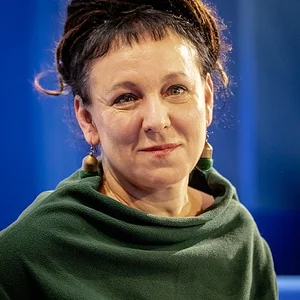

Polish novelist born in 1962, laureate of the 2018 Nobel Prize in Literature. Her work explores collective memory, identity, and the boundaries between living beings through fragmented and mythical narratives.
Olga Tokarczuk(1962 — ?)
Olga Tokarczuk
Pologne
9 min read
Frequently asked questions
Famous Quotes
« Borders are a human invention — nature knows nothing of them.»
« To tell stories is to give shape to the chaos of the world.»
Key Facts
- Born on January 29, 1962, in Pegelów, Poland
- Nobel Prize in Literature 2018 (announced in 2019 for the year 2018)
- Man Booker International Prize 2018 for 'The Books of Jacob'
- Author of 'Drive Your Plow Over the Bones of the Dead' (2009), adapted for cinema in 2017
- Activist for animal rights and environmental causes
Works & Achievements
A novel tracing the history of an imaginary Polish village throughout the twentieth century across several generations. This book established her reputation in Poland and showcases her way of weaving collective history and individual destinies into a single temporal tapestry.
A fragmented narrative blending reality and legend in a region of Lower Silesia. This novel exemplifies her distinctive style: polyphonic narration and a blurring of the boundaries between present and past, between the real and the mythical.
A novel composed of short narrative fragments exploring the theme of travel and perpetual movement across the centuries. Winner of the Man Booker International Prize in 2018, it is the work that brought her to global recognition and convinced the Nobel Academy.
A philosophical crime novel whose narrator, an elderly woman obsessed with William Blake, investigates mysterious murders in the Polish mountains. Adapted for the screen by Agnieszka Holland (Silver Bear, Berlin 2017), it reveals her commitment to animal rights.
A historical epic of over nine hundred pages centred on Jakob Frank, a controversial Jewish mystic of eighteenth-century Poland-Lithuania. This monumental novel, winner of the Nike Award, explores the buried memory of Polish Judaism and questions the boundaries between religions and identities in Central Europe.
Anecdotes
Olga Tokarczuk studied psychology at the University of Warsaw in the 1980s and worked as a psychotherapist before devoting herself entirely to writing. This background profoundly shapes her work: she explores with precision the mechanisms of memory, collective trauma, and fragmented identities — as if her novels were extended analysis sessions for the European soul.
The Nobel Prize in Literature was awarded to her for the year 2018, but the ceremony did not take place until December 2019: the Swedish Academy had suspended the prize in 2018 due to a serious internal scandal. Tokarczuk and Peter Handke (Nobel 2019) therefore received their awards at the same ceremony — an exceptional situation in the history of the Nobel Prize.
Her novel 'Flights' ('Bieguni') earned her the Man Booker International Prize in 2018, shared with her English translator Jennifer Croft — highlighting the crucial role translators play in the spread of world literature. It was the first time a Polish novel had won this prestigious British prize.
In 2019, Tokarczuk stated in an interview with a foreign magazine that Poles had participated in crimes against Jews during the Second World War. This claim, though historically documented by historians such as Jan Gross, led to defamation lawsuits being filed against her in Poland. After the announcement of the Nobel Prize, these proceedings were dropped, but the episode painfully illustrates the sensitivity of questions of historical memory in Central Europe.
Her monumental novel 'The Books of Jakob' (2014), running to more than nine hundred pages, traces the life of Jakob Frank, an eighteenth-century Jewish mystic in the Polish-Lithuanian Commonwealth. To write it, Tokarczuk spent several years conducting research in archives in Poland, Germany, and Austria, learning the rudiments of Yiddish and Hebrew. The book earned her the Nike Award, Poland's highest literary honor.
Primary Sources
Storytelling is a way of organizing and taming the world. We are storytelling beings — homo narrans. That may be our most profound singularity as a species.
I was a few years old when I first understood that the world was far too large to see it all, and that one therefore had to choose.
Every living creature deserves to have its story told. Those who kill animals for sport do not understand that they are also killing something within themselves.
We have committed terrible acts as a nation, acts we have never acknowledged or mourned: our treatment of minorities, of Jews, of Ukrainians, of Lithuanians. We Poles were not innocent victims.
Key Places
Birthplace of Olga Tokarczuk, born in 1962 in this region formerly part of Germany (Züllichau) that was incorporated into Poland after 1945. This history of shifting borders and displaced populations is a fundamental influence on her thinking about identity, memory, and belonging.
Tokarczuk studied psychology here in the 1980s under the communist regime, in a climate of intense political tension. This training shaped her sensitivity to collective trauma, repressed memory, and the complexity of human identity.
A small town in the Sudeten Mountains where Tokarczuk has lived and worked for many years. This borderland, marked by the intertwined traces of German and Polish history, directly inspires her novels about memory and places inhabited by several pasts at once.
A major city in Lower Silesia where Tokarczuk spent part of her adult life. Wrocław — a German city that became Polish after 1945 — embodies in itself the themes of palimpsest memory and recomposed identity that run throughout her entire body of work.
The city where Tokarczuk received the Nobel Prize in Literature in December 2019. In her acceptance speech titled "The Tender Narrator," she developed her vision of literature as radical empathy, capable of transcending national and cultural borders.
Typical Objects

Tokarczuk fills notebooks with notes, quotes, and travel observations. Her novels, built like mosaics of narrative fragments, are nourished by these personal archives consulted over years of gestation.

Holding a degree in psychology and an avid reader of Carl Gustav Jung, she keeps texts on the collective unconscious and archetypes close at hand. These Jungian concepts permeate the mythic and symbolic structure of her narratives.

Travel and geography are at the heart of her work, most notably in *Flights*. She uses maps to visualize her characters' itineraries and to ground her stories in real spaces steeped in history.

To write *The Books of Jacob*, she studied Yiddish and consulted sources in Hebrew and 18th-century German. These tools reflect her rigorous documentary standards in faithfully representing the Jewish world of Polish-Lithuania.

Her novels rest on extensive research. She reads widely in the work of historians on collective memory, religious minorities, and the cultural frontiers of Central Europe — most notably Jan Gross's writings on the Holocaust in Poland.

Tokarczuk writes her works on a computer, working with discipline in her home in Lower Silesia. She describes a daily writing routine, often in the morning, which she considers essential to making progress on projects that span several years.
School Curriculum
Vocabulary & Tags
Key Vocabulary
Daily Life
Morning
Tokarczuk describes mornings devoted to rereading her notes from the day before and writing proper. She works in the quiet of her Lower Silesian home, surrounded by books and notebooks, drinking coffee in the light of the Sudetes.
Afternoon
The afternoon is often dedicated to documentary research: consulting historical archives, reading specialist works on history, anthropology, or philosophy. For *The Books of Jacob*, this research led her to work in libraries and archives in Kraków, Vienna, and Berlin.
Evening
In the evenings she reads widely — philosophy, mythology, analytical psychology — and follows Polish political news closely. Committed to environmental causes and animal rights, she takes part in public debates and signs petitions.
Food
Olga Tokarczuk is a vegetarian, a commitment consistent with her sensitivity to animal rights, a central theme in *Drive Your Plow Over the Bones of the Dead*. She favors simple food, in keeping with her rural life in Lower Silesia.
Clothing
At public appearances and major ceremonies such as the Nobel Prize, Tokarczuk favors an elegant but understated style, often in neutral or dark tones. She makes no effort to cultivate a particular sartorial image, preferring that attention remain on her writing.
Housing
She lives in a house in the countryside of Lower Silesia, a region she cherishes for its palimpsest history — formerly German, it became Polish in 1945. This rootedness in a territory layered with overlapping memories directly feeds her literary relationship with place and the past.
Historical Timeline
Period Vocabulary
Liens externes & ressources
Références
Œuvres
Les Demeures des anciens (Prawiek i inne czasy)
1996
La Maison de jour, la maison de nuit (Dom dzienny, dom nocny)
1998
Les Pérégrins (Bieguni)
2007
Les Livres de Jakob (Księgi Jakubowe)
2014