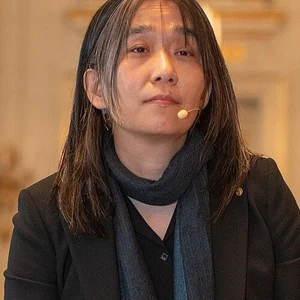

South Korean novelist born in 1970, Han Kang is one of the most important voices in contemporary Asian literature. Her work explores violence, traumatic memory, and the fragility of the human body. She is the first Asian author to receive the Nobel Prize in Literature.
Frequently asked questions
Famous Quotes
« Human beings are fundamentally fragile.»
« I write to understand what I cannot understand.»
Key Facts
- Born on November 27, 1970, in Gwangju, South Korea
- Publication of 'The Vegetarian' in 2007, translated into English in 2015, Man Booker International Prize 2016
- Publication of 'Human Acts' in 2014, a novel about the 1980 Gwangju massacre
- Nobel Prize in Literature 2024, first Asian author to receive this distinction
- Her work has been translated into more than 40 languages
Works & Achievements
A novel in three parts about a woman who refuses to eat meat after a traumatic dream and yearns to become a plant. Translated into more than 40 languages, it earned Han Kang the Man Booker International Prize in 2016.
A novel about two people who are gradually losing their senses — a woman her language, a man his sight — and find each other in that shared vulnerability. A meditation on the fragility of the body and of communication.
A polyphonic novel about the Gwangju Uprising of May 1980, tracing the fates of victims, survivors, and perpetrators. Considered her most politically charged and harrowing work.
A poetic meditation on the color white, grief, and an older sister who died two hours after birth. A hybrid text blending prose and poetic fragments, shortlisted for the Man Booker International Prize 2018.
A novel about the intergenerational transmission of memory surrounding the Jeju massacre (1948). Han Kang continues her exploration of political violence and the ghosts of Korean history.
Anecdotes
Han Kang was born in Gwangju on November 27, 1970, a city that experienced a democratic uprising in May 1980, brutally suppressed by the South Korean army. As a child living in Seoul, she discovered in her father's books harrowing photographs of the massacre's victims — bodies, anonymous faces. These images haunted her throughout her life and became the foundation of her novel 'Human Acts' (2014).
The idea for 'The Vegetarian' (2007) took root after Han Kang read a line by Korean poet Yi Sang: “I believe that humans should be plants.” She spent years meditating on the image of a human body that would deny itself to become a plant. This novel, translated into English by Deborah Smith, earned her the Man Booker International Prize in 2016 — a first for a Korean author.
Han Kang is the daughter of Han Seung-won, one of South Korea's most respected novelists. Growing up in a household where books and writers were a constant presence naturally drew her toward literature, but she forged a radically personal style — poetic, dark, focused on the body and inner pain — very different from her father's.
In October 2024, Han Kang learned by phone that she had just received the Nobel Prize in Literature while she was working with her son. She thus became the first Korean woman and the first Asian female author to receive this distinction. The Swedish Academy praised “her intense poetic prose that confronts historical traumas and exposes the fragility of human life.”
Han Kang has shared in several interviews that she writes her first drafts by hand, in notebooks, before transcribing them on a computer. This physical gesture keeps her in touch with her characters' emotions. This relationship with the body — at once subject, instrument, and metaphor — runs through her entire work, from the woman who yearns to transform into a plant to the soul of a dead boy wandering among the living.
Primary Sources
Before my wife became a vegetarian, I had always considered her a perfectly ordinary woman. She was neither particularly beautiful nor ugly, neither very intelligent nor stupid, and her views had nothing remarkable about them.
You were searching for your friend's face among the bodies laid out in the gymnasium turned morgue. Candles burned at either end of the room. You were fifteen years old and you did not yet know what you were seeing.
The swaddling cloth. White. The tiny newborn gown. White. The salt. White. The snow. White. The moon. White. The rice. White. The pear blossoms. White. The blank page. White.
I wanted to understand how human beings can inflict such suffering on other human beings. And whether such understanding was even possible. It is from this question that my books were born.
The Nobel Prize in Literature 2024 is awarded to Han Kang for her intense poetic prose that confronts historical traumas and exposes the fragility of human life.
Key Places
Han Kang's birthplace and the site of the May 1980 democratic uprising. The images of the massacre, discovered in her father's books, form the founding trauma at the heart of her novel 'Human Acts'.
The capital where Han Kang grew up after her family relocated, where she studied Korean literature at Yonsei University, and where she has lived and worked throughout her career.
One of South Korea's most prestigious universities, where Han Kang studied Korean literature and encountered the foundational texts that continue to shape her writing.
The setting of her novel 'We Do Not Part' (2021), which explores memories of the 1948 massacre. Han Kang conducted extensive research on the island to document the traces of this long-suppressed collective trauma.
The city where Han Kang received the Nobel Prize in Literature in December 2024, at a ceremony that brought Korean literature to the attention of the entire world.
Typical Objects

Han Kang systematically writes her first drafts by hand in notebooks before transcribing them on a computer. This ritual allows her to maintain a direct physical and emotional connection with her texts.

An avid reader of poetry — particularly Yi Sang, Kim Hyesoon, and Choi Seungja — Han Kang draws from these works the inspiration for her most striking imagery. A line by Yi Sang is at the origin of the central concept of *The Vegetarian*.

To write *Human Acts*, Han Kang spent long hours consulting photographs and testimonies documenting the events of May 1980. These images haunted her writing process for years.
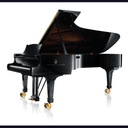
Han Kang plays the piano and considers music a language parallel to writing. Musical rhythm directly influences the slow, meditative cadence of her prose.
📷 CC BY-SA 3.0 · Wikimedia Commons ↗
The preparation and tasting of green tea punctuate Han Kang's long, solitary writing days — a practice deeply rooted in everyday Korean culture.

Han Kang chooses every word with great precision, keenly aware of the layers of historical meaning carried by the Korean language through its borrowings from Classical Chinese. Her prose is renowned for its lexical exactitude.
School Curriculum
Vocabulary & Tags
Key Vocabulary
Tags
Lieu
Daily Life
Morning
Han Kang begins her day early, often before sunrise. After green tea and a light breakfast, she settles at her desk to write by hand in her notebooks, making the most of the morning quiet she considers the ideal time for creative concentration.
Afternoon
Her afternoons are devoted to reading, archival research, or transcribing and revising her texts on the computer. For her historical novels, she spends long hours poring over survivor testimonies and photographic archives. She may also meet with editors or translators.
Evening
In the evenings, Han Kang makes time to play the piano or walk through Seoul. She reads poetry before bed — a ritual she considers essential for maintaining the sensitivity that writing demands. She prefers a withdrawn life to the social scene of literary circles.
Food
Han Kang follows a simple, largely meat-free diet that echoes the themes running through her work. She eats rice, fermented vegetables (kimchi, namul), tofu, and light broths typical of traditional Korean cuisine, though she does not define herself as vegetarian in her everyday life.
Clothing
Han Kang dresses modestly and unobtrusively, in keeping with her reserved personality. She favors comfortable, neutral clothing for her long writing days, and elegant yet unfailingly understated outfits for public appearances and award ceremonies.
Housing
Han Kang lives in a modest, sparsely furnished apartment in Seoul, well-suited to intellectual work. She has described her writing space as a quiet place where books and notebooks hold center stage — free of any ostentation, and in harmony with her belief in the primacy of inner life.
Historical Timeline
Period Vocabulary
Liens externes & ressources
Références
Œuvres
La Végétarienne (채식주의자)
2007
Leçons de grec (희랍어 시간)
2011
Actes humains (소년이 온다)
2014
Le Livre blanc (흰)
2016
L'impossible adieu (작별하지 않는다)
2021