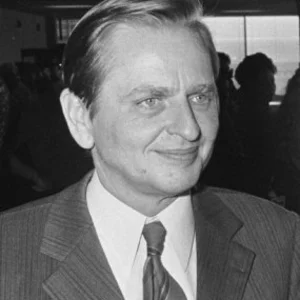

Swedish social democratic statesman, twice Prime Minister of Sweden. A major figure of the European left and of Third World solidarity, he was assassinated on a Stockholm street in 1986, a crime that long remained unsolved.
Olof Palme(1927 — 1986)
Olof Palme
Suède
6 min read
Frequently asked questions
Key Facts
- Prime Minister of Sweden for the first time from 1969 to 1976
- Returned to power as Prime Minister from 1982 to 1986
- Fierce critic of the Vietnam War and apartheid, advocate of disarmament and North-South dialogue
- Shot and killed on a Stockholm street on 28 February 1986
- Investigation closed in 2020, naming Stig Engström as the probable suspect without a trial
Works & Achievements
Under his government, Sweden adopts a new constitution that strips the king of all political power, turning the monarchy into a symbol.
Major development of parental leave, gender equality, free education, and social welfare — the Scandinavian model that became a worldwide reference.
As a special envoy of the United Nations, Palme led numerous diplomatic missions in an effort to bring the conflict to an end.
A doctrine of common security that influenced debates on nuclear disarmament and détente between the blocs.
A consistent and public stance against American intervention, making Sweden a critical voice within the Western world.
Palme backed liberation movements in southern Africa and development aid, embodying social-democratic third-worldism.
Anecdotes
In 1968, before he had even become Prime Minister, Olof Palme marched through the streets of Stockholm alongside the North Vietnamese ambassador to protest against the war waged by the United States. The gesture triggered a genuine diplomatic chill: Washington recalled its ambassador, and relations between the two countries remained icy for years.
Palme led a remarkably simple life for a head of government. On the evening of his assassination, 28 February 1986, he was walking home from the cinema with his wife Lisbeth, without any bodyguards, after watching a Swedish comedy film. It was on an ordinary Stockholm street that he was shot in the back.
Born into a conservative bourgeois family, Palme was an aristocrat who chose the side of the workers. A polyglot and a graduate of an American university, he went from being the son of the upper bourgeoisie to a global figure of the left, which earned him fierce hatred from part of the Swedish right.
The investigation into his murder became the longest and most expensive in Swedish criminal history. For more than thirty years, thousands of leads were explored without result. In 2020, the prosecutor named Stig Engström, known as “the Skandia man,” as the probable culprit, but since he had taken his own life in 2000, the case was closed without a trial.
In 1980, Palme was appointed United Nations mediator in the conflict between Iran and Iraq. He made numerous diplomatic shuttle trips between Tehran and Baghdad in an attempt to halt this deadly war, illustrating his constant commitment to peace and international dialogue.
Primary Sources
Olof Palme compared the American bombings of North Vietnam to a list of historical atrocities, denouncing “a form of torture” inflicted on a people. These remarks triggered a major diplomatic crisis with the United States.
The report defends the idea of “common security”: nations cannot achieve security against one another, but only with one another, especially in the face of the nuclear threat.
Palme described apartheid as a “particularly odious and inhuman” system, calling on the international community to impose sanctions against the South African regime.
The movement asserts its aim to extend democracy from the political sphere to economic life and the world of work, through reform rather than revolution.
Key Places
Capital of Sweden where Palme was born, built his political career, and was assassinated. The heart of Swedish social-democratic power.
Site of Palme's assassination on 28 February 1986, today marked by a commemorative plaque.
American university where the young Palme earned his degree, an experience that shaped his critical view of the inequalities of capitalism.
Seat of legislative power where Palme served as Prime Minister and championed his social reforms.
Cemetery of the Adolf Fredrik Church, located near the site of the murder, where Olof Palme is buried.
Typical Objects

Stage from which Palme, a feared and impassioned orator, addressed the crowds during election campaigns and May Day celebrations.

Document from the Palme Commission proposing the concept of common security between rival nations to ward off the nuclear threat.

A key tool of modern political life; Palme excelled in televised debates and media appearances.

A symbol of Palme's Third World commitment; he publicly marched against the American intervention.

The ordinary outfit Palme was wearing the night of his assassination, walking home from the cinema like an ordinary citizen.

A tragic reminder of Palme's last evening, when he attended a screening with his wife without police protection.
School Curriculum
Vocabulary & Tags
Key Vocabulary
Daily Life
Morning
A tireless prime minister, Palme started his days early by reading the press and notes from his advisers. Mornings were devoted to cabinet meetings and government business in his Stockholm offices.
Afternoon
Afternoons were divided between sessions in the Riksdag, negotiations with trade unions and employers, and receiving foreign delegations. A brilliant orator, he carefully prepared his speeches and television appearances.
Evening
In the evening, Palme led a surprisingly ordinary life for a head of government, readily going out without a security escort. He loved the cinema, intellectual discussions, and spent time with his family at home.
Food
His table reflected the Swedish diet of the time: fish (herring, salmon), potatoes, rye bread, and dairy products. Palme shared the Scandinavian taste for simple, unostentatious cooking.
Clothing
Palme wore the plain suits and overcoats of the twentieth-century Western politician. His neat but modest attire matched the egalitarian image he cultivated.
Housing
Refusing pomp, Palme lived in an ordinary Stockholm apartment rather than in a protected official residence. This choice of simplicity, in keeping with the social-democratic ideal, tragically contributed to his vulnerability.
Historical Timeline
Period Vocabulary
Liens externes & ressources
Références
Œuvres
Réforme constitutionnelle de 1974
1974
Extension de l'État-providence suédois
années 1970
Médiation ONU dans la guerre Iran-Irak
1980-1986
Rapport « Common Security » (Commission Palme)
1982
Engagement contre la guerre du Vietnam
1968-1972
Soutien à la lutte contre l'apartheid et au tiers-monde
années 1970-1980