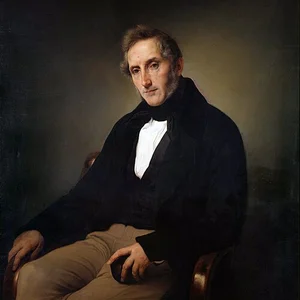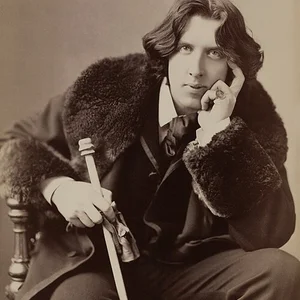

A 19th-century Irish writer, Oscar Wilde is the author of major witty comedies and symbolist novels. An iconic figure of the Aesthetic movement, he left a lasting mark on English literature through his brilliant style, biting irony, and celebrated plays.
Frequently asked questions
Famous Quotes
« The only way to get rid of a temptation is to yield to it.»
« I can resist everything except temptation.»
« To love oneself is the beginning of a lifelong romance.»
« The truth is rarely pure and never simple.»
Key Facts
- 1890: Publication of 'The Picture of Dorian Gray', a philosophical novel on aestheticism and moral corruption
- 1891–1892: Triumphant success of his comedies 'A Woman of No Importance' and 'The Importance of Being Earnest'
- 1895: Landmark trial for gross indecency that marked the turning point of his life
- 1898: Publication of 'The Ballad of Reading Gaol' following his imprisonment
- 1854–1900: A life marked by artistic genius, scandal, and exile in France
Works & Achievements
Wilde's only novel, it is a masterpiece of Victorian symbolism and aestheticism. It explores themes of beauty, moral corruption, and the Faustian bargain through a young man whose portrait ages in his place.
Considered the greatest English comedy since Shakespeare, this play brilliantly satirises Victorian society through a series of mistaken identities and misunderstandings around marriage. It represents the pinnacle of Wilde's style.
A long and poignant poem written after his release from prison, inspired by the execution of a fellow inmate. It is Wilde's most personal work, where humour gives way to a sincere meditation on suffering and death.
A play written directly in French, Salomé is a symbolist drama inspired by the Bible. Banned in England during his lifetime, it inspired Richard Strauss's opera (1905) and exerted a considerable influence on Art Nouveau.
A long autobiographical letter addressed to Lord Alfred Douglas from Reading Prison. This text blends personal score-settling with reflection on suffering, art, and Christian spirituality.
Wilde's first great comedy of manners, it portrays the hypocrisies of London's aristocracy centred on a family secret. Its success established Wilde as the most brilliant playwright of his era.
A collection of poetic tales blending the fairy tale form with subtle and moving social criticism. These texts, often studied in schools, reveal the humane and engaged dimension of Wilde behind the dandy's mask.
Anecdotes
When passing through American customs in 1882, Oscar Wilde reportedly declared to the officers: "I have nothing to declare except my genius." This phrase, perhaps apocryphal but perfectly in keeping with his style, sums up his art of turning every situation into a spectacle.
Oscar Wilde wore extravagant outfits, including velvet knee breeches, silk stockings, and sunflower or lily buttonholes. He would stroll through the streets of London to provoke and assert that life itself could be a work of art.
At the opening night of his play The Importance of Being Earnest in 1895, the audience laughed so loudly and for so long that the actors had to stop several times. It stands as one of the greatest comic triumphs in the entire history of English theatre.
Imprisoned in Reading from 1895 to 1897, Wilde was subjected to degrading hard labour, such as turning the crank of a purposeless wheel. The experience broke his health but gave rise to his most poignant poem, The Ballad of Reading Gaol.
On his deathbed in Paris, Oscar Wilde reportedly looked at the wallpaper of his squalid room and said: "One of us has to go." He died on 30 November 1900, ruined and exiled, but his literary reputation would undergo a spectacular resurrection in the twentieth century.
Primary Sources
I forgot that every little action of the common day makes or unmakes character, and that therefore what one has done in the secret chamber one has some day to cry aloud on the housetop.
Yet each man kills the thing he loves, / By each let this be heard, / Some do it with a bitter look, / Some with a flattering word!
The aim of art is to reveal art and to conceal the artist. [...] All art is at once surface and symbol. Those who go beneath the surface do so at their peril.
The human personality will develop to a point as yet unknown when every man is free to choose his own work, to do it well, and to devote himself to it with joy.
The love that dare not speak its name, in this century, is such a great affection of an elder for a younger man as there was between David and Jonathan, such as Plato made the very basis of his philosophy.
Key Places
Oscar Wilde was born on 16 October 1854 at 21 Westland Row in Dublin. His father, a distinguished surgeon, and his mother, a nationalist poet, provided him with a brilliant education that shaped his precocious literary sensibility.
It was at Oxford that Wilde fully developed his Aestheticist philosophy, influenced by Walter Pater and John Ruskin. He won the Newdigate Prize for poetry there in 1878 and gained a reputation as a brilliant intellectual provocateur.
This London theatre was the venue for the premieres of several of his most celebrated comedies, including The Importance of Being Earnest in 1895. It was here that Wilde enjoyed his greatest theatrical triumphs before his downfall.
Wilde was imprisoned there from 1895 to 1897 following his conviction for homosexuality. This traumatic experience gave rise to his two final masterpieces: De Profundis and The Ballad of Reading Gaol.
Wilde spent the final months of his life in this modest hotel on the rue des Beaux-Arts in Paris, under the pseudonym Sebastian Melmoth. He died there on 30 November 1900, ruined and in exile.
Oscar Wilde was interred in this Parisian cemetery in 1900. In 1909, his remains were transferred to a tomb adorned with a winged sphinx sculpted by Jacob Epstein, now covered in lipstick kisses left by his admirers.
Liens externes & ressources
Références
Œuvres
Le Portrait de Dorian Gray
1890 (magazine), 1891 (livre)
L'Importance d'être Constant (The Importance of Being Earnest)
1895
La Ballade de la geôle de Reading
1898
De Profundis
1897 (écrit en prison), 1905 (publié partiellement)
L'Éventail de Lady Windermere (Lady Windermere's Fan)
1892
Le Prince heureux et autres contes
1888