 flip
flipAbsinthe à la fontaine, green fairy of Paris
Absinthe à la fontaine, green fairy of Paris
Why this dish? Exiled in Paris after prison, Wilde frequented the cafés of the Latin Quarter and Saint-Germain where absinthe flowed, the drink of poets and artists of the Belle Époque. The "green fairy" accompanied his final years, until the Hôtel d'Alsace where he died in 1900.
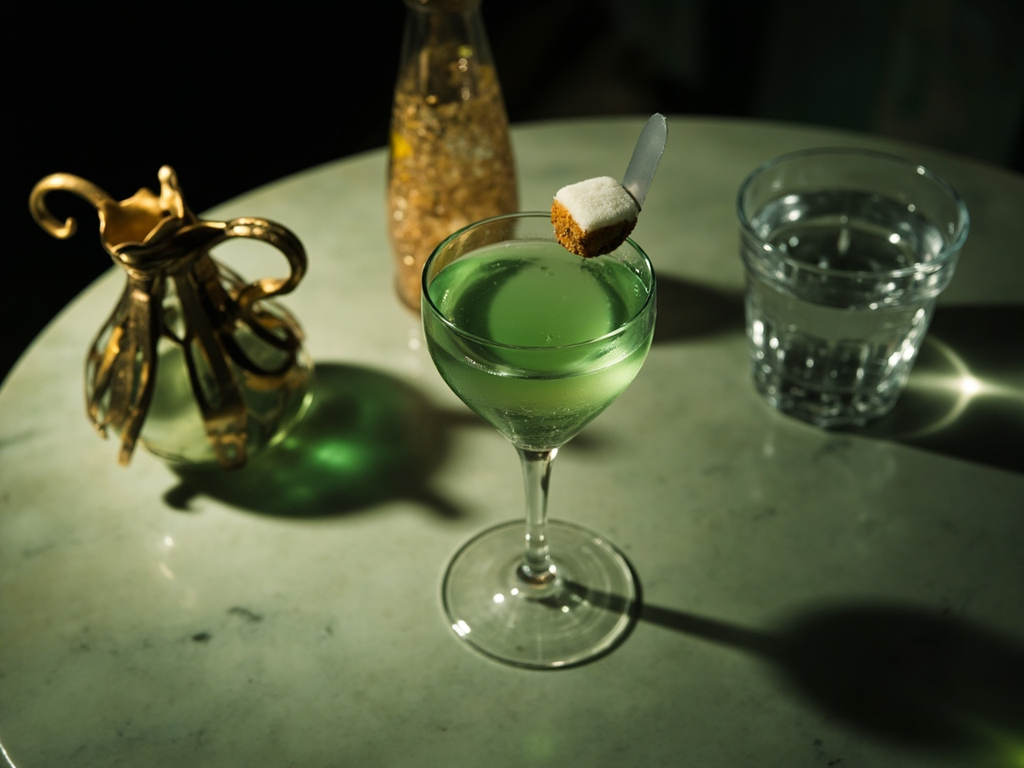
A measure of deep green absinthe, over which ice-cold water is dripped through a sugar cube placed on a perforated spoon. The alcohol clouds and whitens — this is the "louche" — releasing the aromas of anise, fennel, and wormwood. Bitter, herbaceous, hypnotic. (Adult version only; serve young people the lemonade below.)
Bring your glass closer, and watch carefully: nothing is more beautiful than the moment when cold water makes the green fairy pale, like a truth diluted to make it bearable. They say that after the first glass you see the world as you would wish it, and after the third as it really is — which, believe me, is the more horrible of the two visions. Place the sugar on the spoon, let the water fall with the slowness of remorse, and never be in a hurry: only unimaginative people drink fast. I have nothing left but this glass and my mind, and each sustains the other.
- •Absinthe (distillate of anise, fennel, grande wormwood) — one measure (star)
- •Ice-cold water — three to five measures (dilution and louche)
- •Sugar cube — one (sweetener for bitterness)
Absinthe à la fontaine, green fairy of Paris
A measure of deep green absinthe, over which ice-cold water is dripped through a sugar cube placed on a perforated spoon. The alcohol clouds and whitens — this is the "louche" — releasing the aromas of anise, fennel, and wormwood. Bitter, herbaceous, hypnotic. (Adult version only; serve young people the lemonade below.)
Why this dish? Exiled in Paris after prison, Wilde frequented the cafés of the Latin Quarter and Saint-Germain where absinthe flowed, the drink of poets and artists of the Belle Époque. The "green fairy" accompanied his final years, until the Hôtel d'Alsace where he died in 1900.
Bring your glass closer, and watch carefully: nothing is more beautiful than the moment when cold water makes the green fairy pale, like a truth diluted to make it bearable. They say that after the first glass you see the world as you would wish it, and after the third as it really is — which, believe me, is the more horrible of the two visions. Place the sugar on the spoon, let the water fall with the slowness of remorse, and never be in a hurry: only unimaginative people drink fast. I have nothing left but this glass and my mind, and each sustains the other.
Ingredients (period version)
- Absinthe (distillate of anise, fennel, grande wormwood) — one measure (star)
- Ice-cold water — three to five measures (dilution and louche)
- Sugar cube — one (sweetener for bitterness)
Ingredients
- Absinthe (modern authorized version, ~3 cl) — 1 measure, for adults (star)
- Very cold water — 9 to 15 cl (dilution)
- Sugar cube — 1 (sweetener)
- Alcohol-free alternative: non-alcoholic pastis / anise-mint lemonade — 1 glass (family version)
Method
- Pour the absinthe into the bottom of a wide glass.
- Place a flat (or perforated) spoon across the glass, and a sugar cube on it.
- Drip ice-cold water onto the sugar cube, very slowly, until it dissolves: the mixture clouds (the "louche").
- Dilute to your taste, 3 to 5 parts water to 1 part absinthe. Stir.
- Family version: make a homemade lemonade with green anise and mint, alcohol-free, served very cold.
How it was made : During the Belle Époque, "the green hour" (around 5 p.m.) saw cafés fill with absinthe drinkers. The ritual of the water fountain and melting sugar was codified. Deemed dangerous, absinthe was banned in France in 1915; modern regulated versions are again legal.
The contemporary twist : For the whole family, a "fake green fairy": artisanal anise-mint-cucumber lemonade, served with a sugar cube and fountain, for the pleasure of the ritual without the alcohol.
Sources : Marie-Claude Delahaye, L'Absinthe : histoire de la fée verte, 1983 · Richard Ellmann, Oscar Wilde, 1987
Oscar Wilde · Charactorium