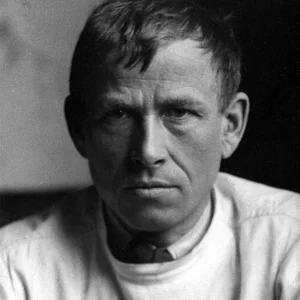

Otto Dix was a German painter and printmaker, a leading figure of the New Objectivity movement (Neue Sachlichkeit). Deeply affected by his experience in the trenches of the First World War, he produced a body of work of stark realism that denounced the horrors of war and the failings of German society between the two world wars.
Otto Dix(1891 — 1969)
Otto Dix
Allemagne
7 min read
Frequently asked questions
Famous Quotes
« All war means observing the human being thoroughly, up close, in this extreme state.»
« I had to see all of this with my own eyes.»
Key Facts
- Born in 1891 in Untermhaus, near Gera (Germany).
- Enlisted and fought as a machine gunner during the First World War (1914-1918), an experience that marked his entire body of work.
- Created the print portfolio “Der Krieg” (The War) in 1924 and the triptych “The War” (1929-1932).
- His works were branded “degenerate art” (Entartete Kunst) by the Nazis from 1933 onward; he was dismissed from his teaching post at the Dresden Academy.
- Died in 1969 in Singen (Germany).
Works & Achievements
A series of etchings of extreme rawness depicting the horror of the trenches, inspired by Goya's “Disasters of War.” One of the most powerful visual denunciations of the First World War.
A painting so unbearable in its realism that it sparked a scandal and was taken down. Seized by the Nazis, it has since vanished.
An iconic portrait of the New Objectivity, an image of the modern, emancipated woman of the Weimar era.
A jarring canvas showing three disfigured war invalids playing cards, a denunciation of the forgotten maimed of the post-war years.
An immense triptych inspired by religious altarpieces, the pinnacle of his anti-militarist work. Now held at the Galerie Neue Meister in Dresden.
A three-panel painting contrasting bourgeois revelry with the misery of the streets, a sharp portrait of Weimar society.
A series of portraits of great psychological frankness, refusing any idealization, typical of the New Objectivity.
Anecdotes
A volunteer enlistee in 1914, Otto Dix fought as a machine gunner on the Somme front and was deeply scarred by the trenches. All his life he had nightmares in which he crawled through destroyed houses. He said that war was “something bestial” that an artist had to have seen in order to understand it.
In 1933, as soon as the Nazis came to power, Dix was one of the very first artists to be dismissed: he lost his professorship at the Dresden Academy. The regime deemed his art “degenerate” and more than 250 of his works were confiscated from German museums.
Several of his paintings appeared in the 1937 Nazi propaganda exhibition “Entartete Kunst” (Degenerate Art), put on display to be ridiculed. His great anti-war triptych “The War” narrowly escaped destruction.
In 1939, Dix was arrested for a few days by the Gestapo, accused of having taken part in a failed plot against Hitler. In 1945, at over 50 years old, he was forcibly conscripted into the Volkssturm (the people's militia) and briefly taken prisoner by the French.
For his painting “The Trench” — so realistic and unbearable that it caused a scandal — a museum director in Cologne had to take it down in 1925 under pressure. The work was later seized by the Nazis and has today disappeared.
Primary Sources
You have to have seen men in this unleashed state to know anything about man. War is something bestial: the hunger, the lice, the mud, those senseless noises.
As a young man, you don't notice at all that you have, deep down, been profoundly affected. For years, at least ten years, I kept having these dreams in which I had to crawl through ruined houses.
Professor Otto Dix is dismissed from his post at the Dresden Academy of Fine Arts, his art being judged contrary to the moral sentiment of the German people.
Key Places
Dix's native village, where he grew up in a modest working-class environment. His birthplace is now a museum dedicated to him.
The city of his artistic training, and where he was a professor at the Academy of Fine Arts from 1927 until his dismissal in 1933.
The 1916 battlefield where Dix fought as a machine gunner. The experience of the trenches left a lasting mark on his entire body of work.
Capital of the Weimar Republic, where Dix took part in avant-garde artistic life and portrayed the society of the interwar years.
The village where Dix took refuge in “inner exile” after 1933 and where he lived out the rest of his life, painting landscapes.
A town near Lake Constance where Otto Dix died in 1969 following a stroke.
Typical Objects

A weapon he operated personally at the front. It became a recurring and terrifying motif in his war-themed work.

A surface incised with a needle and bitten by acid for his cycle “Der Krieg.” He mastered engraving techniques inherited from the old masters.

An emblematic object of trench warfare, a symbol of the dehumanization of soldiers that he often depicts in his prints.

Dix often painted in tempera and oil on wood, reviving the meticulous craft of German Renaissance painters such as Cranach and Dürer.

Dix drew relentlessly in the trenches, accumulating hundreds of studies that would later feed his paintings and prints.

A military decoration he received for his bravery at the front. It illustrates the ambiguity of a decorated soldier who became a fierce denouncer of war.
School Curriculum
Vocabulary & Tags
Key Vocabulary
Daily Life
Morning
Methodical and disciplined, Dix started early in his studio, painstakingly preparing his wooden panels and layers of paint in the manner of the old masters. He studied his many sketches before laying down a single stroke.
Afternoon
The afternoon was devoted to the patient work of painting or engraving, a demanding technique he practiced with great rigor. During the interwar years, he also observed the street, the cafés, and the city's outcasts whom he loved to depict.
Evening
Under the Weimar Republic, Dix frequented the nightlife of Berlin and Dresden — cabarets, balls, dance halls — which he scrutinized with a critical eye. After 1933, withdrawn to the shores of Lake Constance, his evenings became more solitary and family-centered.
Food
Coming from a working-class background in Thuringia, Dix kept simple tastes. During the war, he experienced hunger, rationed food, and the precarious life of the trenches, an experience that left a lasting mark on his relationship with the body and survival.
Clothing
In the city, Dix readily took care to present the look of a modern urbanite, suit and tie, in the image of the dandies and bourgeois he painted. At the front, he had worn the feldgrau uniform of the German Imperial Army.
Housing
He lived in urban apartments and studios in Dresden and Berlin during his productive years. After his dismissal in 1933, he settled into a house in Hemmenhofen, on the shores of Lake Constance, in a kind of inner exile far from the big cities.
Historical Timeline
Period Vocabulary
Liens externes & ressources
Références
Œuvres
Der Krieg (La Guerre), cycle de 50 eaux-fortes
1924
Portrait de la journaliste Sylvia von Harden
1926
Les Joueurs de skat (Die Skatspieler)
1920
Triptyque La Guerre (Der Krieg)
1929-1932
Métropolis / Portrait des parents de l'artiste
années 1920