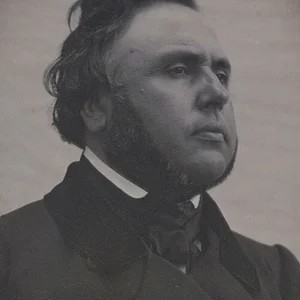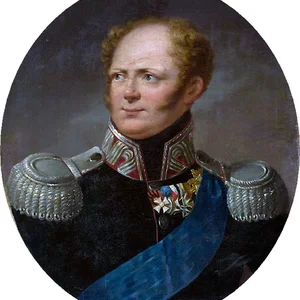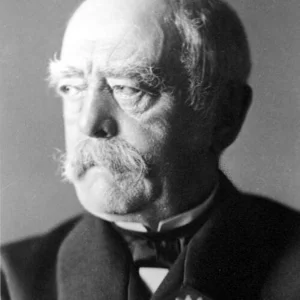

Prussian statesman, first chancellor of the German Empire. Nicknamed the “Iron Chancellor,” he achieved the unification of Germany around Prussia between 1864 and 1871 through a policy of warfare and diplomatic skill.
Otto von Bismarck(1815 — 1898)
Otto von Bismarck
royaume de Prusse, Reich allemand
6 min read
Frequently asked questions
Famous Quotes
« The great questions of the day are not settled by speeches and majority decisions, but by iron and blood.»
Key Facts
- Appointed minister-president of Prussia by William I in 1862
- Victory over Austria at the Battle of Königgrätz (Sadowa) in 1866, establishing Prussian preeminence
- Franco-Prussian War of 1870-1871, leading to French defeat and the fall of the Second Empire
- Proclamation of the German Empire in the Hall of Mirrors at Versailles on 18 January 1871; Bismarck becomes chancellor
- Dismissed by the new emperor William II in 1890
Works & Achievements
Achievement of German unity around Prussia through three successive wars, culminating in the birth of the German Empire in 1871.
The institutional framework of the new Empire, which placed the chancellor at the heart of executive power under the authority of the emperor.
Health insurance (1883), accident insurance (1884) and old-age and disability insurance (1889): the world's first major state social welfare laws.
A diplomatic network (the Triple Alliance, the Reinsurance Treaty with Russia) designed to isolate France and preserve peace in Europe.
A policy of struggle against the influence of the Catholic Church in the state and in schools, eventually abandoned through compromise.
Political memoirs written after his resignation, a major but biased source on his vision of power and diplomacy.
Anecdotes
During a speech before the Prussian Diet in 1862, Bismarck declared that the great questions of the age would not be settled by speeches and majority votes, but “by iron and blood.” This phrase became his motto and earned him the nickname “the Iron Chancellor.”
In 1870, Bismarck altered a telegram sent from the town of Ems by King Wilhelm I. By shortening and sharpening the wording of this “Ems Dispatch,” he made the message insulting to both France and Prussia, sparking outrage among both peoples and triggering the Franco-Prussian War.
Bismarck suffered from chronic insomnia and had a colossal appetite: he was famous for his gargantuan meals washed down with beer and champagne, and his physician Ernst Schweninger eventually forced him onto a strict diet that made him lose around thirty kilograms.
To cut the ground from under the socialists, Bismarck created the world's first major state social insurance schemes in the 1880s (sickness, accident, and old age). Paradoxically, this fierce opponent of the left is thus regarded as one of the inventors of modern social welfare.
In 1890, the young Emperor Wilhelm II, who wanted to rule alone, pushed Bismarck into resignation after twenty-eight years in power. A famous cartoon in the British magazine Punch immortalized the scene under the title “Dropping the Pilot.”
Primary Sources
It is not through speeches and majority decisions that the great questions of the age are settled — that was the mistake of 1848 and 1849 — but by iron and blood.
His Majesty the King has since declined to receive the French ambassador again, and has had the aide-de-camp on duty inform him that His Majesty had nothing further to communicate to him.
Politics is the art of the possible, the science of the relative.
The restoration of social peace cannot be sought solely through the repression of the excesses of social democracy, but also through the positive improvement of the workers' condition.
Key Places
The Bismarck family estate in the Altmark region, where Otto was born in 1815 into a family of the Prussian landed nobility (Junkers).
Capital of Prussia and later of the German Empire, the seat of power where Bismarck served for nearly thirty years as minister-president and then chancellor.
It was in the Hall of Mirrors that the German Empire was proclaimed on 18 January 1871, a deeply symbolic gesture in the heart of defeated France.
A spa town where King William I was staying in 1870; the meeting with the French ambassador there gave rise to the Ems Dispatch, which Bismarck reworked.
An estate given to Bismarck after 1871, where he retired following his resignation in 1890 and where he died in 1898.
A university town where the young Bismarck studied law, leading a rowdy student life before entering the Prussian civil service.
Typical Objects

Prussian military helmet topped with a spike, symbol of the army that forged German unity. Bismarck wore it with his cuirassier uniform at official ceremonies.

Message transmitted by electric telegraph, a fast-growing technology in the 19th century. The famous Ems Dispatch was a telegram whose release hastened the war of 1870.

The chancellor's writing instruments, with which he personally drafted many dispatches, treaties and laws. Bismarck's signature sealed the Empire's great decisions.

Bismarck was a famous bon vivant, able to down litres of beer and then champagne during his meals. The table was also a place for political negotiation.

Documents born of the Bismarckian social laws of the 1880s, certifying a worker's right to health, accident or old-age insurance. They mark the birth of the welfare state.

A bladed weapon worn with the military uniform that Bismarck favoured, he the “Iron Chancellor”. It symbolises the primacy of force and the army in his politics.
School Curriculum
Vocabulary & Tags
Key Vocabulary
Daily Life
Morning
A chronic insomniac, Chancellor Bismarck often rose late, having worked through part of the night on his files and correspondence. His mornings were devoted to reading diplomatic dispatches and newspapers, whose articles he monitored closely.
Afternoon
Afternoons were spent in audiences, councils with the emperor, and negotiations with ambassadors and members of parliament. Bismarck dictated extensively and personally drafted the most important texts himself.
Evening
In the evening, he loved to host dinners and discuss politics around the table, where many a decision was forged. He smoked long pipes and large cigars, prolonging conversations late into the night.
Food
Famous for his enormous appetite, Bismarck enjoyed meats, game, oysters, and rich dishes. A heavy drinker of beer and champagne, he was forced on his physician Schweninger's orders to follow a strict diet in the 1880s.
Clothing
On official occasions, he readily wore the uniform of a general or cuirassier, complete with a *Pickelhaube* and decorations, displaying his ties to the army. In private and in the countryside, he adopted the simpler attire of a country gentleman.
Housing
Bismarck divided his life between the official palaces of Berlin and his rural estates of Varzin and Friedrichsruh. He remained attached to the life of a landowner (*Junker*), amid the forests and fields where he hunted.
Historical Timeline
Period Vocabulary
Liens externes & ressources
Références
Œuvres
Unification de l'Allemagne
1864-1871
Constitution de l'Empire allemand
1871
Lois d'assurance sociale
1883-1889
Système d'alliances bismarckien
1873-1887
Kulturkampf
1872-1878
Pensées et Souvenirs (Gedanken und Erinnerungen)
1898