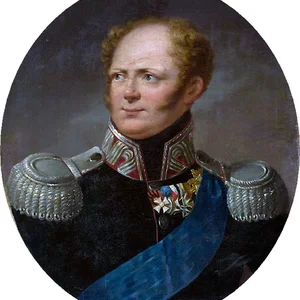

Emperor of Russia from 1801 to 1825, Alexander I was one of Napoleon's chief adversaries. Victorious in the campaign of 1812, he played a major role at the Congress of Vienna and founded the Holy Alliance.
Alexander I(1777 — 1825)
Alexander I
Empire russe
6 min read
Frequently asked questions
Key Facts
- Becomes Emperor of Russia in 1801 after the assassination of his father Paul I
- Faces Napoleon at Austerlitz (1805) then signs the Peace of Tilsit (1807)
- Repels the Napoleonic invasion during the Russian campaign of 1812
- Takes part in the Congress of Vienna (1814-1815) and founds the Holy Alliance in 1815
- Exiles the poet Pushkin in 1820 for his liberal poems; dies in 1825
Works & Achievements
Peace and alliance agreement concluded with Napoleon, which temporarily reshaped the balance of power in Europe.
Decisive resistance to the Napoleonic invasion that broke the Grande Armée and marked the beginning of Napoleon's downfall.
Major participation in the reorganization of Europe and the establishment of a new international order based on the balance of power.
Pact between Christian sovereigns aimed at preserving the monarchical order and peace in Europe according to religious principles.
Grant of a liberal constitution to the Kingdom of Poland united with Russia, one of the most advanced in Europe at the time.
Creation or reform of universities (Kazan, Kharkov, Saint Petersburg) as part of the educational reforms of the early reign.
Integration of Finland into the Russian Empire as an autonomous grand duchy after the war against Sweden.
Anecdotes
When his father Paul I was murdered by conspirators during a palace coup in 1801, Alexander I came to the throne at the age of 23. All his life he was haunted by the feeling that he had allowed this murder to happen, which fed his deep religious piety.
During Napoleon's invasion of Russia in 1812, Alexander I refused all negotiation even after the capture of Moscow. The city was set ablaze and the Grande Armée, caught in the Russian winter, was forced to retreat: of more than 600,000 men, barely a few tens of thousands returned.
In 1814, after the fall of Napoleon, Alexander I entered Paris at the head of the coalition armies. As the victor, he proved surprisingly moderate toward the French, refusing to hand the capital over to the looting that many expected.
Deeply influenced by religious mysticism late in his life, Alexander I proposed in 1815 the creation of the Holy Alliance, a pact between Christian sovereigns (Russia, Austria, Prussia) meant to base politics on the principles of the Gospel.
The sudden death of Alexander I at Taganrog in 1825 gave rise to a persistent legend: according to rumor, the emperor did not truly die but withdrew under the identity of a hermit named Fyodor Kuzmich, in Siberia.
Primary Sources
Under Our reign, We shall govern the people entrusted to Us by God according to the laws and according to the heart of Our august grandmother the Empress Catherine the Great.
The three contracting monarchs shall remain united by the bonds of a true and indissoluble fraternity, and considering themselves as fellow countrymen, they shall on all occasions lend one another assistance, aid and support.
I shall not lay down arms so long as a single enemy soldier remains on the soil of my empire.
From the date of the exchange of ratifications of the present treaty, there shall be peace and perfect friendship between His Majesty the Emperor Napoleon and His Majesty the Emperor of all the Russias.
Key Places
Capital of the Russian Empire where Alexander I was born in 1777 and ruled from the Winter Palace. The center of Russian political and military power.
The ancient capital and spiritual heart of Russia, seized by Napoleon in 1812 and then devastated by a great fire. Alexander I was crowned there in 1801.
Town in East Prussia where Alexander I met Napoleon on a raft in the middle of the Niemen River to sign a peace agreement in 1807.
The Austrian capital that hosted the 1814–1815 congress tasked with reorganizing Europe after the fall of Napoleon. Alexander I played a leading role there.
Russian port on the Sea of Azov where Alexander I died suddenly in 1825, giving rise to the legend that he had survived in the guise of a hermit.
The French capital where Alexander I entered triumphantly in March 1814 at the head of the allied armies, displaying remarkable restraint.
Typical Objects

Green military attire trimmed with golden braid that the emperor, trained in the art of war, wore frequently. Alexander I loved the pomp of parades and the discipline of the uniform.

Emblem of the autocratic power of the tsars, topped with the famous Orlov diamond. It symbolized Alexander I's absolute authority over the vast Russian Empire.

A diadem set with thousands of diamonds and a large red spinel, created for Catherine II and used during coronations. Alexander I received it at his coronation in Moscow in 1801.

A curved bladed weapon carried by Russian officers during the Napoleonic Wars. It illustrates the emperor's personal involvement in the military campaigns.

A painted holy image that the emperor, deeply pious especially toward the end of his life, venerated in his daily prayers. The Orthodox faith inspired his mystical vision of the Holy Alliance.

A cartographic document used to plan the movements of the armies during the campaign of 1812 and the campaigns in Germany and France. An essential tool of strategy against Napoleon.
School Curriculum
Vocabulary & Tags
Key Vocabulary
Daily Life
Morning
The emperor rose early and often began his day with a walk or a military review, a passion he shared with his father. The morning was devoted to reading dispatches and to audiences with his ministers and advisers.
Afternoon
The afternoon was divided between affairs of state, the reception of ambassadors, and the review of military and administrative reports. On campaign, **Alexander I** inspected the troops and conferred with his generals.
Evening
In the evening, the imperial court offered balls, concerts, and receptions at the **Winter Palace**, where the emperor showed himself charming and refined. Toward the end of his life, having grown more mystical, he preferred prayer and spiritual conversations.
Food
The Russian imperial table blended refined French cuisine with traditional dishes such as soups (*shchi*, *borscht*), fish, and game. Court banquets served fine wines and elaborate fare, but **Alexander I** had personally rather modest tastes.
Clothing
**Alexander I** most often wore the green military uniform of the imperial guard, adorned with decorations, which he preferred to civilian clothes. For ceremonies, he donned the great ceremonial mantle and the insignia of imperial power.
Housing
The emperor resided at the **Winter Palace** in **Saint Petersburg**, an immense Baroque dwelling on the banks of the Neva, and spent the summer in the palaces of **Tsarskoye Selo** and **Peterhof**. These sumptuous residences were among the most magnificent in Europe.
Historical Timeline
Period Vocabulary
Liens externes & ressources
Références
Œuvres
Traité de Tilsit
1807
Victoire de la campagne de Russie
1812
Rôle au congrès de Vienne
1814-1815
Fondation de la Sainte-Alliance
1815
Constitution du royaume de Pologne
1815
Fondation d'universités
1802-1804
Annexion de la Finlande
1809