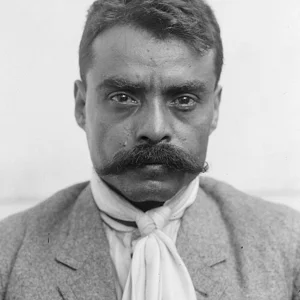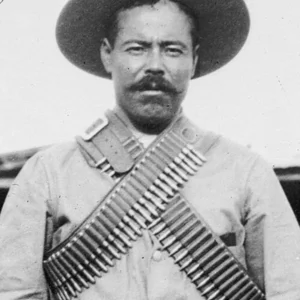

A Mexican revolutionary leader, Pancho Villa was one of the key figures of the Mexican Revolution (1910-1920). At the head of his famous Division of the North, he fought against the regimes of Porfirio Díaz and then Victoriano Huerta before leading an armed raid against the town of Columbus, New Mexico, in 1916.
Pancho Villa(1878 — 1923)
Pancho Villa
Mexique
7 min read
Frequently asked questions
Key Facts
- Born in 1878 in San Juan del Río (State of Durango, Mexico)
- Took part in the Mexican Revolution against the dictator Porfirio Díaz starting in 1910
- Commanded the Division of the North (División del Norte), a major force of the revolutionary armies (1913-1915)
- Led a raid on Columbus (New Mexico) in March 1916, triggering the American punitive expedition of General Pershing
- Assassinated on July 20, 1923, in Parral (State of Chihuahua)
Works & Achievements
Villa organized one of the largest revolutionary armies in Mexico, made up of peasants, miners, and horsemen. It became the spearhead of the struggle against Huerta.
This major victory shattered the federal army and hastened the fall of dictator Victoriano Huerta. It made Villa one of the most powerful leaders in the country.
Villa and Zapata, representing the peasants of the north and the south, made their joint entry into the capital. A powerful image of revolutionary unity that has remained famous.
An attack on an American town, an extraordinary military event that placed Villa at the center of international attention and triggered the Pershing Expedition.
In the territories he controlled, Villa confiscated large estates and organized distributions of land and food for peasants and the widows of soldiers.
Retired from the war, Villa created a school for the children of the workers on his estate, demonstrating his commitment to popular education.
Anecdotes
Pancho Villa's real name was José Doroteo Arango Arámbula. Having become an outlaw very young, he is said to have taken this alias to escape the authorities. When the Revolution broke out in 1910, this hunted bandit transformed into a military leader followed by thousands of men.
In 1914, Villa signed a contract with an American film company, the Mutual Film Corporation, which wanted to film his battles. It is said that he sometimes agreed to lead his attacks during the day so that the cameras would have enough light. It is one of the earliest examples of war turned into filmed spectacle.
Villa commanded an elite personal guard, the “Dorados” (the Golden Ones), horsemen renowned for their courage and absolute loyalty. An excellent horseman himself, he moved his troops by train across the desert of northern Mexico, turning the locomotives into veritable rolling fortresses.
In March 1916, Villa attacked the town of Columbus, New Mexico: it was one of the rare times that United States territory was invaded by a force coming from Mexico. In retaliation, the American president sent nearly 10,000 soldiers, commanded by General Pershing, who pursued Villa for months without ever managing to capture him.
After years of fighting, Villa agreed to lay down his arms in 1920 in exchange for a large hacienda, Canutillo, where he became a rancher and farmer. There he set up a school for the workers' children. He was assassinated in 1923, riddled with bullets in his car, in the town of Parral.
Primary Sources
The American journalist John Reed, who lived for several months alongside the Division del Norte, describes Villa as a man of inexhaustible energy, idolized by his soldiers, capable of switching from laughter to anger in an instant.
An agreement by which the American film company obtained exclusive rights to film Villa's military campaigns, in exchange for a sum of money intended to fund his army.
The U.S. Army documents recount the hunt for Villa in Mexico following the Columbus raid, and acknowledge the expedition's failure to capture him despite the thousands of soldiers deployed.
In his proclamations, Villa calls on the people to overthrow the tyrants and defends the cause of peasants stripped of their lands by the great landowners of the Porfiriato.
Key Places
Rural region of Durango where Doroteo Arango was born into a family of sharecroppers. The setting of the agrarian inequalities that fueled his revolt.
Mining town in central Mexico where Villa won a decisive victory against Huerta's army in 1914. One of the bloodiest battles of the Revolution.
Town in central Mexico where Villa suffered a crushing defeat against Álvaro Obregón in 1915. This setback marked the decline of his military power.
Small American town attacked by Villa in March 1916. The raid prompted the dispatch of General Pershing's punitive expedition.
Large agricultural estate granted to Villa in 1920 when he laid down his arms. There he lived as a rancher and founded a school.
Town in the state of Chihuahua where Pancho Villa was assassinated in an ambush in July 1923.
Typical Objects

Cartridge belts worn crossed over the chest, an iconic image of the Mexican revolutionaries. They allowed large amounts of ammunition to be carried on horseback.

A repeating rifle widely used by the armies of the Mexican Revolution. The main weapon of the cavalry of the Division of the North.

Locomotives and railcars used to move troops, horses and cannons quickly across the northern desert. Villa turned the railway into a strategic weapon.

A wide felt hat that provides protection from the sun, worn by the peasants and soldiers of northern Mexico. It became a visual symbol of the revolution.

An essential mount for the revolutionaries; Villa was reputed to be an excellent horseman and led swift charges. His guard, the “Dorados,” was entirely mounted.

Artillery pieces transported by train and used in the great battles such as Zacatecas. They gave the Division of the North formidable firepower.
School Curriculum
Vocabulary & Tags
Key Vocabulary
Tags
Daily Life
Morning
On campaign, the day began before dawn, to the sound of bugles. The horses were saddled, the cartridge belts loaded, and the troops gathered near the trains. Villa, an early riser and tireless, inspected his men and gave his orders.
Afternoon
Afternoons were devoted to marches, cavalry maneuvers, or fighting. Between battles, they repaired the railway lines, tended to the wounded, and looked after the horses. Villa often gathered his officers to plan the next offensive.
Evening
In the evening, around the campfires, the soldiers sang “corridos,” those popular songs that recounted their exploits. Villa, who did not drink alcohol, shared his men's meals and listened to their stories. The night was also used to organize surprise movements by train.
Food
The soldiers' diet relied on corn flatbreads (tortillas), beans (frijoles), chili, and dried meat when it could be found. Villa was known for not drinking alcohol — a rare trait among military leaders of the time — and was fond of sweets and coffee.
Clothing
Villa often wore a military uniform, a wide-brimmed hat, and cavalry boots, with cartridge belts crossed over his chest. His soldiers mixed peasant clothing, sombreros, and mismatched military outfits taken from the enemy.
Housing
During the war, Villa lived in railway cars, canvas camps, or occupied haciendas. Once retired to Canutillo, he lived in the estate's large house, surrounded by his family, his guards, and the farm's workers.
Historical Timeline
Period Vocabulary
Liens externes & ressources
Références
Œuvres
Création de la Division du Nord
1913
Victoire de la bataille de Zacatecas
1914
Alliance avec Emiliano Zapata et entrée dans Mexico
1914
Raid de Columbus
1916
Réformes agraires et redistribution de terres dans le nord
1913-1915
Fondation d'une école à l'hacienda de Canutillo
1920-1923