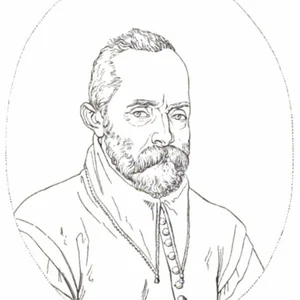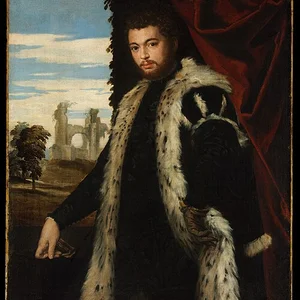

Venetian Renaissance painter (1528–1588), celebrated for his vast, sumptuous compositions featuring large crowds of figures, brilliant colors, and illusionistic architectural settings. He painted decorative cycles for the Serenissima in the palaces and churches of Venice.
Paolo Veronese
Paolo Caliari, known as Paolo Veronese
9 min read
Frequently asked questions
Key Facts
- Born in Verona in 1528, trained by Antonio Badile, he settled in Venice around 1553
- In 1562, painted The Wedding at Cana for the refectory of San Giorgio Maggiore (now in the Louvre)
- Summoned before the Inquisition in 1573 over the content of his Feast in the House of Levi, deemed irreverent
- Decorated, alongside Tintoretto, the halls of the Doge's Palace after the fire of 1577
- Died in Venice in 1588, leaving an active workshop continued by his sons (Carletto and Gabriele)
Works & Achievements
An enormous canvas (9.94 × 6.67 m) commissioned for the refectory of San Giorgio Maggiore in Venice, depicting Christ's first miracle set within a lavish Venetian banquet populated by more than 130 figures. Taken by Napoleon in 1797, it is today held in the Louvre.
A colossal canvas (12.8 × 5.55 m) originally titled *The Last Supper*, renamed after Veronese was summoned before the Venetian Inquisition, which deemed its iconography irreverent. Held at the Accademia in Venice, it illustrates both the artist's narrative freedom and the religious tensions of the Counter-Reformation.
An oval ceiling painting in the Hall of the Great Council in the Doge's Palace, depicting Venice enthroned among the clouds, surrounded by allegories of Victory and Peace. This masterpiece of *di sotto in su* painting is regarded as the pinnacle of official Venetian art.
A cycle of *trompe-l'œil* frescoes adorning the Palladian villa of the Barbaro brothers, blending illusionistic landscapes, false architecture, and figures from everyday life peering through painted windows. This cycle represents Veronese's most innovative and most intimate work.
A series of four allegorical canvases (*Union*, *Scorn*, *Respect*, *Happy Union*) now held at the National Gallery in London. These works bear witness to Veronese's virtuosity in rendering fabrics, foreshortened bodies, and the golden light of Venice.
An extensive decorative programme covering the ceiling, the organ loft, and the organ shutters of the Venetian church of San Sebastiano, which Veronese himself chose as his burial place. The ensemble constitutes the most complete gathering of his art in a single location and allows the full arc of his career to be traced.
Anecdotes
In 1573, Veronese was summoned before the tribunal of the Venetian Inquisition. His immense painting depicting a biblical meal scandalized the ecclesiastical authorities, as it showed dwarfs, jesters, German soldiers, and even a dog licking scraps — deemed disrespectful for a sacred scene. Rather than repainting the work, the artist cleverly chose to simply change its title, renaming it “Feast in the House of Levi” instead of “Last Supper.” This artful sidestep allowed this colossal canvas to survive intact to this day.
Born Paolo Caliari in Verona in 1528, the painter owed his nickname “Veronese” to his hometown. Yet it was in Venice that he found his true artistic homeland, captivated by the golden lagoon light and the rich fabrics of the merchants. His contemporaries regarded him as one of the three giants of the Venetian school alongside Titian and Tintoretto — a trinity of talents as much rivals as they were complements.
The Wedding at Cana (1563) is one of the largest paintings ever created, measuring nearly ten meters wide. Veronese depicted more than one hundred and thirty figures seated at the table, including illustrious contemporaries disguised as oriental guests — among the musicians one can recognize Titian, Tintoretto, and the artist himself. Commissioned by the Benedictine monks of San Giorgio Maggiore, the work was carried off by Napoleon's troops in 1797 and now reigns at the Louvre.
For the Villa Barbaro at Maser, Veronese created between 1560 and 1562 frescoes of extraordinary inventiveness. He filled the walls with astonishing trompe-l'oeil: maids peering through false windows, a dog sitting on a false threshold, pastoral landscapes appearing where there is nothing but painted plaster. These illusions have survived the centuries so well that visitors have reportedly still tried to open the false doors.
Veronese ran a highly productive family bottega (workshop), in which his brother Benedetto and his sons Carlo and Gabriele all collaborated. At his death in 1588, the workshop continued to operate under the name “Haeredes Pauli” (heirs of Paolo), perpetuating his flamboyant style. This artisanal organization, typical of the Venetian Renaissance, explains why some works from the late stage of his career intimately blend his touch with that of his collaborators.
Primary Sources
He was asked: Why have you painted in this picture drunkards, buffoons, German dwarfs, and other such improprieties? He replied: We painters take the same license as poets and madmen, and I made these figures as ornamentation, as is customary.
Paolo Veronese giovane di bella aspettativa, pittore veronese, ha lavorato di fresco nella libreria di San Marco alcune storie di chiaro e scuro, che sono state molto lodate.
The painting shall be the size of the refectory wall, that is to say eighteen feet in width and twelve feet in height, depicting the wedding at Cana in Galilee with all the figures that the artist shall deem appropriate.
The Council of Ten has decided to entrust Paolo Caliari, known as Veronese, with the execution of the ceiling paintings of its hall, according to the agreed subjects and dimensions, for the sum of seven hundred gold ducats.
Key Places
Birthplace of Paolo Caliari, where he trained in the workshop of Antonio Badile. Verona, rich in its Romano-Gothic heritage and its constant exchanges with Venice, left a lasting imprint on the young painter's sense of architectural grandeur and color.
The city where Veronese settled permanently and rose to fame, working for its most powerful institutions: the Doge's Palace, the great *scuole*, monasteries, and patrician palaces. It was here that he lived, died, and was buried in the church of San Sebastiano.
A patrician villa designed by Palladio for the Barbaro brothers, decorated by Veronese between 1560 and 1562 with trompe-l'œil frescoes of unparalleled inventiveness. This joint masterpiece of Palladian architecture and Veronese painting is today a UNESCO World Heritage Site.
The seat of government of the Republic of Venice, where Veronese decorated several major halls, including the Hall of the Council of Ten and the Hall of the Great Council with the monumental *Triumph of Venice*. These official commissions represented the pinnacle of his public recognition.
The church that Veronese decorated throughout his career (1555–1570), painting its ceiling, choir loft, and organ shutters in an exceptional decorative scheme. He was buried there in 1588, and his bust still adorns one of the nave's pillars today.
Liens externes & ressources
Références
Œuvres
Les Noces de Cana
1563
Le Repas dans la maison de Lévi
1573
Allégories de l'Amour
vers 1575
Décoration de l'église San Sebastiano
1555-1570