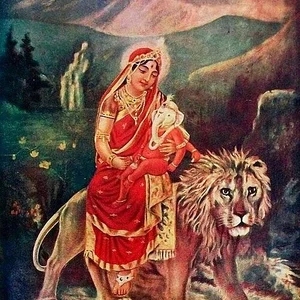

Pārvatī is a major goddess of the Hindu tradition, daughter of the mountain god Himavat and consort of Shiva. Venerated as the goddess of fertility, maternal love, and devotion, she embodies the divine feminine energy (Shakti). Her figure appears in the great Sanskrit epics and the Purāṇas, texts composed between the 4th and 12th centuries CE.
Parvati
Pārvatī
9 min read
Frequently asked questions
Famous Quotes
« "She who is the mother of the universe is also the force that keeps it alive." (attributed by the Devī-Māhātmya tradition)»
Key Facts
- Mentioned in early forms in late Vedic texts (c. 1000–500 BCE), she takes her canonical shape in the Purāṇas (4th–12th century CE)
- Regarded as a reincarnation of Satī, Shiva's first consort, according to the Purāṇas
- Mother of Ganesha (the elephant-headed god) and Kartikeya (god of war) according to Hindu textual tradition
- Venerated under many names and forms: Durgā (the warrior), Kālī (the destroyer), Uma (the light) — reflecting the richness of Hindu polytheism
- Her cult is among the most widespread on the Indian subcontinent, with temples dedicated to her from at least the early centuries CE
Works & Achievements
A central cosmic event in Shaivite mythology, this marriage unites masculine asceticism (Shiva) with feminine creative energy (Pārvatī-Shakti). It makes possible the continuation of the cosmos and the birth of the divine sons Kārttikeya and Ganesha.
Pārvatī gave birth to Kārttikeya, god of war, to save the gods from the demon Tārakāsura. This act illustrates her role as a protective mother and an active cosmic force in the struggle between good and evil.
According to the Shiva Purāṇa, Pārvatī fashioned Ganesha from the clay of her own body and breathed life into him. This episode, one of the most beloved in Hindu mythology, gave rise to a major devotional cult venerated by hundreds of millions of worshippers.
In this tantric text, Pārvatī questions Shiva about the paths to spiritual realization, prompting a teaching of 112 meditation techniques. Her role as initiator and questioner establishes her as a central figure in the transmission of yogic knowledge.
To defeat the demon Raktabīja, whose every drop of blood spawned a clone, Pārvatī transformed into Kālī and drank all the blood before it could touch the ground. This mythic act is interpreted as the capacity of divine consciousness to absorb and transcend evil.
The Ardhanārīśvara form depicts Shiva and Pārvatī merged into a single body, half male and half female. This iconography, one of the most philosophically profound in Hinduism, symbolizes the inseparable unity of the active and passive principles of the universe.
Anecdotes
Pārvatī is the reincarnation of Satī, Shiva's first wife, who threw herself into her father Daksha's sacrificial fire to defend her husband's honor. After her death, Shiva fell into deep grief and withdrew from the world. Pārvatī was then born to bring him back among the gods.
To win the heart of Shiva, who had been lost in meditation for centuries, Pārvatī undertook long and severe ascetic austerities (tapas) of her own. She fasted, exposed herself to extreme cold and heat, and thereby earned the title 'Aparnā' — she who does not eat even a leaf — impressing the gods with her determination.
According to the Shiva Purāṇa, the god of love Kāma was sent to disturb Shiva's meditation so that he would notice Pārvatī. Shiva, enraged at the interruption, opened his third eye and reduced Kāma to ashes. Pārvatī later interceded for Kāma to be resurrected, demonstrating her compassion.
Pārvatī and Shiva are the parents of two major deities: Kārttikeya, god of war born to slay the demon Tārakāsura, and Ganesha, the elephant-headed god of wisdom and new beginnings. Ganesha's own birth is remarkable: some texts recount that Pārvatī molded him from clay before he came to life.
In certain traditions of the Devī Māhātmya, Pārvatī transforms into Durgā or Kālī to battle demons that the male gods could not defeat. This ability to take on fearsome forms while remaining fundamentally benevolent symbolizes the duality of divine feminine energy in Hindu cosmology.
Primary Sources
Pārvatī, daughter of the mountain Himavat and Menā, having performed severe austerities, obtained as her husband the great Shiva, lord of the three worlds, by the grace of Brahmā.
From the Goddess arose all forces. She is Shakti, the primordial power that sustains the universe, mother of all beings, worshipped by Brahmā, Vishnu, and Maheshvara.
The daughter of the king of mountains, whose beauty rivaled that of the goddess Lakshmi, performed the most rigorous austerities in order to win Shiva as her husband.
Uma Haimavati, the consort of Shiva, is venerated among the goddesses as the mother of the world. She bestows prosperity, longevity, and devotion upon those who honor her.
O Umā, daughter of the mountain, may your grace extend over our families as the waters of the Ganges descend from the eternal peaks to nourish the plains.
Key Places
The celestial abode of Shiva and Pārvatī according to Hindu cosmology, this 6,638-meter peak is the holiest pilgrimage site in Shaivism. Devotees perform the parikramā (circumambulation) around the mountain as an act of reverence.
One of the most important tantric temples dedicated to the Mother Goddess, associated with Pārvatī in her Shakti form. According to legend, this is where a part of Satī's body (Pārvatī's previous incarnation) fell when Shiva carried her corpse.
A great shrine dedicated to Meenakshi, a local form of Pārvatī, and Sundareshvara (Shiva). This Dravidian temple founded in the 7th century is one of the most important in South India and symbolizes Pārvatī's presence as divine queen.
The sacred source of the Ganges in the Himalayas, considered Pārvatī's homeland according to Puranic texts. Her father Himavat is the personification of this mountain range, making the entire Himalayan region the goddess's original home.
Shiva's sacred city on the banks of the Ganges, where Pārvatī is venerated in numerous temples under many forms. By tradition, the city is the eternal dwelling place of the divine couple Shiva and Pārvatī.
Typical Objects

Pārvatī is often depicted standing on a lotus or holding a lotus flower, a symbol of spiritual purity and divine blossoming. The lotus growing in mud without being soiled by it illustrates divine perfection within the material world.

During her years of austerities to win Shiva's heart, Pārvatī carried the kamandalu, a vessel made of clay or coconut shell used by ascetics to store sacred water. This object symbolizes her spiritual determination.

An attribute shared with Shiva, the trident represents the three cosmic functions (creation, preservation, dissolution) and Pārvatī's power over the three worlds. She wields it in her warrior forms such as Durgā.

Pārvatī is frequently depicted holding a string of 108 beads with which she recites the divine names of Shiva. This object symbolizes her absolute devotion and her role as a model of daily spiritual practice.

In some iconographic traditions, Pārvatī holds a mirror symbolizing self-knowledge and divine consciousness. It also evokes her incomparable beauty and her nature as a reflection of the universe's creative energy.

The lingam (Shiva's phallic symbol) set within the yoni (Pārvatī's feminine symbol) forms the central object of worship in Shaivite temples. Their union symbolizes the complementarity of the masculine and feminine principles that keeps the universe in balance.
School Curriculum
Vocabulary & Tags
Key Vocabulary
Tags
Daily Life
Morning
Before dawn, Pārvatī presides over the morning puja in the ice palace of Mount Kailāsh. She welcomes gods and sages who come to seek the blessings of the divine couple, while Shiva emerges from his nightly meditation. She herself offers flowers, milk, and incense to Shiva's lingam as a gesture of mutual devotion.
Afternoon
In the afternoon, Pārvatī oversees spiritual teachings: seated beside Shiva, she poses questions about the nature of the cosmos, allowing the assembled sages to receive revealed knowledge. She also tends to Ganesha and Kārttikeya, instructing them in the arts, sacred sciences, and divine duties.
Evening
In the evening, the divine spouses stroll along the snow-covered slopes of Kailāsh. Pārvatī sometimes plays dice with Shiva — a scene common in iconography — symbolizing the playful aspect (līlā) of divine creation. Apsarās dance and gandharvas sing in their honor as the sun sets behind the mountain peaks.
Food
As a goddess, Pārvatī transcends human nutritional needs, but texts and rituals offer her milk, ghee (clarified butter), honey, fruits, coconuts, and rice. During her years of ascetic austerities, she fasted so severely that she received the name Aparnā — she who does not eat even a leaf.
Clothing
Pārvatī is dressed in richly embroidered silks, typically red and gold (colors of auspiciousness and prosperity). She wears a complete set of ornaments: a diadem, multi-strand necklaces, bracelets, a belt, and gold and gem-studded anklets. Her dark hair is adorned with jasmine flowers and a crescent moon, echoing her connection to Shiva.
Housing
The divine couple resides on Mount Kailāsh, a cosmic summit that serves as both celestial palace and sacred mountain. The Purāṇas describe this abode as a space of crystal and gold, surrounded by paradisiacal gardens of eternally blooming trees, inhabited by gods, ṛṣis, and celestial beings who come to receive Shiva's teachings.
Historical Timeline
Period Vocabulary
Visual Style
Iconographie classique de l'Inde médiévale : sculpture en bronze Chola ou miniature Pahari, avec teintes dorées, soieries cramoisies et dorures, parure de fleurs de jasmin et décor himalayen luxuriant.
Sound Ambience
Atmosphère d'un temple shivaïte en montagne à l'aube : cloches sacrées, mantras sanskrits, souffle de la conque et chant dévotionnel des fidèles sur fond de vent himalayen.
Liens externes & ressources
Références
Œuvres
Mariage de Pārvatī et Shiva
mythe intemporel, textualisé vers IVe–XIIe siècle
Naissance et formation de Kārttikeya
mythe purānique, vers VIe–Xe siècle
Création de Ganesha
mythe purānique, vers VIe–XIIe siècle
Enseignement du Yoga à Shiva — dialogue du Vijñāna Bhairava Tantra
vers VIIe–VIIIe siècle
Forme de Kālī — victoire sur Raktabīja
Devī Māhātmya, vers VIe siècle
Ardhanārīśvara — fusion avec Shiva
représentation attestée à partir du IIe siècle