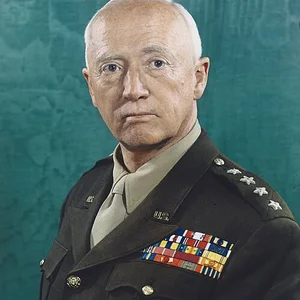

American general of the Second World War, renowned for his boldness and his mastery of armored warfare. He commanded the U.S. Seventh and then the Third Army during the campaigns in Sicily, Normandy, and Germany.
Patton
Patton
5 min read
Frequently asked questions
Key Facts
- Born in 1885 in California, graduated from West Point in 1909
- Took part in the First World War and organized the first American tank units (1917-1918)
- Commanded the Seventh Army during the landing in Sicily in 1943
- At the head of the Third Army, led a lightning breakthrough across France after the Normandy landings (1944) and relieved Bastogne during the Battle of the Bulge
- Died in December 1945 from the aftermath of a car accident in Germany
Works & Achievements
Patton organized and trained the first armored corps of the United States during the First World War. He became a pioneer of mechanized warfare.
He designed a new straight saber for the American cavalry, favoring the thrust over the cut. The weapon was officially adopted by the army.
Leading the 7th Army, he conquered the island in less than six weeks. The speed of his advance illustrated his offensive doctrine.
After Normandy, his 3rd Army swept across France at a lightning pace. These advances threw the German defenses into disarray.
He pivoted his army northward within a few days to free the besieged town. This maneuver has remained a textbook case of military logistics.
A posthumous collection of his notes, letters, and reflections on war. The book reveals his tactical thinking and his character.
Anecdotes
Patton was a firm believer in reincarnation: he claimed to have been a soldier in past lives, under Caesar and Napoleon. When visiting ancient battlefields, he insisted he recognized the places and knew where the fighting had taken place.
Nicknamed “Old Blood and Guts,” he carried ivory-handled revolvers and cultivated his image as a ruthless commander. His speeches, peppered with profanity, were famous for galvanizing his men before an assault.
In 1943 in Sicily, he slapped two soldiers hospitalized for war trauma, accusing them of cowardice. The scandal nearly destroyed his career and kept him away from command for months.
During the Battle of the Bulge (winter 1944), Patton redirected his Third Army by 90 degrees within a few days to relieve the besieged troops at Bastogne — a logistical maneuver deemed nearly impossible that forged his legend.
An accomplished athlete, he competed in the 1912 Stockholm Olympic Games in the modern pentathlon, finishing fifth. He also designed a new cavalry saber for the U.S. Army.
Primary Sources
Americans love to win and will not tolerate defeat. No man ever won a war by dying for his country: he won it by making the other poor dumb bastard die for his.
Never tell people how to do things. Tell them what to do and they will surprise you with their ingenuity.
To be a good soldier, you need discipline, pride in yourself and your unit, and a strong sense of duty and honor.
Key Places
Patton's birthplace, where he grew up in a family with a strong military tradition. His youth there fueled his fascination with the history of great war leaders.
The United States Military Academy where Patton was trained and graduated in 1909. There he forged his discipline and his ambition to become a great soldier.
A town in the Ardennes surrounded by the Germans during the winter of 1944. Patton's Third Army carried out a lightning march to break the siege.
The setting of the 1943 campaign where Patton led the Seventh Army all the way to Messina. His race against Montgomery's British forces revealed his competitive temperament.
The region where Patton was seriously injured in a car accident in December 1945. He died there a few days later, shortly after the end of the war.
The American military cemetery where Patton is buried, among the soldiers of his Third Army. His grave remains a widely visited place of remembrance.
Typical Objects

Patton carried personalized revolvers with engraved ivory grips, symbols of his flamboyant style. He corrected anyone who spoke of “pearl,” which he deemed fit only for a saloon gambler.

A mass-produced American medium tank, the backbone of the armored divisions led by Patton. Its mobility and sheer numbers made up for armor and a gun inferior to those of German tanks.

Patton sported a meticulously polished helmet bearing a general's stars, an integral part of his impeccable attire. He demanded strict dress discipline from his men, even on the front lines.

A former cavalry officer, Patton kept his polished boots and riding crop, a legacy of a horse-mounted branch that was fading away. These objects recalled his early days before the age of the tank.

Patton planned his offensives on vast maps covered with arrows and front lines. His mastery of terrain and logistics enabled swift and daring maneuvers.
School Curriculum
Vocabulary & Tags
Key Vocabulary
Daily Life
Morning
Patton rose early, maintained an impeccable appearance, and often inspected his troops at dawn. He made a point of showing himself in person at the front to keep morale and discipline high.
Afternoon
His afternoons were spent planning with his staff, poring over maps, or moving quickly from one unit to another. He liked to observe combat as close to the danger as possible.
Evening
In the evening, he read works of military history and wrote in his personal diary. There he recorded his thoughts, his prayers, and his analyses of battles.
Food
On campaign, he often shared the army's rations with his men. Coming from a well-off background, he also enjoyed finer cuisine whenever he had the chance.
Clothing
Always immaculately turned out, he wore a pressed uniform, a polished helmet, and his famous ivory-handled revolvers. He demanded the same sartorial discipline from his soldiers.
Housing
On operations, he stayed in mobile headquarters, tents, or buildings requisitioned near the front. In peacetime, he lived in the comfort befitting his wealthy family.
Historical Timeline
Period Vocabulary
Liens externes & ressources
Références
Œuvres
Création de la première unité de chars américaine
1917-1918
Sabre de cavalerie « Patton » (M1913)
1913
Campagne de Sicile
1943
Percée de la 3e armée en France
1944
Secours de Bastogne (bataille des Ardennes)
1944-1945
War As I Knew It
1947