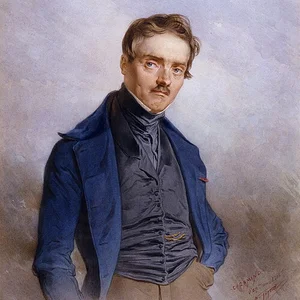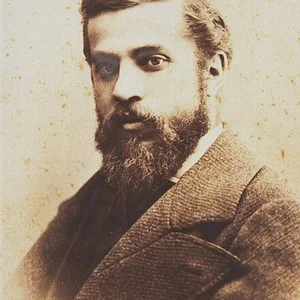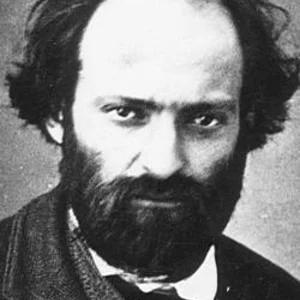

A French painter born in Aix-en-Provence in 1839, Paul Cézanne is considered the father of modern painting. His work on the geometry of forms and construction through color paved the way for Cubism and 20th-century art.
Paul Cézanne(1839 — 1906)
Paul Cézanne
France
7 min read
Frequently asked questions
Famous Quotes
« Treat nature by the cylinder, the sphere, the cone.»
« To paint from nature is not to copy the objective, it is to realize one's sensations.»
Key Facts
- Born on January 19, 1839, in Aix-en-Provence
- Participated in the first Impressionist exhibition in 1874
- Painted more than 80 versions of Mont Sainte-Victoire between 1882 and 1906
- Influenced by Pissarro, he developed a distinctive style grounded in the geometry of volumes
- Died on October 22, 1906, only belatedly recognized as a founder of modern art
Works & Achievements
Cézanne's first widely recognized major work, exhibited at the first Impressionist exhibition of 1874. It marks his transition toward a structured and solid approach to painting, far from the fleeting quality of Impressionism.
A series of five paintings depicting Provençal peasants playing cards, a masterpiece of Cézanne's mature period. The version held at the Musée d'Orsay is one of the most expensive French paintings ever sold.
A series of more than eighty paintings and watercolors devoted to this Provençal massif, in which Cézanne develops his technique of constructing space through color. These works are foundational to modern art.
Nearly two and a half meters wide, this is Cézanne's final masterpiece. This composition of female nudes in a natural setting directly influenced Picasso's "Les Demoiselles d'Avignon," painted the following year.
After one hundred and fifteen sittings, this portrait of the dealer who gave Cézanne his first solo exhibition stands as one of the most unsettling works in modern painting, with its fragmented face and sculptural monumentality.
An iconic still life housed at the Musée d'Orsay, in which Cézanne applies multiple simultaneous viewpoints to the fruit and the tablecloth. This work directly foreshadows the Cubist experiments of Braque and Picasso.
Anecdotes
Paul Cézanne and Émile Zola had been inseparable since childhood in Aix-en-Provence. But in 1886, Zola published 'L'Œuvre', a novel whose hero is a failed painter who takes his own life. Cézanne, recognizing himself in this character, sent him a brief farewell letter. The two friends never saw each other again, after more than thirty years of friendship.
Cézanne was obsessed with the Mont Sainte-Victoire, visible from Aix-en-Provence. He painted it more than eighty times throughout his life, in every light and every season, seeking to capture its fundamental geometric volumes. This mountain became the symbol of his lifelong exploration of pure form.
The art dealer Ambroise Vollard sat for his portrait over one hundred and fifteen sessions, remaining motionless for hours at a time in the painter's studio. After this ordeal, Cézanne declared he was “not displeased with the shirt.” The painting is today considered a masterpiece of modern portraiture.
In October 1906, caught in a storm while painting outdoors near Aix, Cézanne collapsed in a field. Carried home, he died a few days later of pneumonia. Until the very end, he had worked outside, faithful to his method of painting directly from nature.
Primary Sources
Treat nature by the cylinder, the sphere, the cone, everything in proper perspective so that each side of an object or a plane is directed towards a central point.
I continue to work with difficulty, but at last something is happening. That is what matters, I believe.
There are superb subjects here, full sunlight, but the wind is terrible and the motifs are too repetitive; I keep working, but with difficulty.
I owe you a great deal of truth. I may have come too early. I was the painter of your generation more than of my own.
Key Places
Cézanne's birthplace, which he never truly left despite his extended stays in Paris. His Lauves studio, built in 1902 on the heights of the city, is today preserved just as he left it.
A limestone massif on the outskirts of Aix-en-Provence and a true obsession for Cézanne, who painted it more than eighty times. This geological motif became the defining symbol of his entire late work.
Cézanne made many extended stays in Paris, where he frequented the Académie Suisse, the Impressionists, and the Salon des Refusés. It was there that he was first exhibited publicly, and where he eventually achieved his belated critical success.
A village where Cézanne stayed between 1872 and 1874 alongside Camille Pissarro, who introduced him to Impressionist plein-air painting. It was there that he produced 'The House of the Hanged Man', one of his first landmark works.
A fishing village near Marseille where Cézanne took refuge during the Franco-Prussian War of 1870 and to which he returned regularly. The views he painted there, with their ochre rooftops and blue sea, directly anticipate Cubism.
Typical Objects

Cézanne used a palette loaded with pure colors, which he applied in small oblique, parallel strokes, progressively building up form and light through layers of color.

Cézanne painted hundreds of still lifes featuring apples, declaring that he wanted to "astonish Paris with an apple." These simple fruits allowed him to explore spherical form and color relationships without being distracted by the subject matter.

Cézanne often placed skulls among his still lifes, referencing the tradition of *vanitas* painting. These *memento mori* allowed him to explore rounded volumes while evoking meditation on death.

Unlike studio painters, Cézanne always worked directly in front of nature, his easel planted in the Provençal scrubland or facing the Mont Sainte-Victoire, in all weathers.

Cézanne filled sketchbooks with preparatory drawings, studying angles, volumes, and compositions before embarking on oil paintings — most notably for his large bather compositions.

During his outdoor painting sessions under the Provençal sun, Cézanne invariably wore a wide-brimmed straw hat for protection, becoming a recognizable figure in the countryside around Aix.
School Curriculum
Vocabulary & Tags
Key Vocabulary
Daily Life
Morning
Cézanne rose at dawn, often as early as five in the morning during summer. He would have a frugal breakfast, then walk or drive out to his favorite motif in the Aix countryside, seeking the best morning light before the heat began to distort it.
Afternoon
In the afternoons, Cézanne returned to the studio to work on his canvases in progress, adding his slow, methodical touches. He could spend hours before a still life or a watercolor, pursuing what he called *réalisation* — that moment when visual sensation is transformed into painted form.
Evening
In the evenings, Cézanne read, particularly Virgil and the Latin poets he had loved passionately since his school days with Zola. Deeply Catholic in his later years, he attended Mass regularly and found in faith a form of consolation against his artistic self-doubt.
Food
Cézanne ate simply, in the Provençal tradition: garden vegetables, olives, cheeses, and slow-cooked dishes. He drank little alcohol but enjoyed strong morning coffee. His health, weakened by diabetes that was diagnosed late in life, eventually obliged him to moderate his diet.
Clothing
Cézanne dressed without any particular care, preferring the sturdy, practical clothes of a Provençal peasant. When painting outdoors, he wore an old felt or straw hat, a paint-stained work smock, and solid shoes suited for walking through the scrubland.
Housing
After the death of his father in 1886, Cézanne inherited the Jas de Bouffan, a large family estate on the outskirts of Aix. He settled there with his wife Hortense and their son Paul. In 1902, he had his Lauves studio built on the heights above Aix — a large, light-filled room facing north, where he worked until his death.
Historical Timeline
Period Vocabulary
Liens externes & ressources
Références
Œuvres
Les Grandes Baigneuses
1894-1905
Pommes et oranges
1899