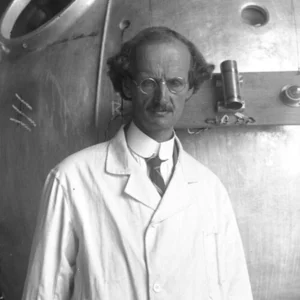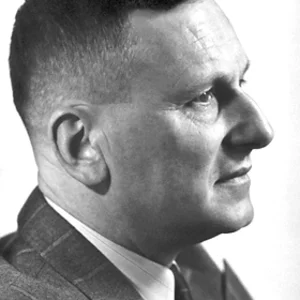

Swiss chemist (1899–1965), Paul Hermann Müller synthesized DDT in 1939 and discovered its insecticidal properties. This discovery earned him the Nobel Prize in Physiology or Medicine in 1948, although DDT is now banned for its harmful environmental effects.
Paul Hermann Müller(1899 — 1965)
Paul Hermann Müller
Suisse
8 min read
Frequently asked questions
Key Facts
- Born on January 12, 1899, in Olten, Switzerland
- Synthesized DDT in 1939 at Geigy and discovered its insecticidal properties
- Nobel Prize in Physiology or Medicine in 1948 for this discovery
- DDT helped eradicate typhus and reduce malaria during and after World War II
- Died on October 12, 1965, in Basel; DDT was progressively banned from the 1970s onward due to its persistence in the environment
Works & Achievements
The founding discovery of Müller's career: the synthesis of dichlorodiphenyltrichloroethane and the demonstration of its ability to kill insects on contact alone. This achievement transformed the fight against vector-borne diseases in the twentieth century.
Legal protection of the discovery, enabling Geigy to produce and market DDT on a global scale. This patent paved the way for the mass industrialisation of the pesticide.
A scientific address delivered at the Nobel Prize ceremony, in which Müller describes his systematic research method and the properties of DDT. This text remains a landmark reference in the history of insecticide chemistry.
Although Müller was not its author, his discovery of DDT was the scientific cornerstone of this programme launched by the WHO. It made it possible to drastically reduce malaria mortality across many regions of the world.
Anecdotes
To test his compounds, Paul Hermann Müller built a special glass cage he called his 'fly cage'. He would seal insects inside and meticulously observe the effect of each substance. After testing more than 300 compounds without satisfactory results, he applied to the walls of the cage a product he had synthesized in September 1939: the flies dropped dead within seconds. It was DDT.
During the typhus epidemic in Naples in 1943–1944, Allied authorities had thousands of Italian civilians dusted with DDT powder to eradicate the lice carrying the disease. It was the first time in history that a typhus epidemic had been halted in the middle of winter. This event convinced the entire world of DDT's devastating effectiveness.
When Müller received the Nobel Prize in Physiology or Medicine in 1948, many were surprised that a chemist was being honored with this award rather than the Chemistry Prize. The Nobel Committee justified its choice by emphasizing that the discovery of DDT's insecticidal properties had saved millions of human lives by protecting populations from malaria and typhus.
Müller was known in his laboratory for his rigorous, patient method: he recorded every experiment in detailed notebooks and refused to skip steps. His colleagues recounted that he sometimes spent entire days observing the behavior of insects under a bell jar, with nothing seeming to happen, before calmly noting his conclusions.
As early as the 1950s, scientists began reporting the presence of DDT in animal organisms far from treated areas, particularly in birds of prey whose eggs were becoming abnormally fragile. The 1962 publication of Rachel Carson's book 'Silent Spring' brought these warnings to the general public and ultimately led to DDT being banned in many countries — while Müller was still alive.
Primary Sources
DDT exhibits a remarkable and persistent contact toxicity for a very large number of insect species, while being, under normal conditions of use, satisfactorily harmless to warm-blooded mammals.
The compound obtained by condensation of chloral with chlorobenzene in the presence of sulfuric acid exhibits exceptional insecticidal properties and great chemical stability.
Indoor residual spraying operations with DDT conducted under the Global Malaria Eradication Programme reduced mortality from this disease by more than 50% in treated regions between 1955 and 1965.
DDT and other chlorinated pesticides accumulate in food chains, reaching lethal concentrations in top predators. The thinning of raptor eggshells is the most dramatic illustration of this.
Paul Hermann Müller rendered a first-rate service to humanity by discovering the insecticidal properties of DDT, thus enabling the control of vector-borne diseases responsible for millions of deaths each year.
Key Places
Birthplace of Paul Hermann Müller, born on January 12, 1899. An industrial town in the canton of Solothurn, it embodies the working-class and artisan environment in which the future Nobel laureate grew up.
The site where Müller spent his entire career and where he synthesized DDT in 1939. This Basel-based chemical company, founded in 1758, is now part of the Novartis group.
The city where DDT was first used on a large scale on a human population in 1943–1944, during a typhus epidemic. This application spectacularly validated the effectiveness of Müller's discovery.
The Scandinavian capital where Paul Hermann Müller received his Nobel Prize in Physiology or Medicine on December 10, 1948, at a solemn ceremony held at the City Hall.
The city where Müller lived and worked for most of his adult life, and where he died on October 12, 1965. Basel is the heart of the Swiss chemical and pharmaceutical industry.
Typical Objects

An experimental device designed by Müller himself to test the effect of insecticidal compounds on live insects. It was in this cage that he first observed the devastating power of DDT.

Müller meticulously recorded every experiment in numbered notebooks, noting chemical formulas, dosages, and results on insects. These notebooks form the archive of his rigorous scientific approach.

A central tool of synthetic organic chemistry, used to prepare and heat the chemical compounds being tested. Hundreds of syntheses were carried out by Müller in such vessels before the discovery of DDT.

A protective garment worn daily in the Geigy laboratories, a symbol of the scientific rigor of the era. It shielded Müller from chemical splashes during his many experiments.

A device used to disperse DDT in powder form during the first field applications. This type of tool was deployed on a massive scale during the anti-malaria and anti-typhus campaigns of the Second World War.

Presented to Müller in December 1948 in Stockholm, this gold medal represents one of the highest scientific distinctions in the world. It symbolizes the international recognition of the medical impact of his discovery.
School Curriculum
Vocabulary & Tags
Key Vocabulary
Daily Life
Morning
Müller arrived early at the Geigy laboratories in Basel, often by seven o'clock. He would begin his day by reviewing the previous day's notebooks, planning the chemical syntheses to be carried out. The morning was devoted to the most delicate procedures, requiring maximum concentration.
Afternoon
In the afternoons, he would observe and record the results of his experiments on insects in his glass cage, sometimes for several hours at a time. He also took part in team meetings at Geigy, exchanging ideas with his fellow chemists about the progress of research and promising new leads.
Evening
In the evenings, Müller returned to his Basel home and devoted himself to his family. A reserved and unsociable man, he would sometimes spend his evenings reading specialist scientific journals on entomology or organic chemistry, constantly keeping abreast of the latest publications.
Food
Like most German-speaking Swiss of his generation, Müller followed a simple, hearty diet: bread, cheese, cold cuts, seasonal vegetables, and meat at main meals. Lunch in the Geigy canteen was often an opportunity for informal exchanges with colleagues.
Clothing
In the laboratory, Müller invariably wore a buttoned white coat, essential for protection from chemicals. Outside of work, he dressed plainly in the bourgeois Swiss fashion of the 1930s–1950s: dark suit, white shirt, and a hat when going out.
Housing
Müller lived in a comfortable apartment in a residential district of Basel, befitting the status of a senior scientist in the chemical industry. Basel housing of the era was characterized by solid stone buildings with large, well-lit apartments.
Historical Timeline
Period Vocabulary
Liens externes & ressources
Références
Œuvres
Synthèse et étude des propriétés insecticides du DDT
1939
Brevet international sur le DDT (déposé par Geigy)
1942
Conférence Nobel : 'Dichlordiphenyltrichloräthan und neuere Insektizide'
1948
Programme mondial d'éradication du paludisme (contribution indirecte)
1955