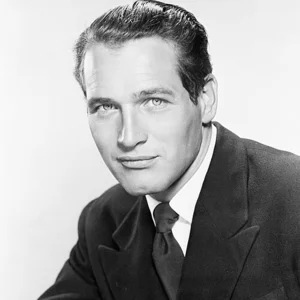

Paul Newman was an American actor and a major figure of Hollywood cinema in the second half of the 20th century. Renowned for his charisma and the exceptional longevity of his career, he was also a racing driver and a committed philanthropist.
Paul Newman(1925 — 2008)
Paul Newman
États-Unis
5 min read
Frequently asked questions
Key Facts
- Born in 1925 in Cleveland (Ohio), he trained at the Actors Studio in New York in the 1950s.
- Came to prominence in films such as “Cat on a Hot Tin Roof” (1958) and “The Hustler” (1961).
- Starred alongside Robert Redford in the title roles of “Butch Cassidy and the Sundance Kid” (1969) and “The Sting” (1973).
- Won the Academy Award for Best Actor in 1987 for “The Color of Money”.
- Founded the charitable food brand “Newman's Own” in 1982, donating its profits to good causes; he died in 2008.
Works & Achievements
Adaptation of the Tennessee Williams play that introduced Newman to a wide audience and earned him an Oscar nomination.
Newman plays “Fast Eddie” Felson, an ambitious pool player; a role that became iconic.
Portrait of a rebellious prisoner, one of his most memorable roles on the theme of individual defiance.
An iconic Western that paired him with Robert Redford in one of cinema's most famous duos.
A con-artist comedy reuniting him with Redford, showered with Oscars and a huge popular success.
Sequel to “The Hustler” directed by Martin Scorsese, which finally earned him the Oscar for Best Actor.
One of his last major roles, which brought him a final Oscar nomination.
A food brand whose profits are all donated to charity, which became his great philanthropic legacy.
Anecdotes
Paul Newman had eyes of such an intense blue that they became his trademark. When the film "In Cold Blood
(1967) was shot
the story goes that a director wanted to film it in black and white partly so as not to
waste" that gaze; in reality, Newman was color-blind and often joked about his difficulty telling certain colors apart.
Passionate about car racing ever since filming "Winning
(1969)
Newman became a professional driver at over 45 years old. In 1979
he finished second at the prestigious 24 Hours of Le Mans
proving he was not merely a famous amateur but a genuine competitor.
In 1982, Newman launched a line of dressings and sauces
Newman's Own
at first as a joke among friends. He decided to give away all of the profits to charity: within a few decades, the company had donated hundreds of millions of dollars to good causes.
Newman was nominated for the Oscars ten times but only won the Best Actor statuette in 1987, for "The Color of Money." Weary of his previous defeats, he had refused to attend the ceremony, convinced he would lose once again.
With his wife
the actress Joanne Woodward
whom he married in 1958
Newman formed one of the most enduring couples in Hollywood. Asked about his faithfulness
he is said to have delivered the line that became famous:
Why go out for hamburger when you have steak at home?
Primary Sources
Newman was honored for “his many and memorable and compelling screen performances and for his personal integrity and dedication to his craft.”
The pledge to donate 100% of after-tax profits and royalties to charitable causes.
A collection of transcripts from interviews recorded by Newman and those close to him, retracing his life in his own words.
Key Places
Affluent suburb of Cleveland where Paul Newman was born in 1925 and grew up.
New York drama school where Newman trained in “the Method,” alongside other great actors of his generation.
Center of the American film industry where Newman shot most of his movies.
Famous endurance race where Newman, a passionate driver, finished second in 1979.
Town where Newman lived much of his life with his family and where he died in 2008.
Typical Objects

Newman's piercing blue gaze became his visual signature, showcased on posters and set photographs.

Central object of “The Hustler” and “The Color of Money,” in which Newman plays the pool player Fast Eddie Felson.

Race-car driver's gear that Newman wore on the track, notably during his appearances at the 24 Hours of Le Mans.

Newman drove for and backed motor-racing teams; racing was his great passion alongside cinema.

The founding food product of his charitable brand, whose label bears his own portrait.

The highest honor in American cinema, which he won in 1987 for “The Color of Money” after many nominations.
School Curriculum
Vocabulary & Tags
Key Vocabulary
Tags
Daily Life
Morning
During filming, Newman would get up early for makeup and scene preparation. Off set, he liked to start his days outdoors, devoted to a simple life far from Hollywood glamour.
Afternoon
His afternoons might be spent working on scenes, reading scripts or, starting in the 1970s, training and practicing on the racing circuits he was so fond of.
Evening
In the evening, Newman favored family life with Joanne Woodward and their children, steering clear of social events. He enjoyed quiet evenings, sometimes over a beer, of which he was a great connoisseur.
Food
Newman liked simple, convivial food: salads, popcorn, and homemade sauces that later inspired his brand "Newman's Own." He was known for his pronounced taste for beer.
Clothing
In everyday life, he cultivated an understated, casual style — jeans, a shirt, sunglasses — far from the extravagance of the stars. On the racetrack, he slipped into a driver's suit and helmet.
Housing
Rather than living permanently in Hollywood, Newman settled with his family in Westport, Connecticut, seeking a discreet, grounded life away from the spotlight.
Historical Timeline
Period Vocabulary
Liens externes & ressources
Références
Œuvres
La Chatte sur un toit brûlant
1958
L'Arnaqueur (The Hustler)
1961
Luke la main froide (Cool Hand Luke)
1967
L'Arnaque (The Sting)
1973
La Couleur de l'argent
1986
Les Sentiers de la perdition
2002